

Photo caption: The virtual reality roadwork environment created by Kang during his internship was designed to help users experience traffic management scenarios in a safe, simulated setting. ArtStation - VR Training Module, Kevin Kang
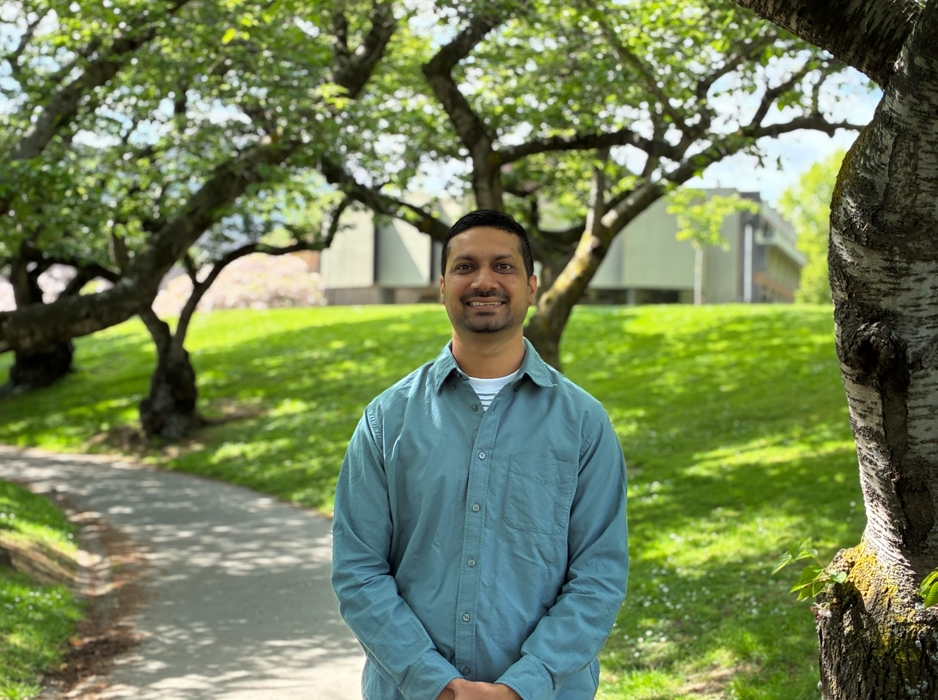
Photo caption: UC Game Arts honours student Kevin Kang explored how digital screen skills can be applied beyond games and animation during a summer internship with Fulton Hogan.
Bachelor of Digital Screen with Honours (Game Arts) student Kevin Kang is currently in his fourth and final year at Te Whare Wānanga o Waitaha | University of Canterbury (UC). Originally studying Applied Immersive Game Design before moving into Game Arts when the Digital Screen Programme launched at UC, Kang says the shift has helped him focus on the part of the creative process he was most drawn to: building visual worlds, characters and digital experiences.
“I loved the visual side of digital media such as games, films, and animation. Especially because all those mediums are starting to converge and overlap each other in many ways,” Kang says.
“I was always interested in 3D and digital artwork as a medium. I think there's always a charm in technical ways to tackle art.”
However, it was the broad foundation of his course that helped Kevin take on a summer internship with Fulton Hogan, where he used virtual reality (VR) to explore workplace health and safety.
After researching VR training modules, reading incident reports and speaking with staff, Kang created a VR traffic management scenario, which placed users in a roadwork environment, using stop/go signs while traffic moved around them.
“I think VR is really good for like, replicating events that are dangerous and impossible to train for in real life, such as out-of-control cars going past the worksite,” Kang says.
“I utilised what I’ve learnt such as the theory and concept and was able to swiftly implement relevant assets and features into the internship project.”
Kevin says the programme’s strength is that students do not learn one isolated skill. Rather than preparing him for one narrow role, Kang says his course is helping him understand how different parts of a project fit together. That matters in creative industries, but it also matters in workplaces where digital tools are being used to solve practical problems.
“What they look for in the industry is how well you can fit in between pipelines and work. And if you understand the pipeline, then you'll have an easier time understanding what to do in the industry rather than just focusing on one thing.”
The internship also broadened Kevin’s view of where his skills could take him. While he is still interested in the game industry, he is also considering opportunities in areas such as engineering and visualisation.
“I didn’t know that my skillsets could be easily translated to visualisation part of the industry. I would definitely look into the visualisation industry as a career in the future.”
His advice to other students is to stay open to opportunities, even when a role does not look like an obvious fit at first.
“Be open to learning new things. And don’t give up on applying just because you think you lack a certain skill.”


.png)