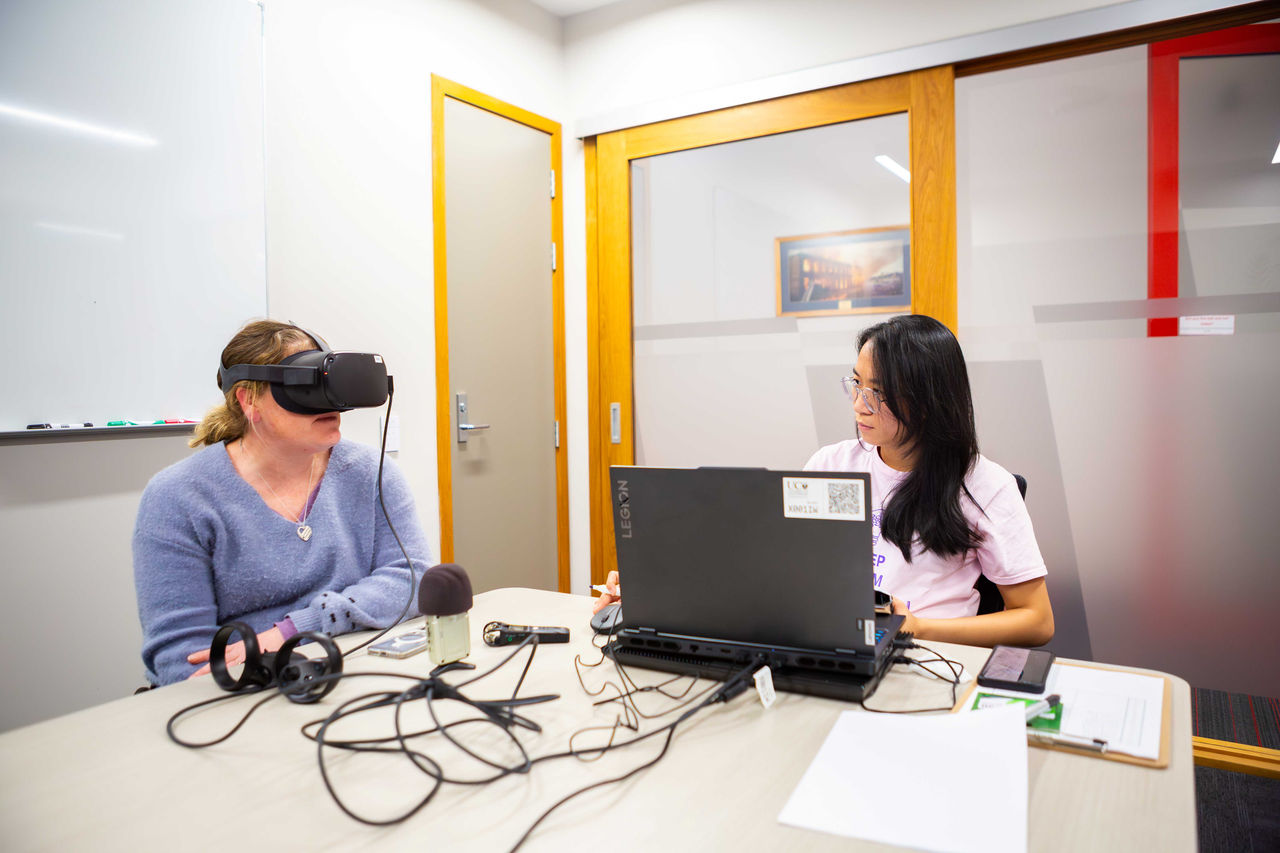


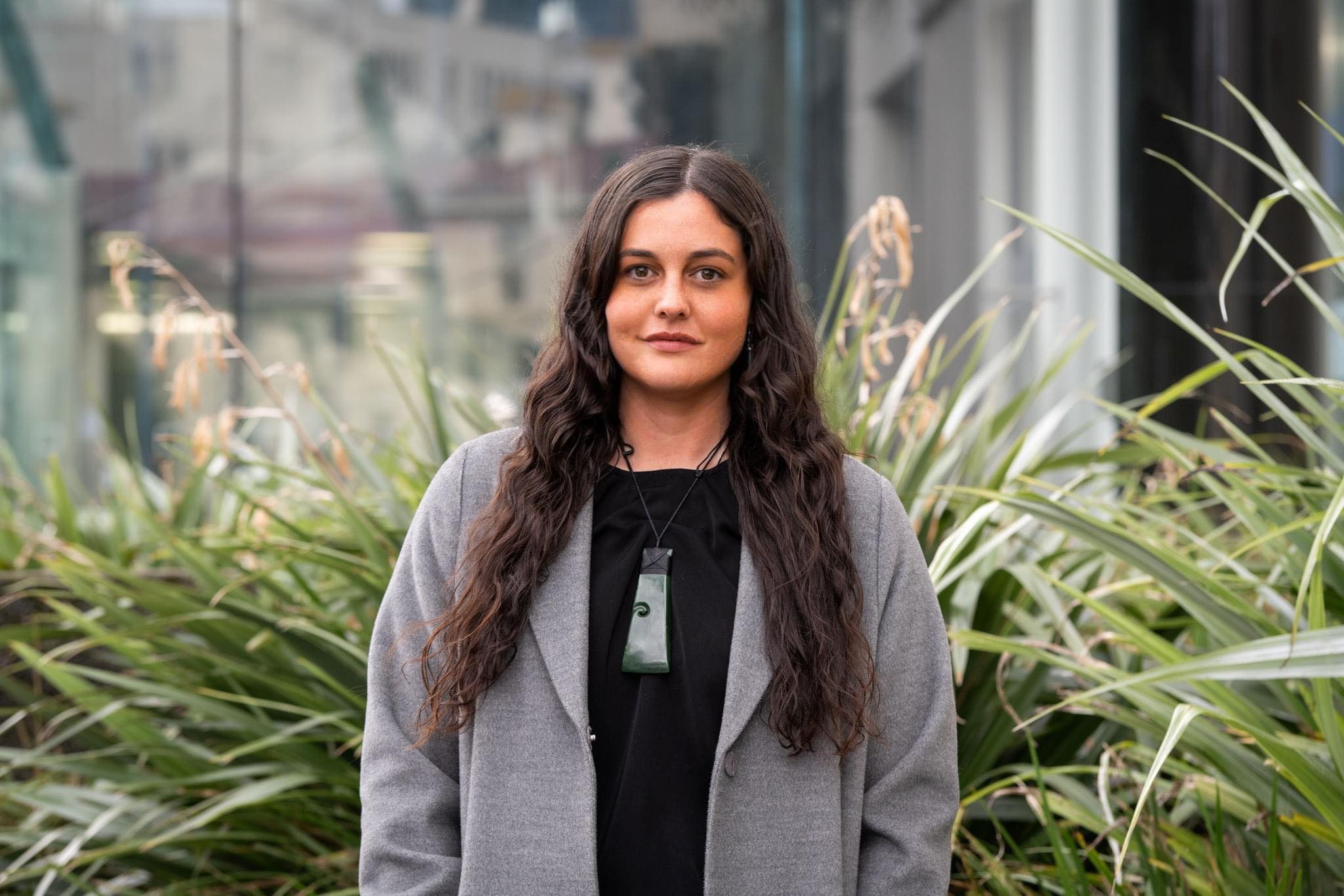
Photo caption: A UC master’s student is using VR to identify how fire evacuation systems can be improved for people in wheelchairs.
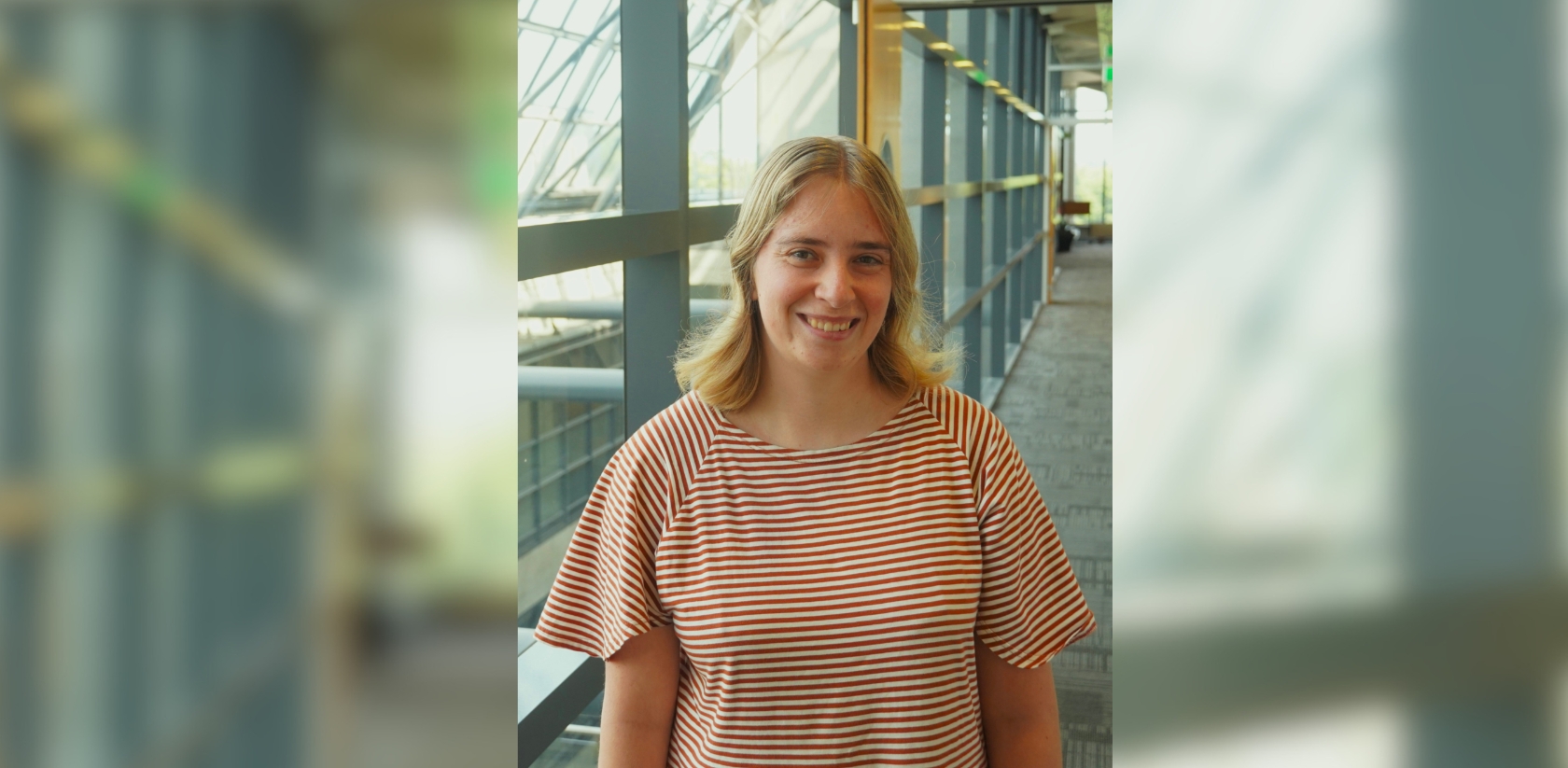
Wing Yiu Ma, a Master of Fire Engineering student at Te Whare Wānanga o Waitaha | University of Canterbury (UC), has enlisted 16 people in wheelchairs to take part in a series of practical experiments using Virtual Reality (VR).
The VR programme, which Ma helped develop, allows the participants to feel they are in a multi-storey building that’s being evacuated, complete with the sound of a siren in the background.
Ma says it’s very important the research is co-creational, meaning the participants are actively involved and have input into the design of evacuation systems.
Many of the participants have commented on the usefulness of VR as a tool, she says. “Usually these kinds of studies to improve designs for people with mobility impairment are done through questionnaires or interviews. But in those scenarios, it's quite hard for them to visualise what is actually happening in a 3D environment.
“With VR, we can give them visual cues not only to the design features but also include sounds, such as the fire siren. The interactions and the experience are much more realistic and that means they can give a more realistic estimate of how they would behave.”
In the first round of experiments the participants experienced three VR scenarios either with basic signage that identified either an area of refuge, a safe place where a person in a wheelchair can wait to be evacuated or provided direction to an occupant evacuation lift; or a control scenario without any signage.
They were asked open-ended questions about the scenarios and how it could be improved, such as what information they would need and how they would like it to be communicated.
In the second stage, the same group of people tried the scenarios again, but this time with improved design features based on the feedback they’d given. This included clearer, more visual fire action notices accompanied by green indicative signage placed in easier-to-spot locations, and a scenario providing an intercom system so they could communicate with someone giving information and instructions. They were asked how useful these improvements were.
“The message that came out quite strongly is that people in wheelchairs want to have a person, whether that’s through an intercom or a fire warden, to give them information about what’s happening,” Ma says. “They want someone to know that they’re in the building and to know someone is going to help them.
“That’s even more important when people are waiting in a place of refuge rather than being able to evacuate themselves through a lift. Because in that kind of situation, people seek more comfort and more communication. They’re just waiting, and they need to feel safe.”
In the final round of the experiment, which is currently underway, a new group of participants who haven’t previously experienced the environment, will be asked for their reactions to the updated design.
Ma’s research is supervised by Amy Harpur at Fire Emergency New Zealand (FENZ) and UC Civil and Environmental Engineering Professor Daniel Nilsson. Professor Nilsson says involving people who are in a wheelchair in the design of evacuation systems is critical.
“We don’t fully understand the evacuation challenges they go through – even something as simple as what height a lift button should be for someone in a wheelchair, or whether the button is placed in the middle of a wall or in a corner, can be difficult for a person who does not use a wheelchair to understand.
“We’ve seen over and over again that unless you ask the people in a realistic setting, how they interpret the situation and how they would like it to change, you will introduce design mistakes. And that's going to be potentially dangerous.”
Ma says it has been a privilege to hear the stories of people taking part in the experiment. “Not only do they talk about how they feel about the evacuation designs, they also talk about their past experiences. Some of them mentioned that people have told them they don’t need to take part in fire drills because it’s too troublesome to get someone to help them. I think it’s sad that they haven’t been familiarised on what to do during a fire situation.”
She says the participants have welcomed her study because it makes them feel heard and she hopes it will have a real-world impact. “I think the engineering community needs to find good solutions to address these information needs, and that’s the next step.”
Ma’s research has been funded by the Building Research Association of New Zealand (BRANZ), GHD consulting and Halliwell Group, with support from FENZ and the Building Innovation Partnership (BIP).
It is part of a wider project, "Changing evacuation behaviour to meet densified housing needs for our current and future population" which runs until the end of August this year.
.png)