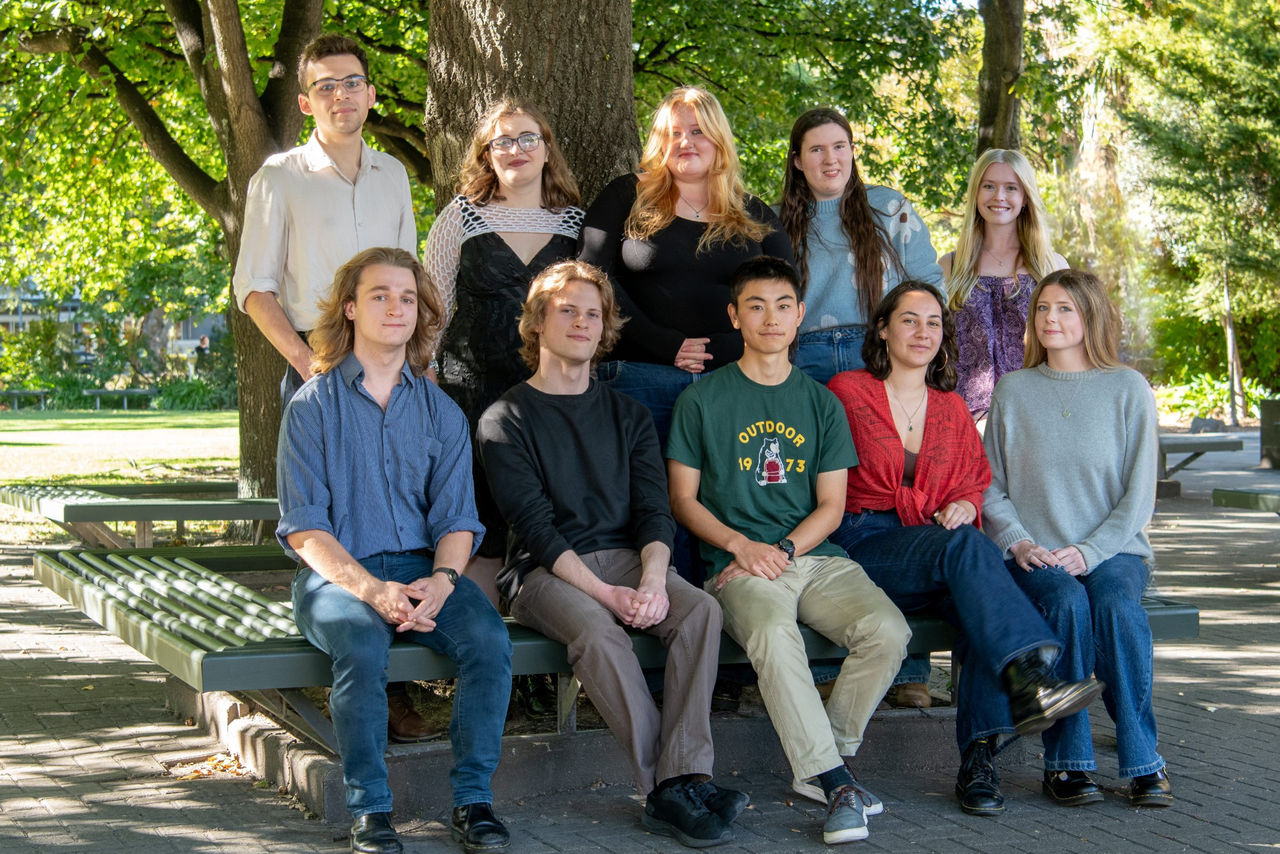


Photo caption: UC Nanobrew team: (backrow left to right) Samuel Ramsay, Rosie McCormick, Bella Marsh, Thea-Rose Willcocks, Aislinn Prest (font row) Charles Cadillac, JP Opperman, Kaito Ito, Jade Wilson, Grace Baragwanath
A team of Te Whare Wānanga o Waitaha | University of Canterbury (UC) students has started lab testing to see whether spent grain from breweries can be turned into nanocellulose, a high-performance material used in everything from electronic circuit boards to cosmetics.
The project, called Nanobrew, tackles one of the brewing industry’s biggest waste streams. Approximately 85% of brewing waste is spent grain, which spoils so quickly it must be collected the same day or become unusable.
The nature of the grains makes them difficult to compost, forcing breweries to either sell it at a significant loss as low-value animal feed or send it to landfill, where it contributes to substantial carbon emissions.
“Brewers have to organise farmers to come and pick up the waste on the same day that they do the brewing, and if it's not that same day, then it's gone off and it can't be fed to animals,” says Jade Wilson, a third-year biochemistry student and Nanobrew team member.
What makes the project particularly compelling is the potential value the students hope to extract. Nanocellulose is a tiny, high-performance fibre with a global market value in the billions of dollars, thanks to its diverse applications. UC School of Product Design researchers, Dr Ali Nazmi and Dr Hossein Zadeh, are already developing products from nanocellulose, including wound dressings, oil remediation, cosmetic formulations, and potentially also plastic substitutes.
“It's one of those new, really exciting materials, so it's being explored in a range of applications,” Wilson says, citing research into tissue regeneration and biodegradable polymers. For the brewing industry, the opportunity is significant: transforming their largest waste stream into a valuable commodity, potentially creating packaging or containers from their own byproducts.
The team of 10 UC student biochemists, biologists and engineers is working with a local brewery, brewing industry-focused organisations, Leo Vanhanen, and breweries in other parts of the country as they test the concept over the coming months.
Their results will be judged as part of the international Genetically Engineered Machine (iGEM) synthetic biology competition that culminates in a jamboree in Paris this November with over 2,000 participants.
The students' approach combines cutting-edge synthetic biology with practical engineering. They plan to use two specialised enzymes to break down the complex plant structures surrounding cellulose fibres in barley grain, then further process those fibres into nano-scale particles.
One enzyme is particularly innovative: an ancestral endoglucanase reconstructed from computer analysis of proteins across different species throughout evolutionary time. This hypothetical enzyme, which never actually existed in nature but represents the theoretical ancestor of modern enzymes, has been shown to be more thermally stable and resistant to different conditions than naturally occurring versions.
“These conserved regions imbue more thermostable properties to the enzyme, meaning it stays active at high temperatures,” explains Dr Amy Yewdall, UC researcher and Principal Investigator at the Biomolecular Interaction Centre, who is mentoring the team. "We're basing this research on a paper that was published by another group, taking that work and applying it in this context."
The goal is to design a bioreactor, which is essentially a large vat where bacteria produce the enzymes that break down the spent grain, yielding nanocellulose at the other end.
This marks the second time UC has integrated the iGEM competition into an undergraduate course, giving third-year students the rare opportunity to design and execute a complete research project from ideation through to international presentation. “It's not often that undergraduates get to do a full research project that's their idea from the very start,” Wilson says. “We're very lucky, very grateful to our mentors: Amy, Kelsi, Myles, and Mackenzie.”
Regardless of whether their specific approach succeeds, the students emphasise that their findings will contribute to future research. If successful, Nanobrew could offer New Zealand breweries an opportunity to lead globally in sustainability while tapping into a billion-dollar material market — all from what they currently throw away.
The team expects preliminary results within a few months, with all research completed by October ahead of the Paris competition. They plan to share their findings with the local community, including their brewery partners, when they return in December.
If you’d like to support the Nanobrew team on their journey to the iGEM jamboree in Paris, click here.
.png)