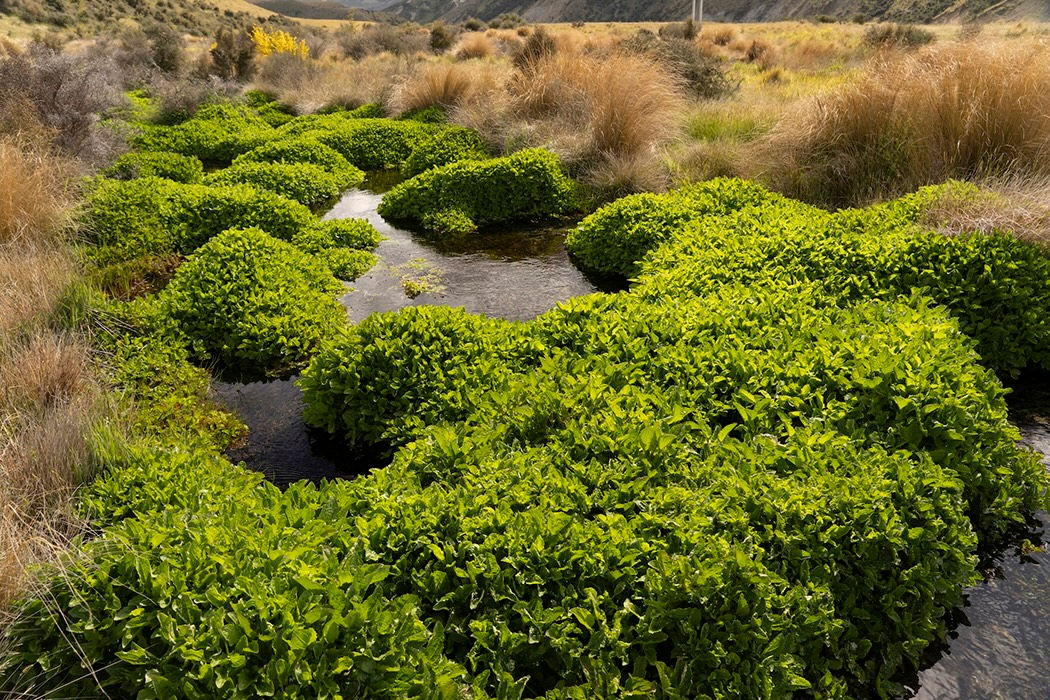


Photo description: The spread of aquatic weeds in Aotearoa New Zealand’s high-country springs is destroying habitats relied on by native invertebrates.
Key points
- Aquatic plants such as monkey musk and watercress, known to cause problems in lowland waterways, are rapidly expanding in high-country springs in the upper Waimakariri Valley, transforming freshwater habitats and communities.
- More than two decades of observations, together with new approaches to monitoring and experiments, are helping researchers understand why these changes are occurring, how they affect spring ecosystems, and how best to respond.
- UC researchers are working with DOC, Lincoln University, mana whenua and other partners to inform management that protects biodiversity while recognising multiple values, including watercress as mahinga kai.
Detecting change in high-country freshwater ecosystems
High-country springs are among Aotearoa New Zealand's most distinctive freshwater habitats. Fed by cold, clear and remarkably stable water sources, they support distinctive invertebrate and fish communities found in few other environments.
Despite their remoteness, research led by Dr Helen Warburton and Professor Angus McIntosh from UC's School of Biological Sciences has revealed major ecological change. Plants typically associated with lowland waterways, particularly monkey musk and watercress, are becoming increasingly dominant in some high-country springs, fundamentally changing these ecosystems.
The power of long-term monitoring – and experiments
A key strength of the research is the ability to draw on more than twenty years of ecological data from the same sites, collected by UC students. Long-term environmental datasets of this kind are rare, particularly in remote high-country environments. They allow researchers to move beyond simply identifying change, to also understand when it began, how quickly it occurred, and the potential factors driving it.
An important question is why these plants are expanding now. They may be behaving like 'sleeper weeds' – persisting at low abundance until environmental conditions allow rapid expansion. Nutrient enrichment seems unlikely to be the main driver in these high-country environments, but this and other factors, including warming temperatures, grazing by wildlife, and the spread of plants by people and other animals, remain under investigation.
Understanding how whole ecosystems change
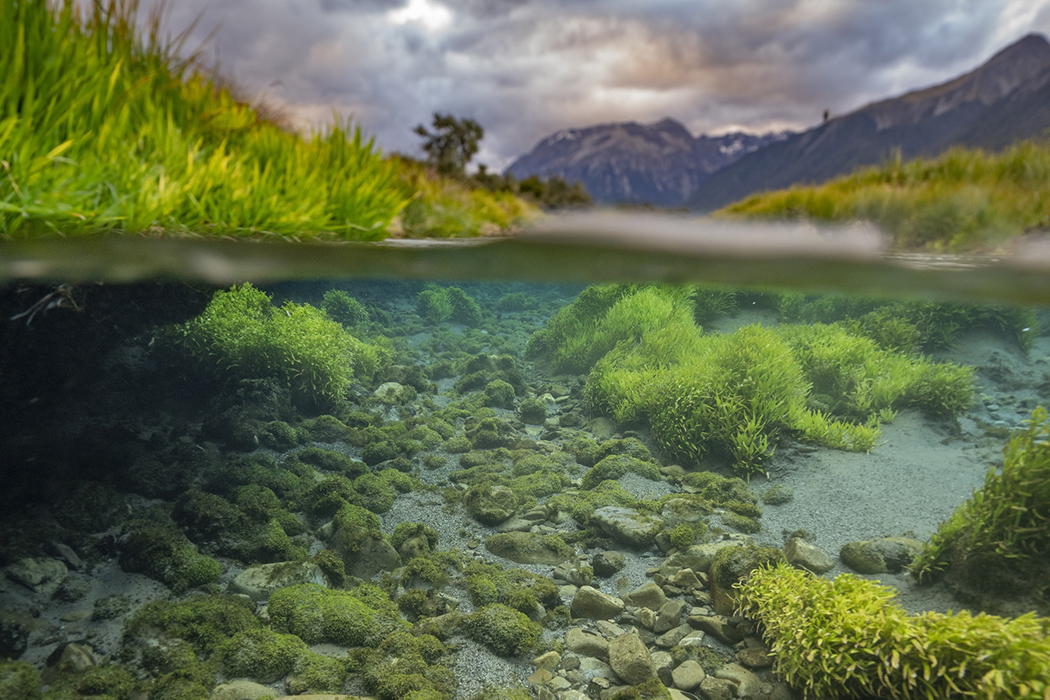
The impacts extend well beyond the plants themselves. Dense growth changes water movement and habitat structure, covering the rocky streambeds used by native invertebrates and fish. In some invaded springs, diverse invertebrate communities have shifted towards communities dominated by native mud snails, while many aquatic insects that provide important prey for fish become much less abundant. Researchers are investigating whether these changes represent an ecological 'flip' to a different state, and how difficult that change may be to reverse.
Experiments at the Cass Experimental Stream Mesocosms (CESM) complement field observations by allowing researchers to manipulate environmental conditions and tease apart processes that are difficult to separate in natural environments. These experiments have confirmed that dense plant growth can dramatically shift invertebrate communities.
The research is now examining how these changes affect wider ecosystem processes and how monitoring can be scaled up. Working with biogeochemist and ecosystem scientist Dr Naomi Wells from Lincoln University, the team is investigating how dense plant growth affects oxygen, nutrients and the movement of energy through spring ecosystems. With UC spatial data science researcher Dr Vanessa Bastos, the team is also testing whether drone and satellite imagery could help map aquatic plant cover, identify invasion fronts and monitor change across larger and more remote landscapes.
Protecting biodiversity through better understanding
The Department of Conservation has begun controlling some infestations, and researchers are working closely with DOC to ensure emerging science can inform future monitoring and management. Protecting high-country springs is not simply a question of removing every non-native plant. Watercress, while introduced and capable of transforming spring ecosystems when it becomes dominant, is also an important mahinga kai species. Working with Professor Shaun Ogilvie, the researchers are exploring what this means for the future of watercress harvest and how high-country waterscapes might be managed for multiple ecological and cultural values.
Without long-term monitoring, we would never have known how quickly these changes were occurring. Some springs have changed dramatically in just two decades, highlighting how vulnerable even remote ecosystems can be.– Dr Helen Warburton
Effective long-term management will require a coordinated, science-informed approach involving landowners, agencies, mana whenua and local communities. There is still an opportunity to make a difference: while some springs have undergone substantial ecological change, others remain largely unaffected, allowing for early and targeted intervention.
Talk to Dr Helen Warburton or Professor Angus McIntosh about freshwater ecology and invasive species, and biodiversity management at Cass.
Last updated: October 2026
Related topics
Research Commitments
Enabling Infrastructure
Sustainable Development Goals (SDGs)


Contact


We acknowledge funding for this work from the Brian Mason Scientific and Technical Trust and the Department of Conservation.