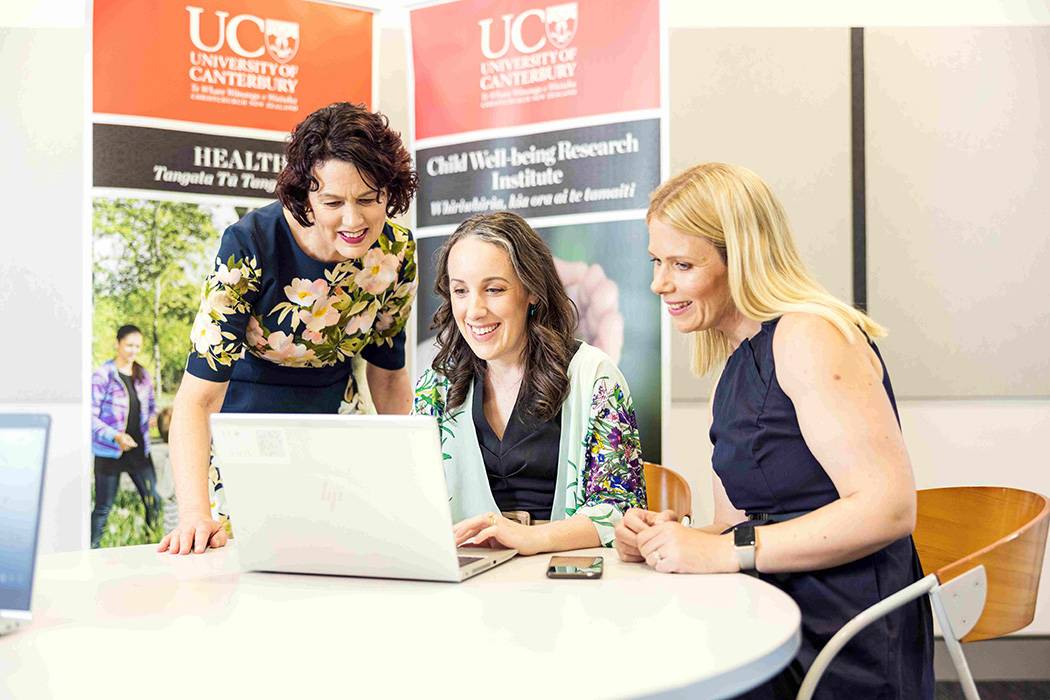


Photo caption: University of Canterbury researchers Professor Gail Gillon, Dr Amy Scott, and Professor Brigid McNeill of the Child Well-being Research Institute.
Key points
UC's Better Start Literacy Approach (BSLA) is accelerating children’s oral language reading and writing outcomes through structured literacy teaching.
Early gains in phonological awareness and phonics are strongly linked to children’s later reading success.
The UC BSLA team has supported more than 18,000 teachers, literacy specialists, and school leaders across 1,174 schools throughout Aotearoa New Zealand and this year expanded to the Cook Islands.
Supporting children to become confident readers
Learning to read is one of the most important milestones in a child's education. Research from the University of Canterbury’s (UC) Better Start Literacy Approach (BSLA) team, led by Professor Gail Gillon, shows that targeted, evidence-based literacy instruction can significantly improve reading, spelling, and oral language skills.
The team’s latest study led by Dr Megan Gath from UC’s Child Well-being Research Institute examined the large-scale implementation of BSLA across Aotearoa New Zealand schools, identifying the factors most strongly associated with later literacy success.
BSLA is a literacy initiative which provides explicit and structured teaching in phonics, phonological awareness, vocabulary, oral language, reading, and writing, giving teachers practical tools to support literacy development in the classroom.
The importance of early literacy skills
The research found that children who made greater progress in phonological awareness and phonics during their first months of BSLA teaching were significantly more likely to achieve proficient and advanced reading levels by Year 2.
Phonological awareness, the ability to recognise and manipulate sounds in spoken language, is a critical foundation for reading and spelling. By developing these skills early, teachers can help place children on a more confident literacy trajectory.
Research-backed support for teachers and learners
Based at UC and developed specifically for the Aotearoa New Zealand context, BSLA combines classroom teaching with targeted support for children who may be at risk of falling behind.
The programme has now supported more than 18,000 teachers, literacy specialists, and school leaders across 1,174 schools in every region of Aotearoa New Zealand, with adoption also extending to the Cook Islands.
The approach enables early identification and intervention, helping address literacy challenges before they become entrenched. The findings reinforce international evidence showing that high-quality early literacy instruction can improve achievement and reduce educational inequities.
Transforming literacy outcomes
Data from a series of studies provides strong evidence that intentional, systematic teaching of foundational literacy skills during a child's first year at school can have lasting benefits.
By supporting teachers with evidence-based practices and providing targeted support for learners, the Better Start Literacy Approach is helping schools strengthen literacy outcomes and ensure more children have the opportunity to thrive.
When children build strong foundational phonological awareness, word decoding, and oral language skills early, their reading outcomes improve significantly over time. It’s about giving every child the opportunity to become a confident, capable reader and writer.– Professor Gail Gillon
Talk to Professor Gail Gillon, Dr Megan Gath, or Professor Brigid McNeill about early literacy, structured literacy approaches, language development and educational outcomes.
Last updated: October 2026
Related topics
Research Commitments
Signature Capabilities
Sustainable Development Goals (SDGs)
Contact


We gratefully acknowledge support from the Ministry of Education.
Read other showcases
Take a look at our showcases to see UC’s research expertise in practice.