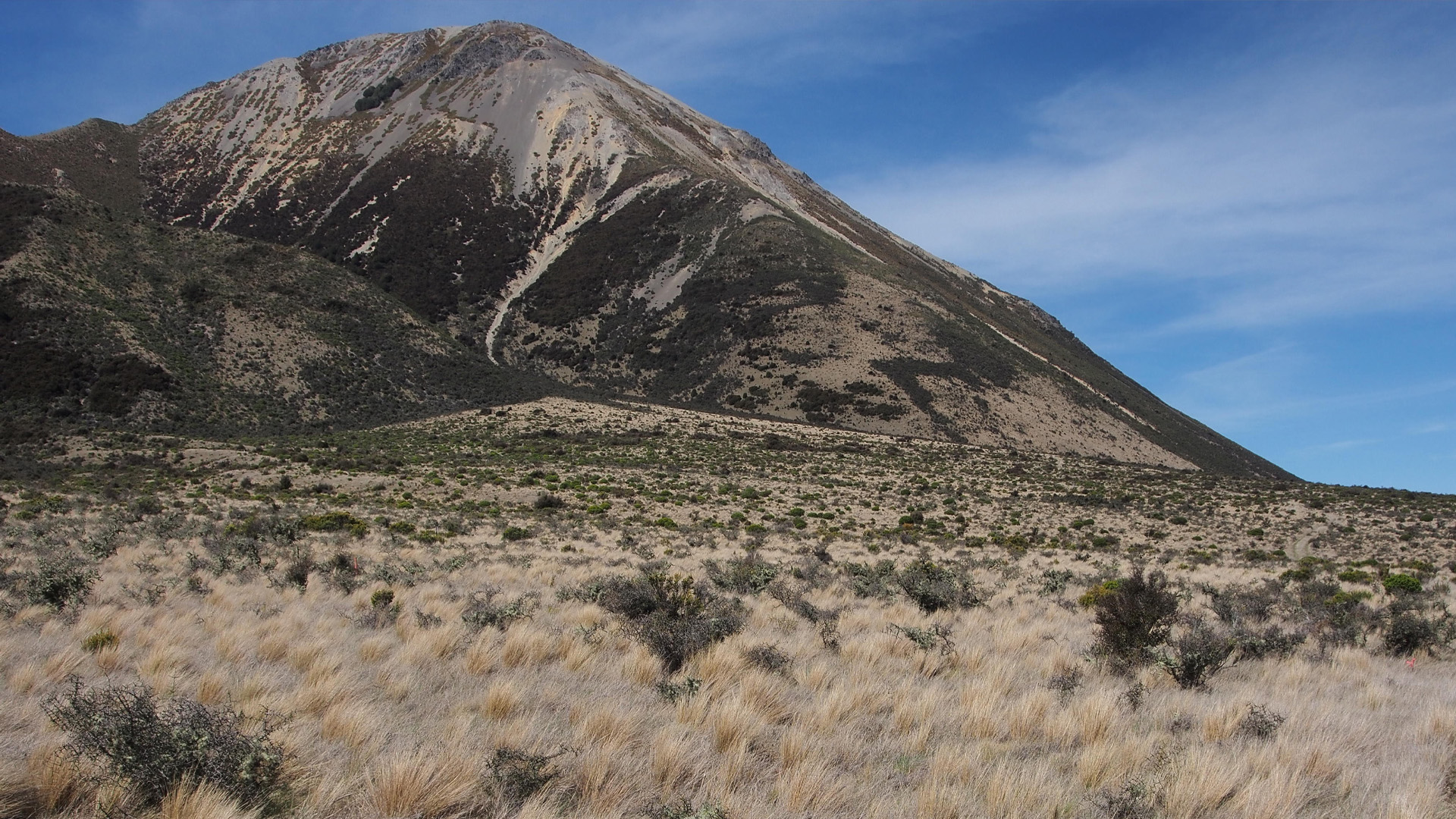


Photo caption: The Cass Mountain Research Area, location of some of Aotearoa New Zealand's longest-running ecological datasets. Photo credit: Dave Kelly.
Key points
A 60-year-long moth monitoring programme at Cass in Waitaha Canterbury has documented substantial declines in native moth abundance.
UC research is helping identify potential drivers of biodiversity change such as introduced predators and invasive plant species.
The Cass Field Station and Mountain Research Area supports a growing collection of long-term datasets and community partnerships that support biodiversity research, restoration, and environmental management.
Six decades of change in the high country
At the University of Canterbury's (UC) Cass Mountain Research Area in Waitaha Canterbury, research is benefitting from ecological monitoring efforts that began decades ago. One of the most remarkable examples is a moth survey programme that began in the early 1960s and has created one of Aotearoa New Zealand’s longest-running insect datasets.
Emeritus Professor Dave Kelly of UC’s School of Biological Sciences and previous postgraduate research student Elizabeth de Jongh, with other collaborators, revisited moth trapping sites established at Cass more than 60 years ago. By comparing surveys from the 1960s, 1980s, and 2020s, researchers documented substantial declines in native moth abundance despite relatively stable land management and little visible change in the surrounding landscape. Across the study, more than 42,000 moths representing 216 species were recorded, with the overwhelming majority being endemic to Aotearoa New Zealand. By the 2020s, moth numbers had fallen to only one-third of the numbers found in the 1960s.
Detecting such a decline in moths would not have been possible without the multi-generational commitment to undertaking repeated surveys at Cass. The findings raise important questions about what is driving biodiversity change in remote environments that have experienced relatively little development. The research suggests that introduced predators, including hedgehogs and invasive wasps, may have contributed to moth declines, while changes in vegetation and the spread of introduced grasses may have also played a role.
Long-term bird monitoring is another important part of the Cass story. Observations collected through undergraduate field trips and nearby mountain beech forest monitoring have helped researchers understand how native birds respond to predator pressure and environmental change across the wider Waimakariri high country.
Other observations analysed by UC postgraduates showed that introduced rats are moving into higher-altitude forest sites in this area because of global warming. Together with the moth studies, these datasets provide valuable insights into how different parts of ecosystems are changing through time.
Cass as a living archive of environmental change
The moth monitoring programme is just one of many long-term research initiatives based at Cass. These projects represent a rich environmental record that supports research, teaching, and conservation across the high country of Te Waipounamu South Island.
Researchers maintain datasets that include more than a century of weather observations from the Cass weather station, long-term freshwater monitoring and fish records, vegetation surveys, photographic monitoring points, flora catalogues, experimental stream studies, and biodiversity records collected by students and citizen scientists. Ecological restoration projects and observations contributed through the Cass iNaturalist Bioblitz continue to expand this unique body of knowledge.
These long-term records allow scientists to study ecological change, climate variability, and biodiversity trends at timescales rarely available elsewhere in Aotearoa New Zealand. They also inform community restoration efforts, provide valuable opportunities for student research, and help answer questions that could not have been anticipated when the datasets were first established.
Cass shows the value of patience in science. The observations collected over generations of researchers and students allow us to understand how biodiversity is changing and provide the evidence needed to respond effectively.– Emeritus Professor Dave Kelly
Talk to Emeritus Professor Dave Kelly about insect declines, predator impacts on biodiversity, long-term ecological monitoring, and the Cass Mountain Research Area.
Last updated: October 2026
Related topics
Research Commitments
Signature Capabilities
Enabling Infrastructure
Sustainable Development Goals (SDGs)

Contact

We gratefully acknowledge support from the Hellaby Indigenous Grasslands Research Trust.
Read other showcases
Take a look at our showcases to see UC’s research expertise in practice.