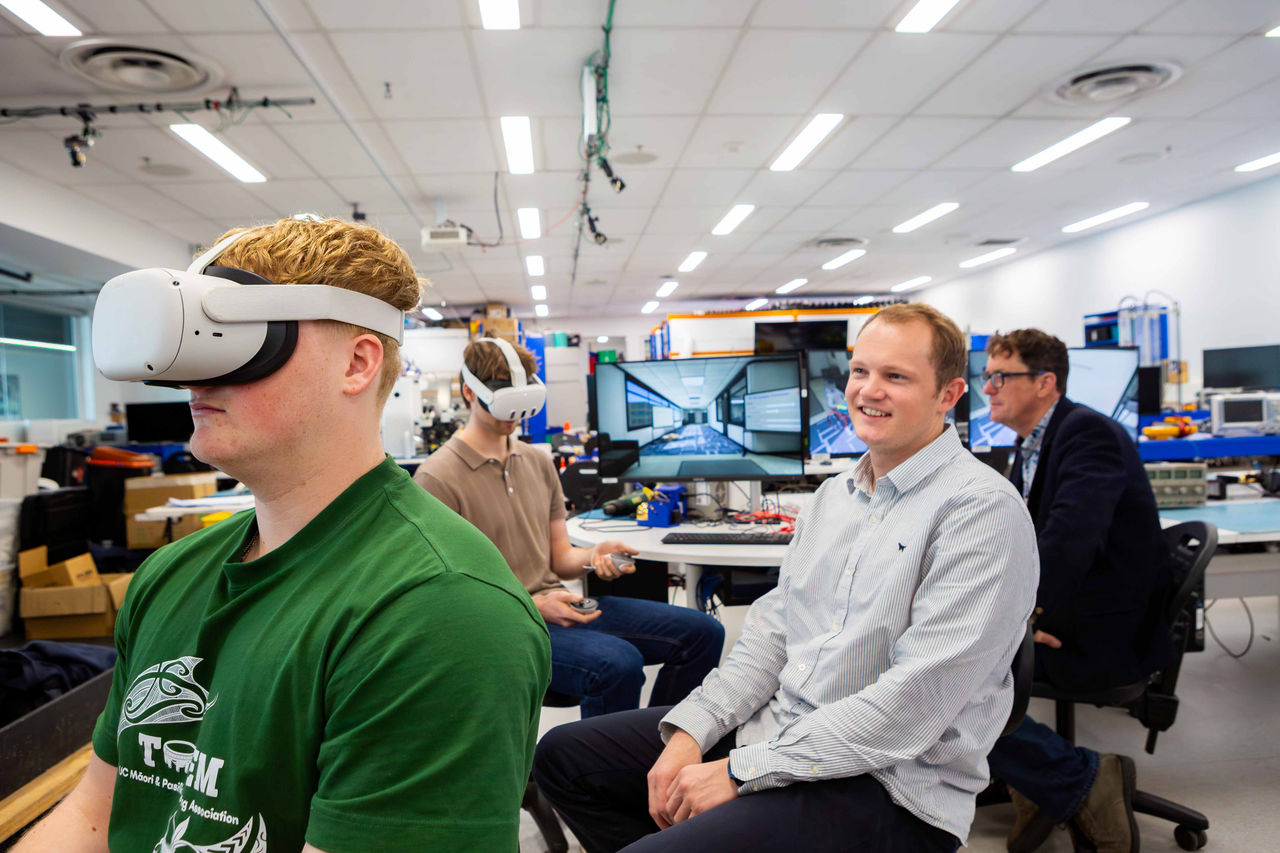


Photo caption: UC Mechanical Engineering student Julio Messenger (left) and Henry Ward with Dr George Stilwell and Associate Professor Shayne Gooch.
About 50 fourth-year students at Te Whare Wānanga o Waitaha | University of Canterbury (UC) have taken part in the new virtual reality (VR) pilot project, which is aimed at promoting human-centred designs.
UC Mechanical Engineering Lecturer Dr George Stilwell came up with the idea of using VR as a tool to give students real insight into the restrictions and hurdles that people with tetraplegia caused by cervical spinal cord injuries face every day.
“The immersive VR allows the students to understand the physical limitations first hand. This technology is one of the best things we can do to help them experience this condition and build their empathy.
“It extends our teaching and bridges the gap between knowledge and experience, helping students create really inclusive, universal designs. Otherwise, it’s easy for them to overlook barriers during the design phase.”
Fourth-year Mechanical Engineering students Henry Ward and Julio Messenger both took part in the trial. “It was incredibly useful, because it gave us a different perspective on our designs,” Henry says. “It was a bit of a ‘whoa’ moment. After using the VR I realised that the design I had in mind would require too much hand function, so I changed my design. You realise that small things really do matter.”
Julio agrees. “After being in the VR system, you start to pivot away from functional aspects and focus more on the ergonomics, which is how the design relates to the person who will be using it.
“It’s hard to realise how difficult something would be until you are in that space yourself.”
The VR technology was developed by programmer Ryan McKee in UC’s Human Interface Technology (HIT) Lab NZ with input from physiotherapist Dr Jennifer Dunn. It allows the students to experience the effects of reduced arm reach and hand function while attempting everyday tasks such as opening a door and reaching for a book on a shelf.
The new tool builds on a long-standing inclusive design programme that UC Associate Professor Shayne Gooch has taught final year Mechanical Engineering students at UC. Each year he invites New Zealand Paralympian and wheelchair rugby champion Cody Everson to speak to students about his experience as a wheelchair user following his spinal injury as a 15-year-old.
“The highest population of new cases of traumatic injuries to the spine is in males aged 15 to 25, and that is a demographic that many of the people in these classes fall into,” Associate Professor Gooch says.
“The VR means students really get involved in this design challenge. It improves their engagement and makes it real for them. The hope is that having that experience will make it more likely for them to create user-centred designs that will lead to real-world solutions for people who need these innovations in their daily lives.
“It shows students they can make a huge impact on society using the skillset they’ve developed during their degree. They can make other people’s lives better.”
This year’s design challenge involved creating a tool that would help someone with tetraplegia get access to a standard single-story New Zealand house.
The impact of the VR trial is still being evaluated but Dr Stilwell says feedback from the students who took part has been very positive. “They’ve told us it’s a useful addition to teaching activities and helps them understand other people’s perspective.
“It extends what we’re already doing and contextualises what they’ve been told. We are planning to make it part of the course next year, and we’re working on the logistics of doing that.”
Associate Professor Gooch says everything engineers design and create is for someone else, so empathy is of critical importance. “They really have to understand other people’s needs. Otherwise, they’re going to make something that people don’t want to use or interact with, and it won’t be successful.”
The VR project was supported by a UC Faculty of Engineering Strategic Research Grant.

.png)