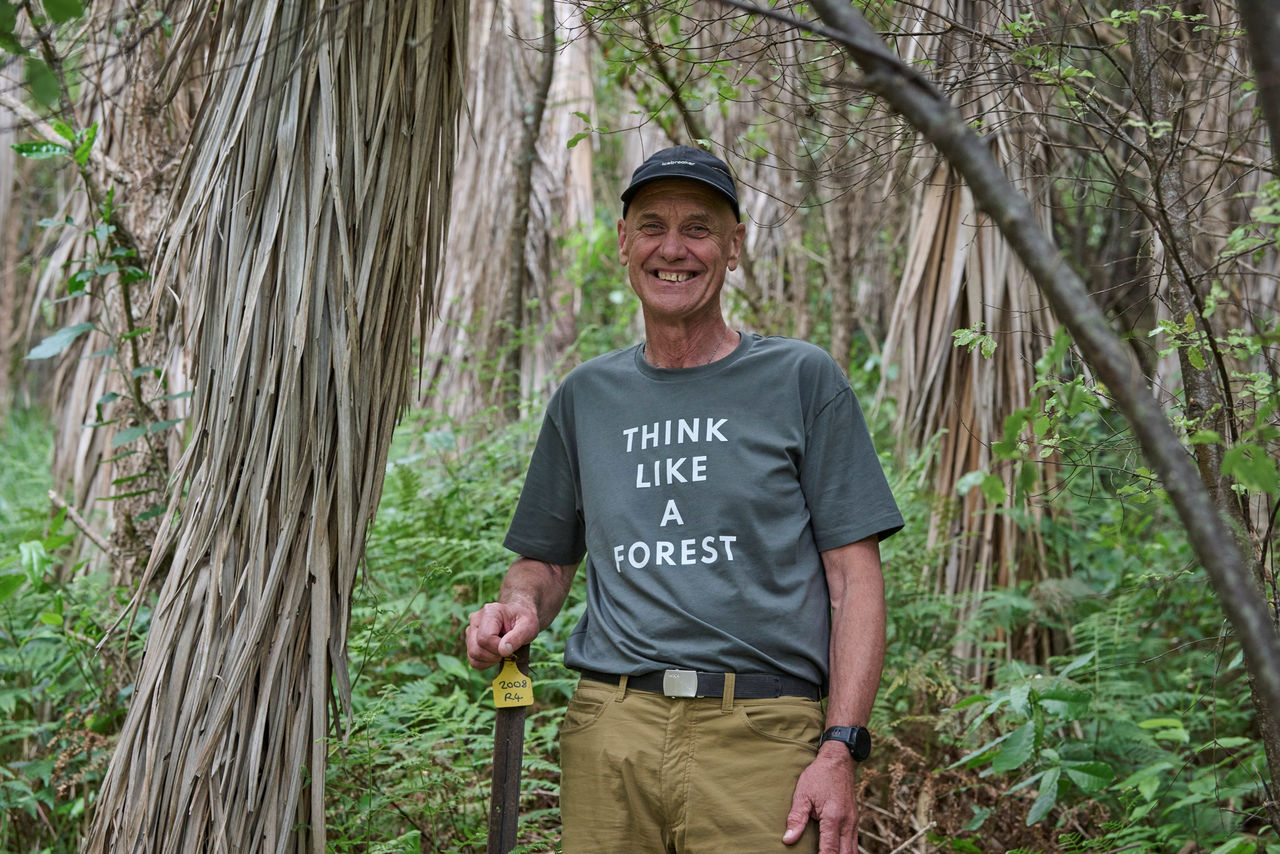


Photo caption: UC Emeritus Professor David Norton is calling for a national deer management strategy to protect Aotearoa New Zealand’s native forests. (Photo credit: Alistair Guthrie, Pure Advantage)
Led by Te Whare Wānanga o Waitaha | University of Canterbury (UC) Emeritus Professor David Norton, the paper Deer in the headlights: sleepwalking our way to a native forest catastrophe warns of a slowly developing crisis that is often hard to see.
“Our mature trees can live for three, four or five hundred years, so we’re looking at centuries-long replacement cycles and aren’t seeing changes happening overnight,” Emeritus Professor Norton says.
“You can walk into a forest and see a beautiful canopy, but there may be nothing underneath it except moss because deer have taken out the intermediate layer. The forest is still there and looks beautiful, but when it goes through its replacement cycle, a lot of those elements like seedlings and shrubs aren’t there anymore.”
The damage caused by deer go beyond just eating plants, Emeritus Professor Norton says.
“Deer also damage forests by trampling the forest floor. Unlike moa, the large native birds that once moved through New Zealand forests on broad, avian feet, deer have narrow, cloven hooves that exert much greater pressure on the ground. This removes leaf litter, compacts the soil and can affect water infiltration and overall soil health.
“While as an ecologist I would like to see no deer in New Zealand, this is not going to happen because they’ve also got social value, so I think we need to look at New Zealand native forests and ask: what areas are high priority for biodiversity conservation and climate change resilience, areas where we should be trying to get rid of all deer, and where can we accept the presence of a well-managed deer herd for recreational hunting?
“We need to work in partnership — hunters and conservationists, farmers, and plantation foresters, government and iwi — because we all want to have a liveable country and we want this environment to be here in the future.”
Before people arrived, around 75 to 80 per cent of Aotearoa New Zealand was covered in native forest. Today, that figure is about 25 to 30 per cent, Emeritus Professor Norton says.
He says native forests provide more than recreational value for New Zealanders. “Our forests provide us with a massive amount of resilience. They’re a huge store of carbon, they provide habitat for so much of our flora and fauna, and they protect our watersheds and look after our downstream human communities.
“If forests start collapsing or changing and we have intense rainfall events, which are increasing due to climate change, less water and sediment will be held back in the system, and we will see more damage downstream.
“Broadleaf is a really good example of deer impacts. You can see the foliage starts up at the height a deer browses to and there’s nothing below that. At some point, when those trees die, there are no more seedlings coming in and it will disappear.”
Deer were introduced to Aotearoa New Zealand in the late 1800s, partly to establish a recreational hunting resource. Initially protected to allow populations to become established, deer numbers increased rapidly due to abundant habitat and no natural predators.
Deer numbers reached a peak in the 1950s. Helicopter harvesting then resulted in a marked collapse in numbers. Emeritus Professor Norton says commercial harvesting pressure however has since declined, while recreational hunting alone is not removing enough animals to control populations, and numbers are again approaching the levels back in the 1950s.
“Without more coordinated management, repeated cycles of high deer numbers will progressively remove vulnerable plant species and alter the long-term structure of New Zealand’s forests.”
Emeritus Professor Norton says deer damage is a nationwide issue, although its severity varies depending largely on hunting pressure, with some remote forests such as those in South Westland experiencing particularly significant impacts.
“We need to look beyond short-term cost and focus on long-term benefits. There will be not only environmental benefits, but also direct economic benefits of a coordinated approach to controlling deer in the long term.”
He says these long-term economic benefits could include reducing the cost of flood and erosion damage, protecting water supplies and infrastructure, and retaining the carbon stored in native forests.
“I think our native forest is still recoverable. We haven’t crossed that divide yet, but if we leave it too far into the future, it will get much harder.”






.png)