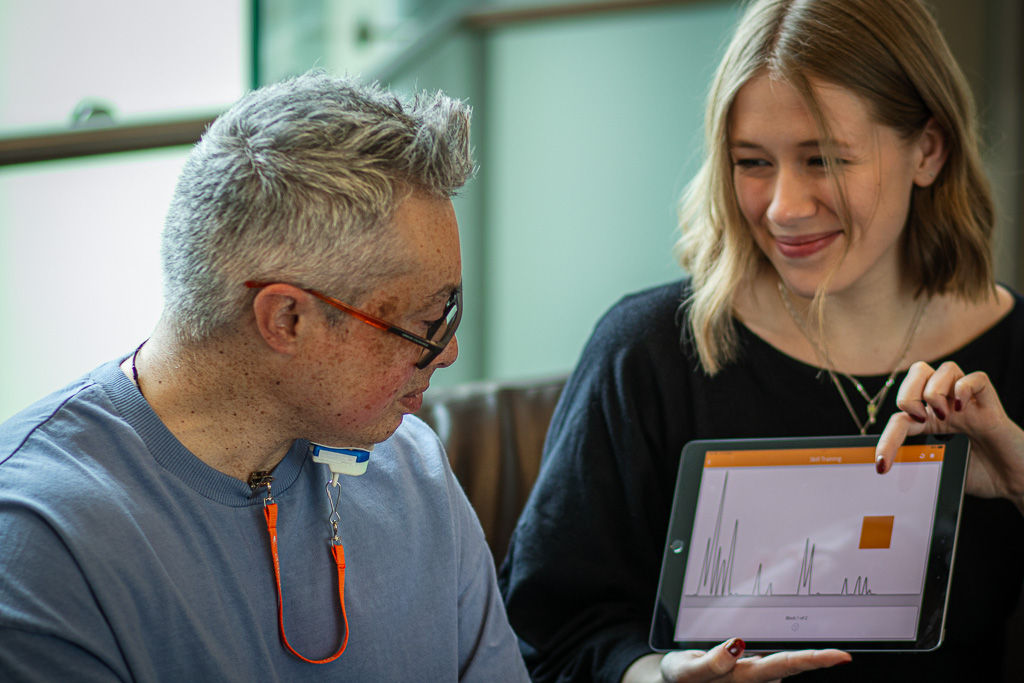


Main photo: Swaltech Patient Engagement Specialist Eric UfiPoa Taule’ale’ausumai and PhD candidate Maddie Mills using biofeedback technology.
Swallowing Technologies (SwalTech) has developed a device that uses biofeedback to help people who have dysphagia – the medical term for difficulty swallowing. SwalTech was established to commercialise research innovations that originated at Te Whare Wānanga o Waitaha | University of Canterbury (UC) Rose Centre for Stroke Recovery and Research.
Co-founder of SwalTech and Founder of the Rose Centre, Professor Maggie-Lee Huckabee, says dysphagia has very significant adverse health, economic and social implications if left untreated.
“Dysphagia can result from stroke, Parkinson's disease, head and neck cancer, traumatic brain injury, or paediatric developmental conditions. It affects an estimated 1.5 percent of the population – about 75,000 people in New Zealand – with 25% of adults dying within one month of diagnosis, increasing to 50% within a year without effective treatment. There is also a significant economic impact, with the condition costing the New Zealand economy $101 million annually from stroke-related cases alone.
“Equally important, people who cannot swallow properly lose confidence in social situations and long-time friends can be uncomfortable eating in their presence. Food is how we nurture and engage with people. When you take food away, people drop away too. The goal throughout my life’s work is to help patients eat again and have a better quality of life.”
Chief Executive Officer Emma Hayes says that unlike approaches that focus only on muscle strengthening, the BiSSkApp (Biofeedback in Strength and Skill Application), technology supports active, skill-based swallowing rehabilitation. Patients use a sensor placed under the chin to see muscle activity generated during swallowing on a tablet screen. As they learn to control the line on the screen, they learn to control their swallowing behaviour through guided practice. This allows clinicians to see patients once or twice to establish treatment, then monitor progress remotely while patients continue with treatment at home. The result is better patient outcomes from intensive treatment and more efficient use of clinical time.
BiSSkApp was launched commercially in February 2025 and is now used at about 30 sites across Australia and New Zealand, including public and private healthcare facilities. Early results and clinician feedback report improved swallowing function, greater independence and renewed participation in everyday social life.
Optimal Speech Pathology Clinical Director Colleen Kerr says the method has improved treatment plans for patients. “BiSSkApp allows the client to know in real time what they're doing. They find it easy, but they also see change quite quickly. BiSSkApp delivers us a fist pump moment every week. It's completely changed the way we approach swallowing management.”
Those receiving the treatment have reported significant improvements in quality of life. Martin, a patient with traumatic brain injury, says: “At first, I wasn't allowed to eat [or] drink much at all. I couldn't tell whether I swallowed or not. I'm allowed to drink a little bit of thin fluid again now. I don't know where I'd be without it.”
Lorraine, who has Parkinson’s disease, says: “I've just been diagnosed with Parkinson's. I tried taking some pills and they got stuck in my throat and then I had dreadful pain. I ended up with a chest infection. I can swallow a lot better [and] can go out and have a coffee now.”
BiSSkApp evolved from BiSSkiT (Biofeedback in Strength and Skill Training), a research tool Professor Huckabee developed after seeing electromyography (EMG)-assisted swallowing therapy help patients with severe dysphagia. After receiving requests from other clinicians for the research tool, Professor Huckabee adapted the software to meet regulatory requirements and release it more widely. Its strong performance led to full commercialisation in 2021 with co-founder Steve Wakefield through the establishment of SwalTech.
The ongoing connection between SwalTech and UC continues through the Rose Centre, where research, evaluation and clinical insight help inform product development. SwalTech has also received support from KiwiNet, Callaghan Innovation, ChristchurchNZ, Healthtech Activator and the Regional Business Partner Network.



.png)