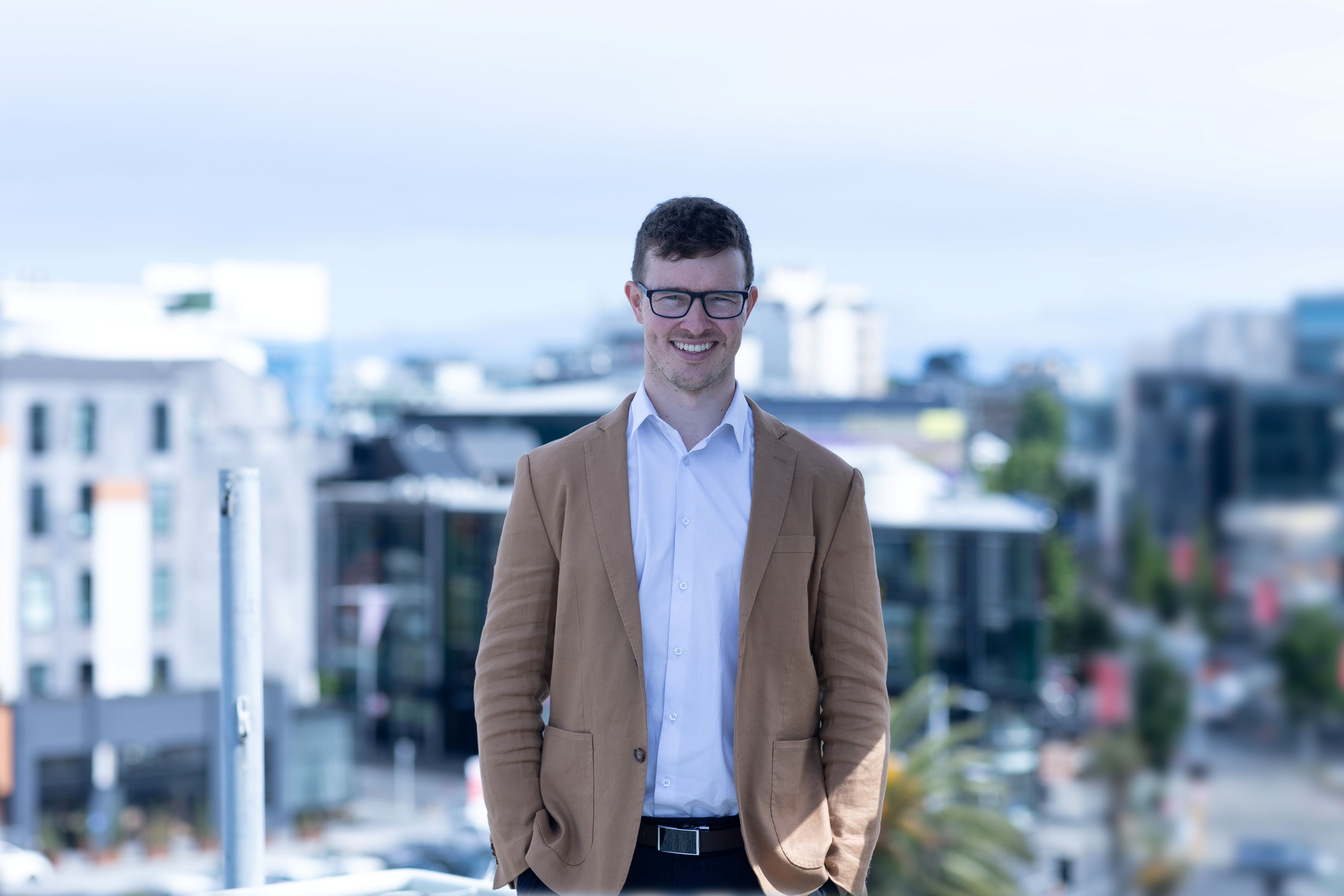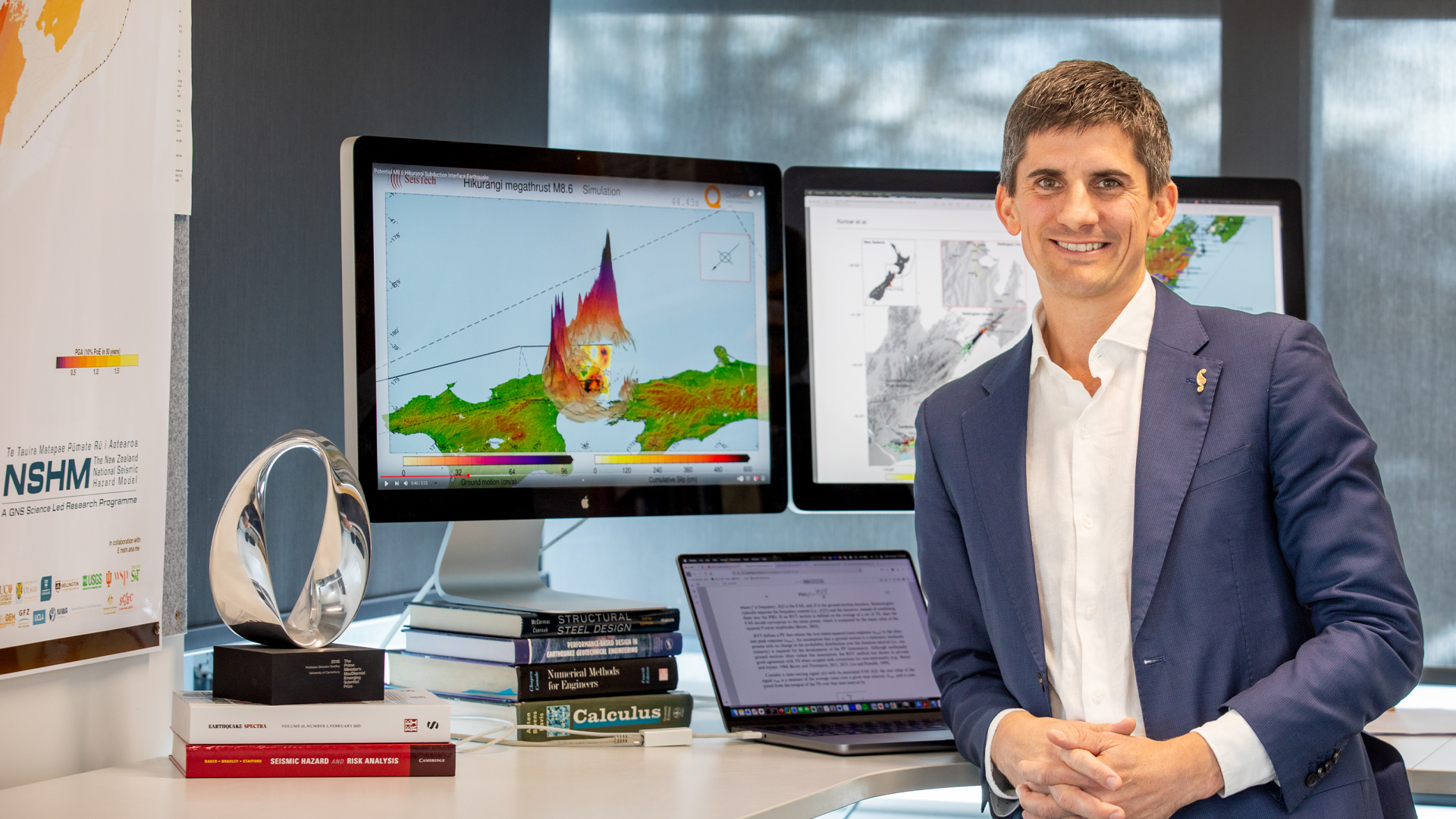

Photo caption: Professor Brendon Bradley.
Key points
UC researchers use high-performance computing to model earthquake ground motion and seismic risk.
Advanced earthquake simulations integrate vast geological and geophysical datasets to predict how shaking may vary across regions.
The research informs building design, infrastructure planning, and Aotearoa New Zealand's National Seismic Hazard Model.
Harnessing supercomputing to understand earthquakes
Earthquakes are one of Aotearoa New Zealand's most significant natural hazards. Improving resilience depends on understanding not only where earthquakes may occur, but also how the resulting ground shaking will affect buildings, infrastructure, and communities.
Research led by Professor Brendon Bradley at the University of Canterbury (UC) combines earthquake engineering, geophysics, and high-performance computing to improve how seismic hazards are assessed and managed.
His work focuses on developing advanced ground-motion simulation methods that recreate how earthquake waves travel through the earth and interact with local geology. Using high-performance computing facilities in Aotearoa New Zealand and internationally, these models can process vast amounts of geological and geophysical data to simulate earthquake impacts with unprecedented detail.
By harnessing supercomputing, the research can model complex earthquake scenarios at scales and resolutions that would otherwise be impossible, providing more accurate information about where damaging shaking is likely to occur and how communities can better prepare for future events.
Predicting ground shaking and risk
The complexity of earthquake behaviour means that traditional modelling approaches can struggle to capture the full range of factors that influence ground shaking.
Advanced computational models allow researchers to simulate thousands of earthquake scenarios, helping to identify which locations are most likely to experience severe shaking and how risks vary across regions. These insights provide engineers, planners, and policymakers with better information to guide resilience investments and risk-reduction strategies.
Brendon played a key role in the 2022 update of Aotearoa New Zealand's National Seismic Hazard Model which underpins national building standards and engineering design codes.
Turning science into resilience
A central goal of the research is translating scientific advances into practical outcomes.
By improving the accuracy of seismic hazard assessments, the research helps ensure that resources are directed towards the buildings, infrastructure, and communities most at risk. This supports more cost-effective strengthening programmes while improving public safety and resilience.
Supercomputing allows us to model earthquake scenarios at a level of detail that was unimaginable a generation ago. These simulations help us understand not only where strong shaking is likely to occur, but also how we can make smarter decisions about the buildings and infrastructure communities depend on.– Professor Brendon Bradley
Brendon co-founded Te Hiranga Rū QuakeCoRE, a centre of research excellence which brings together researchers from across Aotearoa New Zealand to tackle earthquake resilience from collaborative, multidisciplinary perspectives.
Building the future of earthquake resilience
While major earthquakes cannot be prevented, advances in computing, simulation, and engineering are transforming how communities prepare for them.
By combining high-performance computing, advanced ground-motion modelling, and engineering expertise, UC researchers are helping create a future where communities are better able to withstand earthquakes, disruption is minimised, and recovery is fast.
Talk to Professor Brendon Bradley about earthquake ground-motion modelling.
Last updated: October 2026
Related topics
Enabling Infrastructure
Sustainable Development Goals (SDGs)
Contact
-
Professor Brendon Bradley
11 December 2023
Meet Professor Brendon Bradley who received the UC Research Medal in 2023. On a mission to make earthquakes no more than a nuisance, he built his career on fortuitous timing, hard work, and leaning into the basics.

-
Professor Brendon Bradley
Meet Professor Brendon Bradley who received the UC Research Medal in 2023. On a mission to make earthquakes no more than a nuisance, he built his career on fortuitous timing, hard work, and leaning into the basics.
-

Professor Brendon Bradley
-
Professor Brendon Bradley
Meet Professor Brendon Bradley who received the UC Research Medal in 2023. On a mission to make earthquakes no more than a nuisance, he built his career on fortuitous timing, hard work, and leaning into the basics.
We gratefully acknowledge support for the NZ Marsden Fund, Te Hiranga Rū QuakeCoRE , the Natural Hazards Commission, and the New Zealand National Seismic Hazard Model.
Read other showcases
Take a look at our showcases to see UC’s research expertise in practice.