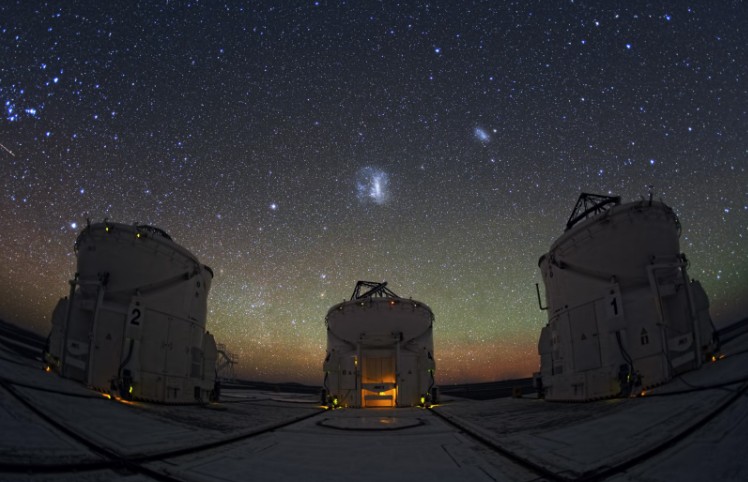


Photo caption: The European Southern Observatory's Paranal Observatory in Chile, home to the Very Large Telescope used to study the interstellar comet 3I/ATLAS. Photo credit: Y. Beletsky (LCO)/ESO.
Key points
- UC researchers lead international efforts to understand the Galaxy’s population of interstellar objects
- Interstellar objects provide a rare opportunity to study the building blocks of planetary systems beyond our own.
- Research suggests the interstellar comet 3I/ATLAS originated in an ancient star system and may be between 8 and 14 billion years old, much older than the Sun.
Studying visitors from other stars
Interstellar objects are asteroids and comets formed around stars other than the Sun. A huge population of these tiny worlds drift between the stars of our Galaxy. Astronomers occasionally detect an interstellar object passing through our Solar System. These exciting events offer a unique opportunity for close-up study of material from distant planetary systems.
Associate Professor Michele Bannister from the University of Canterbury’s (UC) School of Physical and Chemical Sciences, in collaboration with international partners, is leading global efforts to understand the interstellar object population. One example is 3I/ATLAS, only the third interstellar object ever discovered.
Unlike previous interstellar visitors, 3I/ATLAS was exceptionally bright, allowing astronomers to examine both its physical characteristics and chemical composition in unprecedented detail.
A calling card from the distant past
Working with Professor Chris Lintott and researchers at the University of Oxford, Michele and her UC team have developed the Ōtautahi-Oxford model, which explores how interstellar objects form, move through the Galaxy, and what their properties reveal about their origins.
Using this model, the UC-Oxford team was the first to show that 3I/ATLAS is between 8 and 14 billion years old, making it substantially older than our Solar System, which formed 4.6 billion years ago.
Comets like 3I/ATLAS are records of planetary formation processes that took place around other stars billions of years ago. Michele and her colleagues are working to link this to the history of the Galaxy itself.
Reading a comet's chemical fingerprint
A key focus of Michele’s research is on using light to reveal the composition of astronomical objects.
Using the European Southern Observatory's Very Large Telescope, researchers measured the chemical and isotopic composition of 3I/ATLAS, providing the first detailed chemical fingerprint of a comet formed outside our Solar System.
The results revealed unusually high carbon and nitrogen isotopic ratios, along with distinctive chemical signatures including elevated levels of nickel and iron. Together, these findings suggest the comet originated in the outer regions of an ancient, low-metallicity star system formed when the Galaxy was much younger than it is today.
By analysing the chemistry of the comet and its coma, the cloud of gas and dust surrounding it, researchers are gaining rare insights into the environments in which planetary systems formed billions of years ago.
Partnering to understand the Universe
Michele's research spans the formation and evolution of planetary systems, from interstellar visitors to small bodies within our own Solar System. Her work connects UC researchers with global astronomy networks and world-leading facilities, including the Very Large Telescope, the Vera C. Rubin Observatory, NASA’s NEO Surveyor mission, and UC's Mount John Observatory at Takapō.
These partnerships are helping build a national, investigator-led strategy for astronomy in Aotearoa New Zealand while creating new opportunities to discover and study interstellar objects. Future observatories are expected to identify many more visitors from beyond our Solar System, providing unprecedented opportunities to explore the history of the Milky Way.
Objects like 3I/ATLAS are remarkable because they give us a direct glimpse of material formed around another star. By studying their chemical fingerprints, we can begin to understand the conditions in a planetary system very different from our own, and potentially much older than the Sun.– Associate Professor Michele Bannister
Talk to Associate Professor Michele Bannister about interstellar objects, planetary science, astronomy, and space exploration.
Last updated: October 2026
Related topics
Research Commitments
Signature Capabilities
Enabling Infrastructure
Sustainable Development Goals (SDGs)
Contact

We gratefully acknowledge support from a Rutherford Discovery Fellowship.
Read other showcases
Take a look at our showcases to see UC’s research expertise in practice.