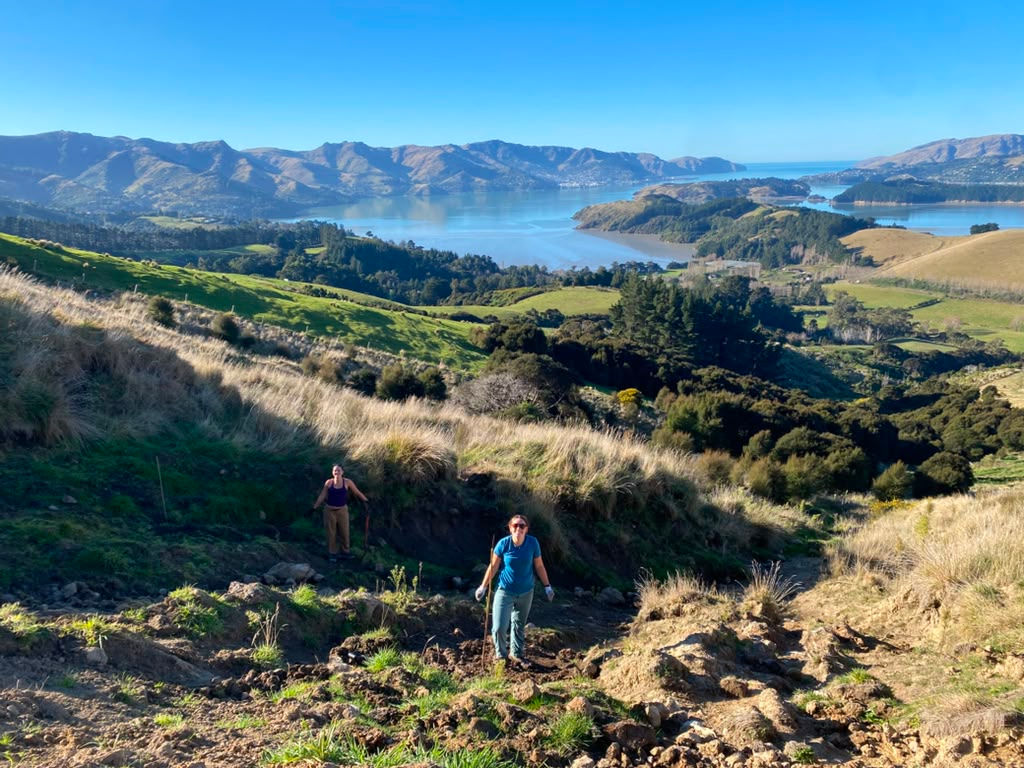


Project Background: Deforestation in New Zealand has accelerated erosion of hillslopes, leading to downstream environmental impacts related to high sedimentation, predominately from intense rainstorm events. New Zealand harbours and their unique and fragile marine habitats have been especially impacted. This project is focused in Whakaraupō | Lyttelton Harbour- home to Te Hapū o Ngāti Wheke, several small communities, and the Lyttelton Port. Once teeming with terrestrial and marine life, unmitigated sedimentation into the harbour over the last ~150 years has negatively impacted natural habitats and led to a significant reduction in mahinga kai. Most sub catchments within the harbour have ephemeral streams that only run consistently in the winter months, but these streams become turbulent and sediment-laden waterways during high intensity rainfall events. Stream sedimentation rates are currently unknown in Whakaraupō, but there is a hypothesis that most sediment that ends up in the harbour is liberated and transported during these heavy rainfall events.
Project aims: As part of a catchment management plan for Whakaraupō | Lyttelton Harbour, the Whaka-ora Healthy Harbour programme has funded this PhD research project to constrain sub-catchment-scale sediment transport processes (mass failure and debris avalanche/flow, sheet erosion and surface runoff, and tunnel gully erosion and transport) and quantify sedimentation rates during high intensity rainfall events. Research methods will be predominantly field-based with 1) mapping geology, soil, land cover, and erosion, 2) establishing experimental test plots in varying soil types and vegetation cover, 3) developing and implementing instrumentation for monitoring sediment transport and load during intense rainfall events, and 4) measuring sediment deposition in the shallow harbour. Field observations and data will be used to improve existing and largely predictive erosion and sediment fate models for Whakaraupō.
Supervisors
Primary Supervisor: Katherine Yates
Key qualifications and skills
Students with earth science Honours- or Masters-level degrees and field research experience in earth surface processes, hydrology and/or engineering geology will be prioritised. Experience with GIS, statistics, and geomodelling are preferred, and an appreciation or willingness to understand Te Ao Māori and tikanga are essential. The scholarship is open to domestic and international candidates, and international candidates moving to New Zealand pay domestic tuition fees. The successful candidate will be enrolled full-time at the University of Canterbury and reside full-time in New Zealand for the duration of the PhD project. Candidates must meet the PhD eligibility criteria for enrolling at the University of Canterbury.
Does the project come with funding
Yes - Annual stipend of NZ$35,000 for 3 years, and fees paid for 3 years
Final date for receiving applications
1 October 2026
How to apply
Interested candidates should apply via email with the subject line “Erosion PhD Application” to Katherine Yates, katherine.yates@canterbury.ac.nz. Applications should include: 1. A Curriculum Vitae (including publication list, if any) 2. Academic transcript(s) 3. A 1-page cover letter outlining your motivation 4. Contact details for two academic references
Keywords
field geology; sedimentation; hydrology; engineering geology; earth surface processes; climate science