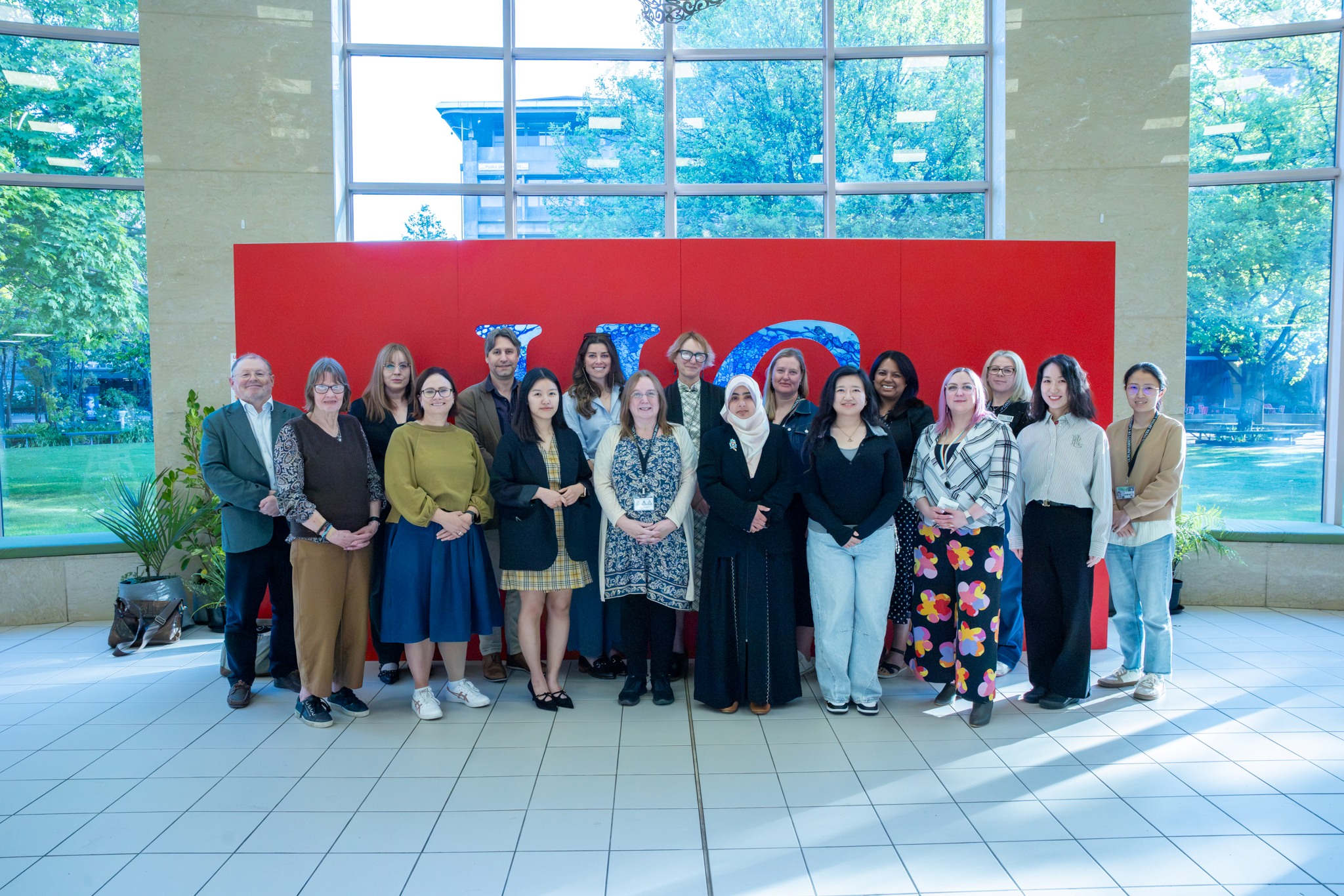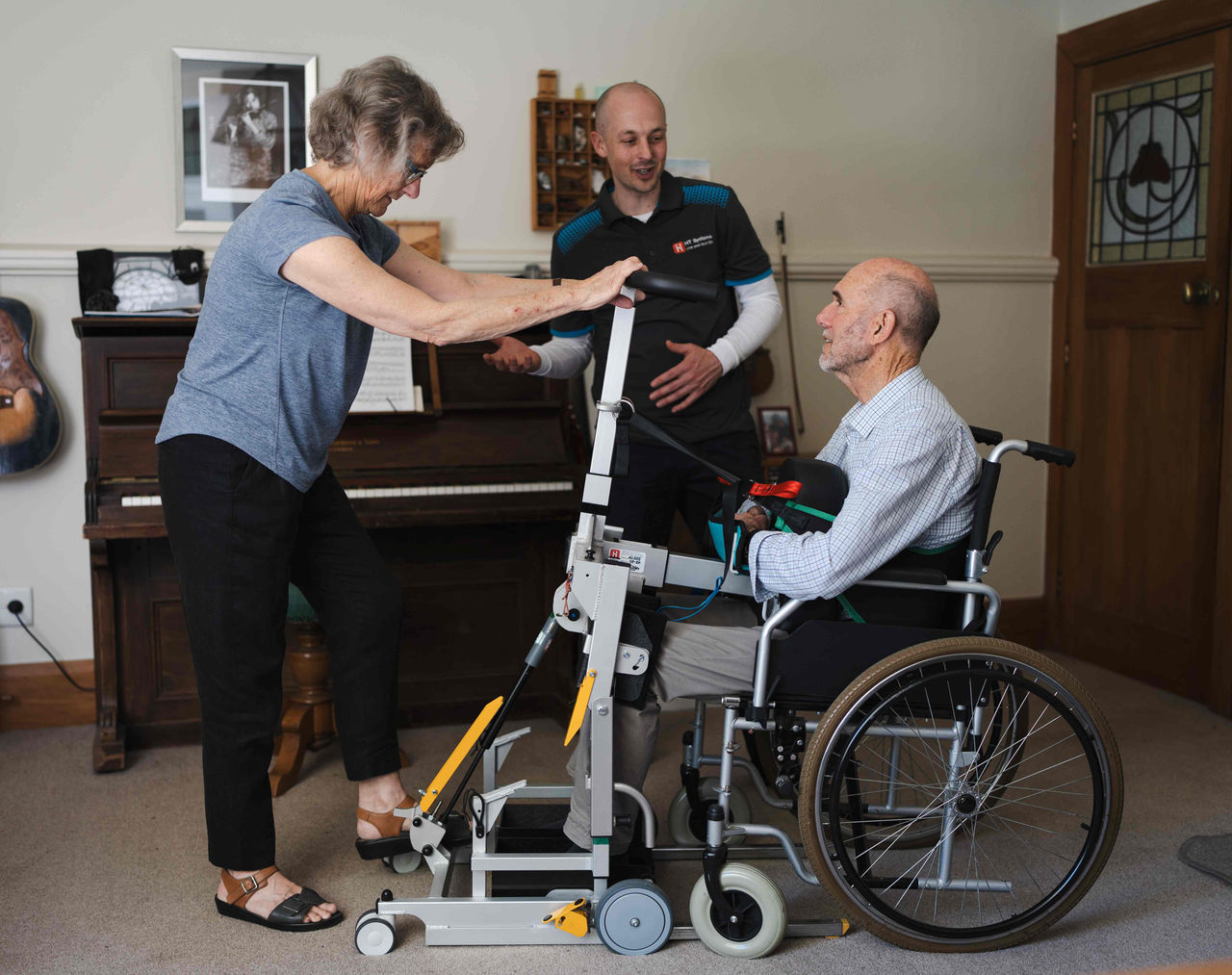


Photo caption: UC Emeritus Professor Keith Alexander Keith testing out his invention at home with his wife Faith, under direction of Alex.
The Kera Travel is a lightweight transfer hoist developed by Christchurch-based HT Systems that enables a single caregiver to move someone with little or no mobility safely between seated positions, such as from a wheelchair to a car seat, bed, or armchair.
The technology is the result of a long-running research and teaching project at Te Whare Wānanga o Waitaha | University of Canterbury (UC), involving modelling, student projects and prototype testing led by HT Systems Founder and UC Emeritus Professor Keith Alexander – inventor of the Springfree Trampoline.
HT Systems Chief Technology Officer and UC graduate Dr Alex O’Keefe says the product is aimed at making travel more accessible and inclusive for the disabled community.
“The Kera Travel was born out of a simple, practical reality: life doesn’t only happen at home. People travel – they visit family, stay in hotels and move through spaces that weren’t designed with ceiling tracks or fixed hoists in mind. At under 21kg, Kera Travel is designed to be portable, enabling partners, family members or caregivers to provide safe, effortless care at home, on the road, overseas, and anywhere in between.”
The Kera Travel uses the same patented sit2sit™ technology as HT Systems’ flagship product, the Kera Home hoist. The system securely "hugs" the user's upper body between a chest pad and a backstrap, while a patented manual lever system allows the user to be lifted forward to a comfortable forward resting position, requiring the effort of a single caregiver and not powered assistance.
“More than 25 years ago, clinicians at Burwood Hospital asked us to develop a safer, more effective way to transfer patients,” says Emeritus Professor Alexander. “Since then, my focus has been on reducing the handle force – the physical effort required to complete a seated transfer – by keeping the person’s centre of mass close to a consistent height as they move through a controlled motion, that mimics the natural standing motion.
“Every design decision has been made with real users and caregivers in mind, and we have been fortunate to have a very engaged community providing feedback that has helped us continually refine the product.”
Dr O’Keefe says that same real-world need is also driving demand for practical transfer technology. “In New Zealand, about 100,000 people require assistive technology when transferring to and from a chair, while the broader mobility aid market is estimated to be worth around $270 million. Globally the mobility aid market is worth over $2.5 billion, driven by ageing populations, rehabilitation needs and the increasing use of assistive technology in homes, hospitals and aged-care settings. The World Health Organization also warns of a global shortfall of more than 11 million health and care workers by 2030, driven largely by rising demand for disability and elder care.”
Maureen Wood, who has multiple sclerosis and uses a mobility scooter, was the first person to buy a Kera Travel. In 2025, she and her husband Peter took it on a 21-day Cunard cruise aboard the Queen Elizabeth. “It is the easiest and best way to travel with a wheelchair or mobility scooter,” says Maureen. “It worked beautifully in the bathroom, bedroom and lounge on the ship.”
For John Reckin and his wife Barbara, who lives with a form of Muscular Dystrophy, the Kera Travel provides greater freedom while reducing the physical strain on John.
“We went through a situation where we didn't know, when Barbara got worse, what to do, until we came across the Kera,” says John. “It's a marvellous innovation for me and Barbara, because it just eliminates any untoward notion of Barbara going into a rest home, which we didn't want as we would be split up. Now we're coping, and that's because of the Kera.
“And now we’ve got the Kera Travel it's really going to help transfer our mobility. We're going to have a little trip to Auckland and stay in a motel and see the progress of my son's house.”
In early 2026, HT Systems received Therapeutic Goods Administration (TGA) registration from Australia’s medical device regulator for the Kera Travel hoist. The company now distributes across New Zealand, Australia, the United States and the United Kingdom, with products sold into more than 20 countries.
Dr O’Keefe says the registration has been a key milestone for expanding their export market. “Registration means that the Kera Travel can now be considered within all healthcare and disability support settings in Australia and supports direct sales to customers in the rest of the world. Our long-term goal is to become a multi-product multinational company, developing practical innovations shaped by the needs we see when working with New Zealand families. We are currently looking for investment partners to accelerate that global expansion and bring our solutions to people who need them sooner.”


.png)