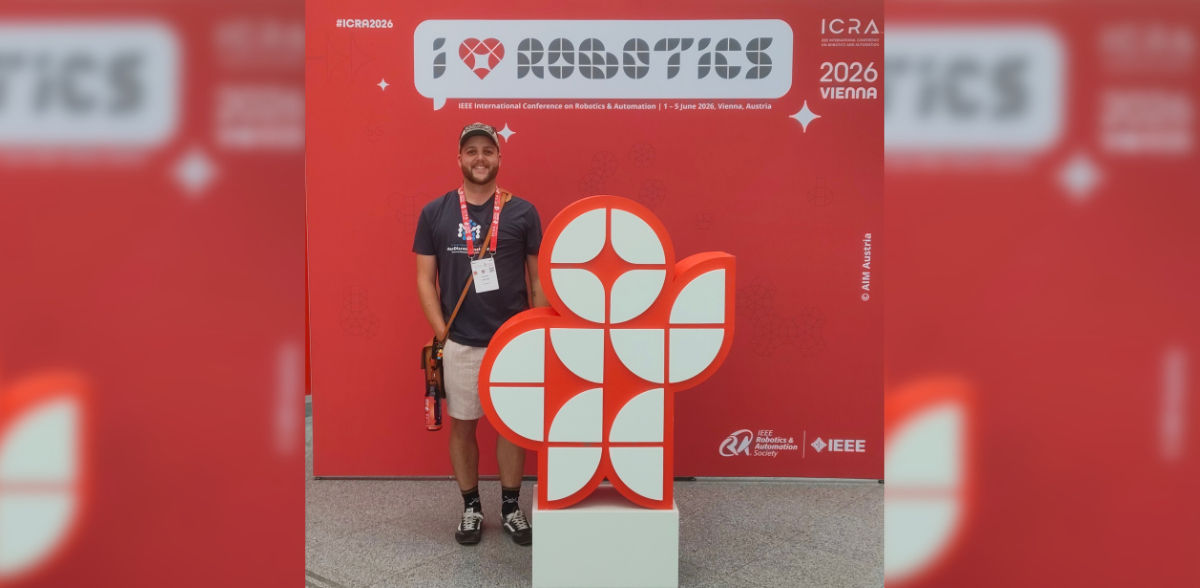


Photo caption: UC PhD student Nicholas Carisle’s groundbreaking research is taking him places, including to the IEEE International Conference on Robotics and Automation this year.
PhD candidate Nicholas Carlisle, a microrobotics researcher at Te Whare Wānanga o Waitaha | University of Canterbury (UC), is developing techniques to control swarms of robots so small that 1,000 of them lined up end to end would barely stretch a millimetre.
Carlisle's PhD research is at the forefront of an emerging, but fast-moving field he believes is only just getting started, with the potential to ripple out into medicine, manufacturing and beyond.
"Microrobotics is a rapidly evolving young research field with endless potential," Carlisle says. "I hope that my research will play a part in bringing this technology to its full potential."
Carlisle's research focuses on a swarming behaviour known as Optical Force-Induced Assembly, an unconventional and under-researched method of controlling microrobots using optical tweezers — a highly focused laser beam that directly transmits force on microscopic particles via Newton's third law of motion.
"Imagine the microrobots are a herd of sheep out in a large paddock," Carlisle says. "If a farmer brought sheep in one at a time, moving the herd would be slow and difficult. But with a team of dogs working with the sheep's natural instinct to swarm, the herd can be moved in a fraction of the time. My research uses a laser in place of the dogs, developing new techniques to move the 'herd' for different tasks."
Optical tweezers are a well-established method for controlling individual microrobots with high precision, but the swarm behaviour that emerges when many are driven at once has rarely been studied. Carlisle's research combines these two approaches, aiming to move optical force-induced assembly from an interesting laboratory phenomenon into a genuinely functional tool.
The scale Carlisle works at is almost unimaginable. The robots are just one micrometre across (roughly a hundredth the diameter of a human hair). At that size, everything becomes inherently sticky — where particles cling to each other and surfaces due to forces like static electricity — demanding creative problem-solving at every turn.
"The most challenging aspect is the size of the robots," Carlisle says. "But the feeling as an engineer when your ideas and plans finally come together and start working is the biggest reward. Travelling the world to present at conferences is pretty good too."
Carlisle stumbled into the field almost by accident. An undergraduate supervisor described a potential project as "swarm robots from Big Hero 6, but under a microscope" (Big Hero 6 is a Disney animated film about a boy and a robot companion who build high-tech gadgets to solve problems). The challenge proved irresistible, despite the smallest device Carlisle had previously worked on being eight centimetres long.
Microrobotics is often associated with targeted drug delivery, one of the driving forces behind the wider field, particularly for magnetically and acoustically driven swarms that are compatible with biological tissue.
"Microrobotic swarm research has a highly specific focus on medical applications, which may act as blinders, limiting development in other aspects of the field," Carlisle says. "Expanding the fundamental base of what's possible with swarms, and exploring new avenues, could help bridge the current gap between development and clinical implementation."
Carlisle began his PhD at Massey University, relocating to UC after Massey's engineering programme was discontinued. Professor Volker Nock, his senior supervisor, brought Carlisle's research team members to UC to continue their studies. Adjunct Professor Ebu Avci, Associate Professor Catherine Whitby (Massey University) and Dr Jack Chen (Auckland University of Technology) complete his supervisory team.
"I am extremely grateful to UC for taking me in and allowing me to complete my PhD," Carlisle says. "The amazing atmosphere and support from my supervisor and the faculty at UC has been a significant reason I'll be able to submit my thesis."

What to read next
NZ study reveals gaps in women's heart healthcare
A review of 25 years of New Zealand research has revealed significant gaps in women's heart healthcare, highlighting opportunities to improve diagnosis, treatment and outcomes.

History goes hi-tech at Awaroa Godley Head
The University of Canterbury's HIT Lab is helping Awaroa Godley Head visitors enjoy a more immersive experience of the World War II heritage site.

UC geography graduate honoured for global science leadership
UC alumnus Distinguished Professor Emeritus Iain Hay has received a prestigious international Fellowship recognising his contributions to geography and scientific collaboration.

Are Kiwi businesses jumping blindly on the AI bandwagon?
AI doesn’t have to play an inevitably dominant role in our lives, businesses and future, argues a guest speaker for an upcoming UC public lecture.

UC engineering students win international competition
A robot designed to transport rocks automatically has helped four UC engineering students claim an international title.
UC wins national award for employability service
UC has been recognised for excellence in helping students develop career-ready skills and connect with employers.

Fair suppliers strengthen business resilience
Businesses are better able to withstand disruption when suppliers make fair decisions and turn strong relationships into flexible action, UC research finds.
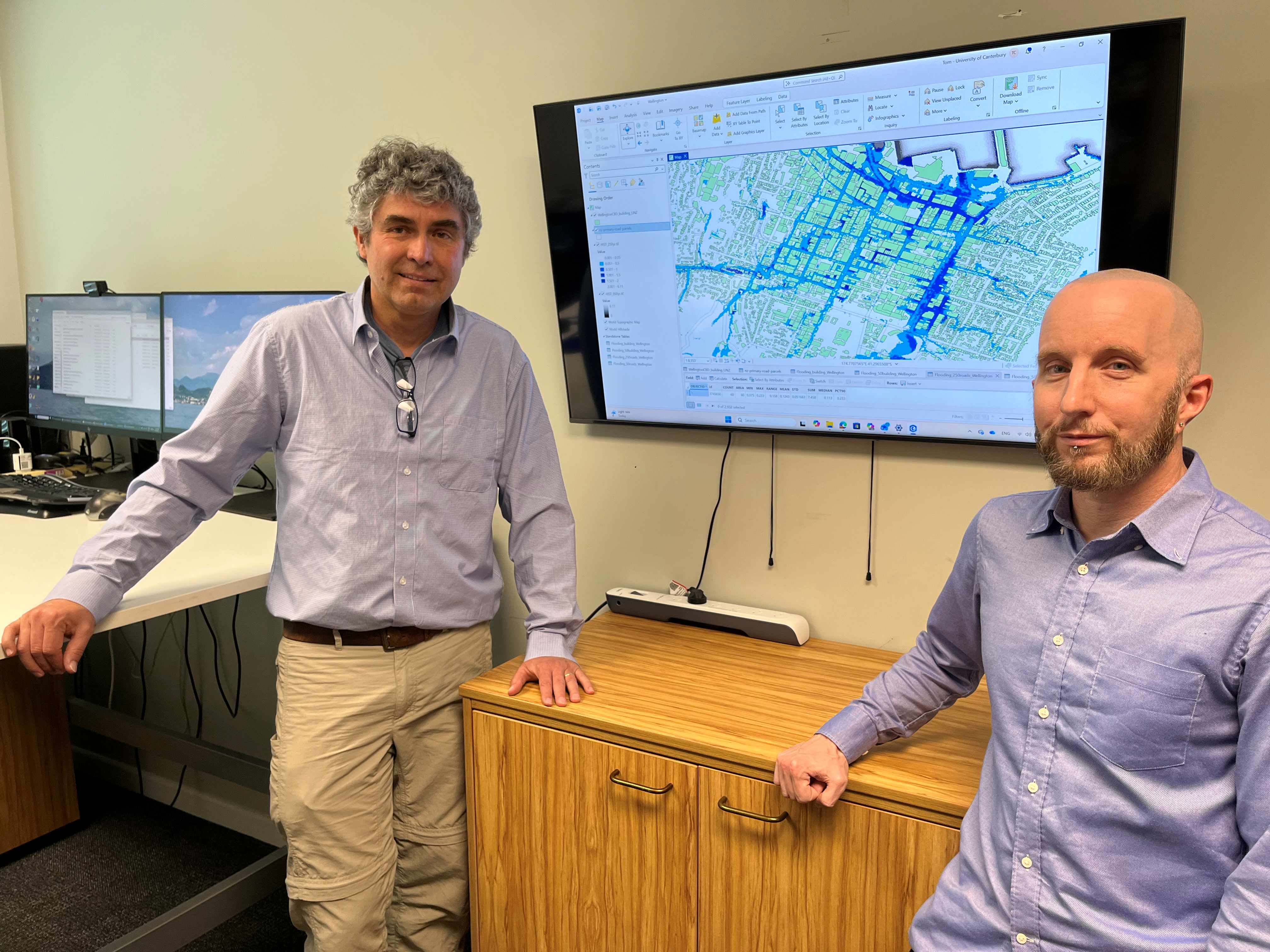
Digital models to help predict natural hazards in Kiwi capital
An innovative project using digital simulations to predict future hazards in New Zealand’s capital city takes its name from science fiction.
UC research challenges how we think autistic children learn
New UC research is challenging assumptions about how autistic children learn language.