

One in five Kiwis think differently and Canterbury business leaders say this overlooked talent could be the key to NZ's 30-year productivity puzzle.
For three decades, New Zealand has wrestled with the same stubborn problem: low productivity. According to Dorenda Britten, co-founder of Christchurch-based Unlock Innovation Ltd, part of the answer has been hiding in plain sight – inside the minds of the one in five Kiwis who think differently.
"I'm frustrated by the ongoing 30-year conversation about low productivity in New Zealand," Britten says. "Productivity requires innovation, and innovation requires different kinds of thinking working together. We're staring straight at a form of talent we don't recognise, in fact, we sideline it."
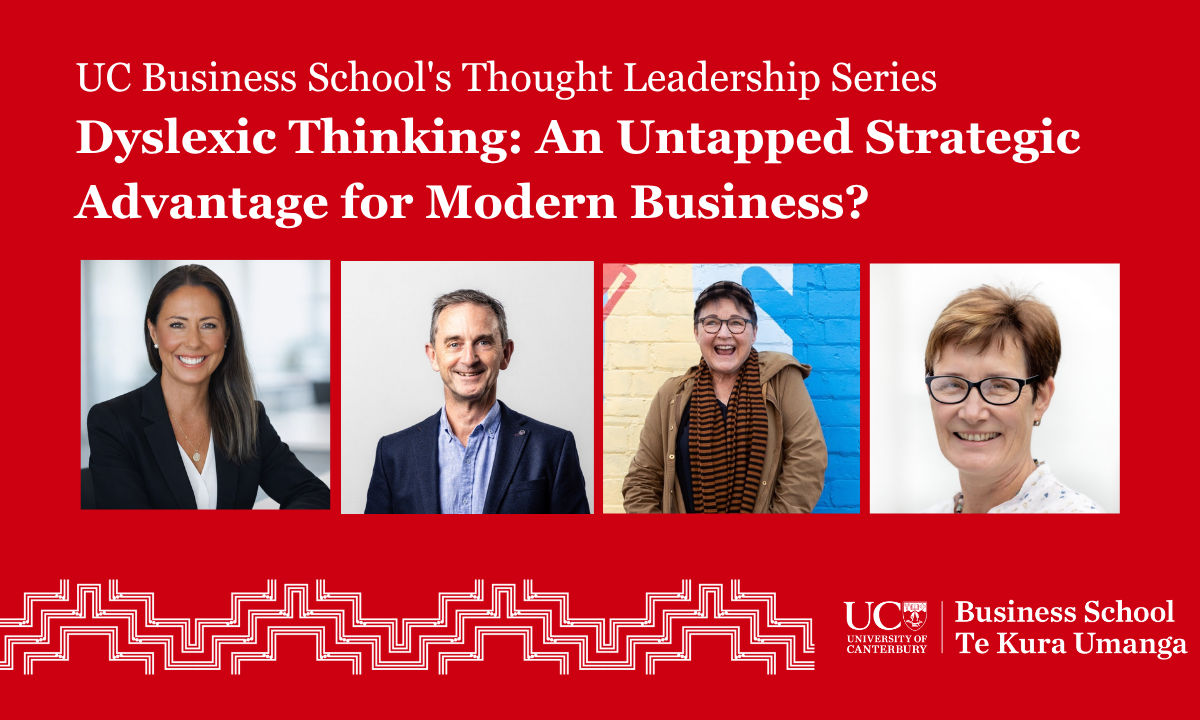
Britten will join fellow Unlock Innovation Ltd co-founder Chris Cole, business leader Graham Grant, and senior executive Michelle Sharp on a panel for the next Te Kura Umanga | UC Business School Thought Leadership event, Dyslexic Thinking: An Untapped Strategic Advantage for Modern Business? on Thursday 18 June at Te Whare Wānanga o Waitaha | University of Canterbury (UC). The event is part of the UC Business School Thought Leadership Series, which brings together researchers, business leaders and the wider Canterbury community to explore practical responses to the challenges facing organisations today.
Both Britten and Cole say the biggest barrier to unlocking this talent is a stubborn misconception that dyslexia is simply about an inability to read and write.
"People take that simplistic view that you can't read and write, therefore you can't think," Britten says. "But dyslexic thinkers carry enormous potential; they take risks, they hold the vision, they're empathetic, they spot pockets of information across different areas and ask, 'What could we create by bringing this together?'"
Cole, an accountant by trade and a late-diagnosed dyslexic herself, says the reading-and-writing stereotype causes workplaces to miss the very strengths they need most.
"Dyslexic thinkers are really good at pattern recognition – seeing themes, sensing how other people feel, and being big-picture thinkers who don't get lost in the detail," she says. "If you understand it and utilise it, it becomes a real asset. However, workplaces tend to focus on the little stuff that might be interrupting the flow, without taking a bigger picture of what that person brings."
Britten is quick to push back against the "heroic dyslexic" narrative. The real gains, she says, come when different kinds of minds work together.
"This is not about dyslexics working alone and being very clever. Teams focused on innovation need all brains. We need that tension; we need to question the assumptions."
She points to a recent project with ChristchurchNZ, where staff who had self-identified as dyslexic joined a team preparing a complex report to Christchurch City Council. "The process was faster and better than ever before, but only because they were part of a mixed team. We have to come together."
The event also shines a light on a new UC research project – funded by Canterbury company Seequent (now part of global infrastructure firm Bentley) – exploring the connection between dyslexia and innovation. Spanning the Faculty of Business and the School of Earth and Environment, it is generating the first New Zealand data of its kind.
"New Zealand has no data on this. We are generating it," Britten says. "Canterbury talks a lot about innovation, often about my late brother John Britten, but what he did was 30 or 40 years ago. The criteria for successful innovation are completely different now. We need to update our thinking."
Cole hopes attendees leave with both a shift in mindset and a practical sense of what to do next.
"I want people to walk out thinking there's something I can do in my workplace to reduce friction, increase productivity, and increase that sense of belonging. Change can't happen unless people first know that others think a different way, and what those strengths actually are."
In keeping with the topic, the event format itself has been designed to be dyslexia-friendly and accessible to all attendees, with a panel discussion followed by audience Q&A.
Panel: Dorenda Britten (Unlock Innovation), Chris Cole (Unlock Innovation), Graham Grant (Sequent / UC MBA Advisory Committee), Michelle Sharp (Power of Purpose; former CEO UNICEF Aotearoa NZ).


.png)