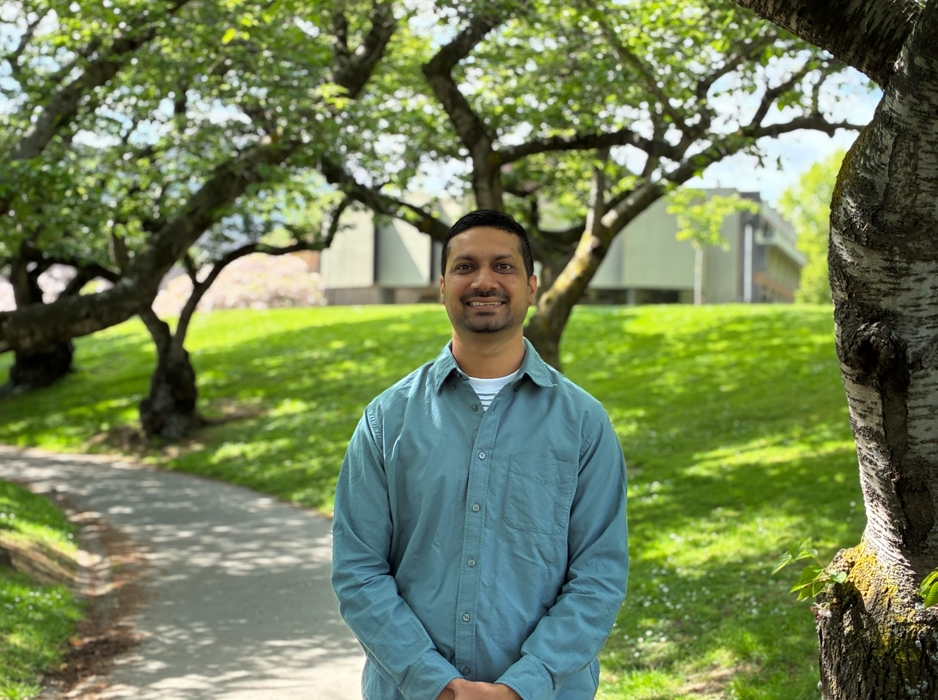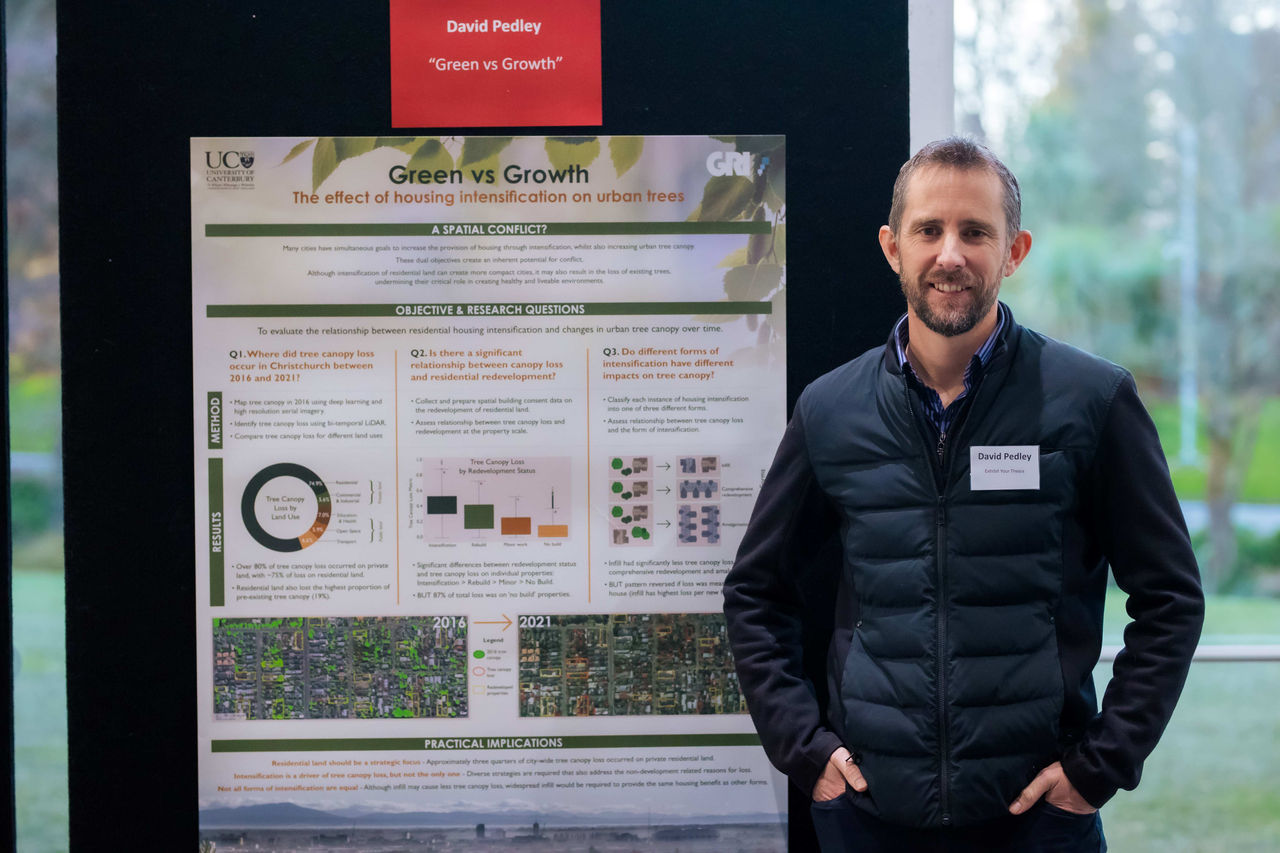


Main photo caption: For his UC PhD in Forestry Dr David Pedley investigated incentives to preserve established trees in growing cities.
As part of his PhD in Forestry at Te Whare Wānanga o Waitaha | University of Canterbury (UC), Dr David Pedley investigated the potential role of incentives to encourage property developers to retain established trees in cities across Aotearoa New Zealand.
Dr Pedley says the loss of trees on private land is one of the most pressing challenges for local government.
“Urban trees do a huge amount of work in our cities by cooling temperatures, managing stormwater, supporting biodiversity, and improving health and wellbeing. When we lose established trees, particularly mature ones, it takes decades to replace what was there.”
The research involved Dr Pedley carrying out surveys and interviews with property developers involved in housing intensification projects and council staff across New Zealand’s major urban centres. These two groups were chosen because an incentive scheme would require buy-in from both sides, making it essential to understand whether their interests could be aligned.
Dr Pedley says while the developers he contacted had different perspectives on retaining trees, most gave broad support to the idea of incentives. Councils were also generally open to the idea with about 70% of local government respondents agreeing that additional tools or approaches were required to manage the loss of trees during housing intensification.
“We looked at a broad range of incentive types, from direct financial payments and reductions in development contribution fees, through to faster consenting, increased development rights, and market-based certification,” Dr Pedley says.
Importantly, the research revealed a mismatch between the preferences of developers and council staff. Education and technical assistance were the top-rated option for councils but ranked among the least likely to sway developers. The incentives that provided the greatest motivation for developers were those with a direct impact on the bottom line, such as reduced development fees.
Those incentives were generally not favoured by councils due to their higher cost and the potential impact on ratepayers.
For that reason, cost-neutral incentives emerged as the most promising and practical option. Survey responses suggested that offering developers who retain existing trees reduced interest rates from bank lenders, was a preferred incentive for both groups.
“Often developers said that having existing trees gives a more established feel and makes a property more appealing to buyers,” Dr Pedley says. “But if keeping a tree means you can only redevelop the site for four townhouses instead of six, then the value gained from keeping the tree isn’t enough to offset the loss. The challenge is to find an incentive that’s meaningful and is actually going to influence that decision-making.”
Dr Pedley emphasised the importance of looking for balanced solutions. “Intensification can provide benefits, such as more affordable housing and vibrant communities. It’s about trying to find ways that we can be a bit more creative and enable development while retaining more of our trees along the way.”
“This research shows that there is openness on both sides to try something different. Although incentives are not a replacement for regulation, there is a need for more innovative approaches, with an initial focus on low-cost incentive options.
“It's about getting some small incremental wins and opening the conversation between councils, developers, and financial institutions that may be willing to support tree retention for the wider public benefits trees provide.”
He hopes his findings, published in Cities: The International Journal of Policy and Planning, will provide guidance for policy makers responsible for managing urban trees on private land.
Dr Pedley received the Geospatial Research Institute PhD Scholarship and his work was supervised by Professor Justin Morgenroth from UC’s School of Forestry.
“Protecting urban forests and preserving the canopy they provide in our cities is important and it’s very helpful to have the evidence and insights gained from Dave’s research,” Professor Morgenroth says.

.png)