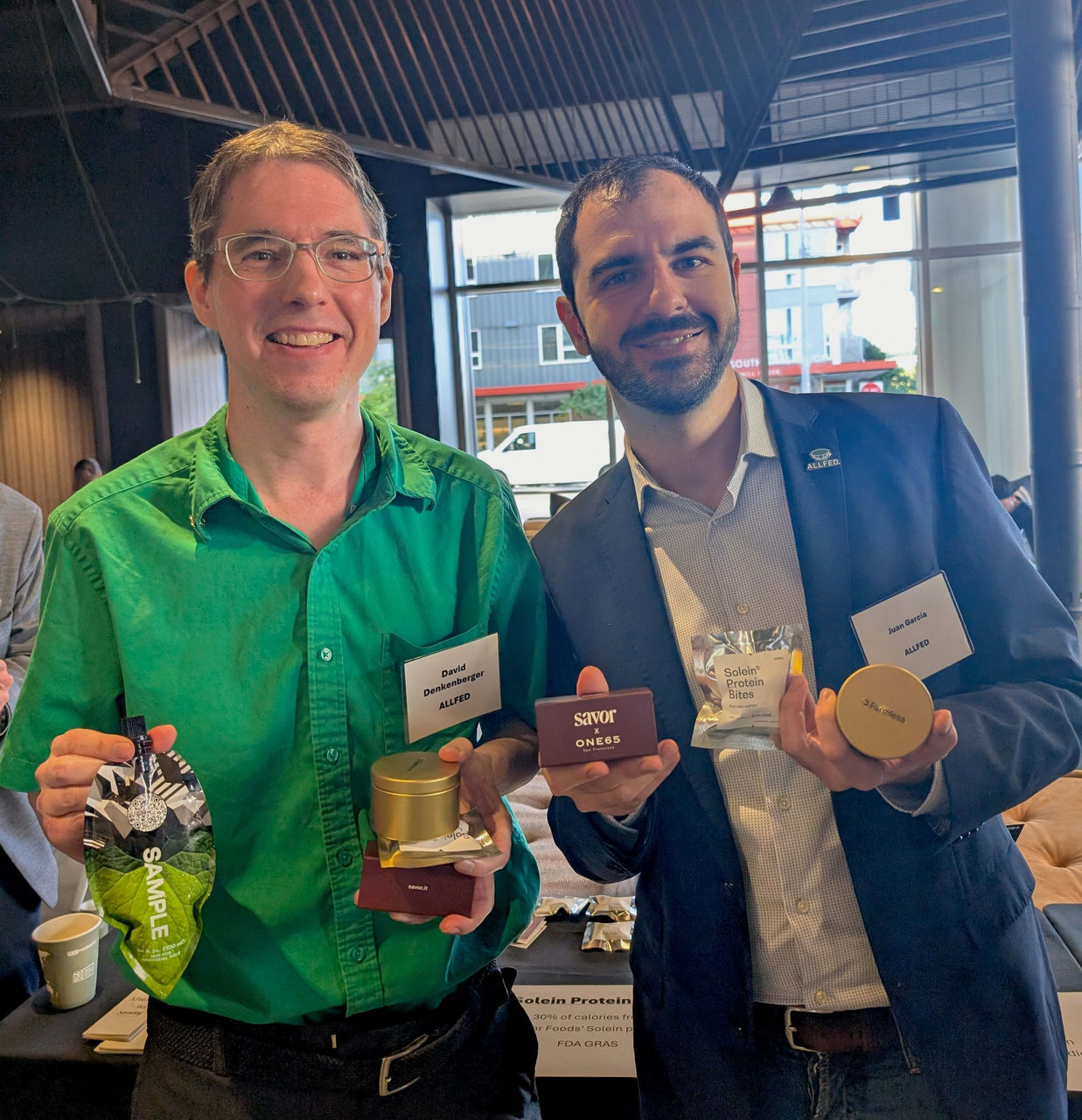


Main photo: David Denkenberger and Juan García Martínez holding various samples of foods produced without traditional agriculture.
Te Whare Wānanga o Waitaha | University of Canterbury (UC) Associate Professor David Denkenberger, who has spent more than a decade studying food resilience in extreme scenarios, says the work is part of a broader effort to identify practical ways to prevent mass starvation if global food systems are severely disrupted.
The research investigates how leaves from crops and forage plants can be processed into leaf protein concentrate for human consumption, while part of the remaining fibre can be converted into sugar. The idea is to make better use of plant material that is typically not eaten by people, potentially increasing the amount of food produced from existing land.
Associate Professor Denkenberger says the research matters because major global shocks, while rare, could disrupt the food systems people rely on every day.
"For about 15 years, we’ve been looking at how to build resilience to global catastrophes," Associate Professor Denkenberger says.
"These catastrophes could include things like a large volcanic eruption that blocks sunlight, or an extreme solar storm that disrupts electricity. This leaf protein work is one of a suite of interventions that could help feed people in those kinds of scenarios."
The study sits within a wider body of research into resilient food systems, including work on greenhouses, alternative proteins, seaweed, and microbes.
While the leaf protein research is designed with worst-case disasters in mind, Professor Denkenberger says it could also have more immediate benefits.
"There is also potential for near-term applications to make food systems more sustainable," he says.
One possible use is in conventional cropping systems. For example, a crop such as wheat could provide its usual grain harvest, while its leaves could also be processed to extract protein. The leftover fibre could then be turned into sugar, creating more food from the same amount of land already being farmed.
Another possible application is on grazing land. Plants such as alfalfa or red clover are not directly edible for humans, but they could potentially be processed to produce human food ingredients.
The research aligns with growing international interest in food security, disaster preparedness and how to build more resilient systems in the face of global shocks.
Associate Professor Denkenberger began working in this area in 2011 and later wrote the book Feeding Everyone No Matter What, which examines alternative food sources for global catastrophes. In 2017, he also helped establish the nonprofit Alliance to Feed the Earth in Disasters (ALLFED), whose work spans scientific research, policy engagement and practical implementation, to help build food system resilience and make food accessible to everyone in the event of global catastrophic food system failure. As the research progresses, there may also be opportunities for public involvement through citizen science.
For Associate Professor Denkenberger, the goal is both ambitious and practical: to find realistic ways to keep people fed when normal systems fail.
"We’re looking at different options that could be used if conventional food production were disrupted," he says. "Leaf protein is one of many possibilities, but it could play an important role in improving resilience."

.png)