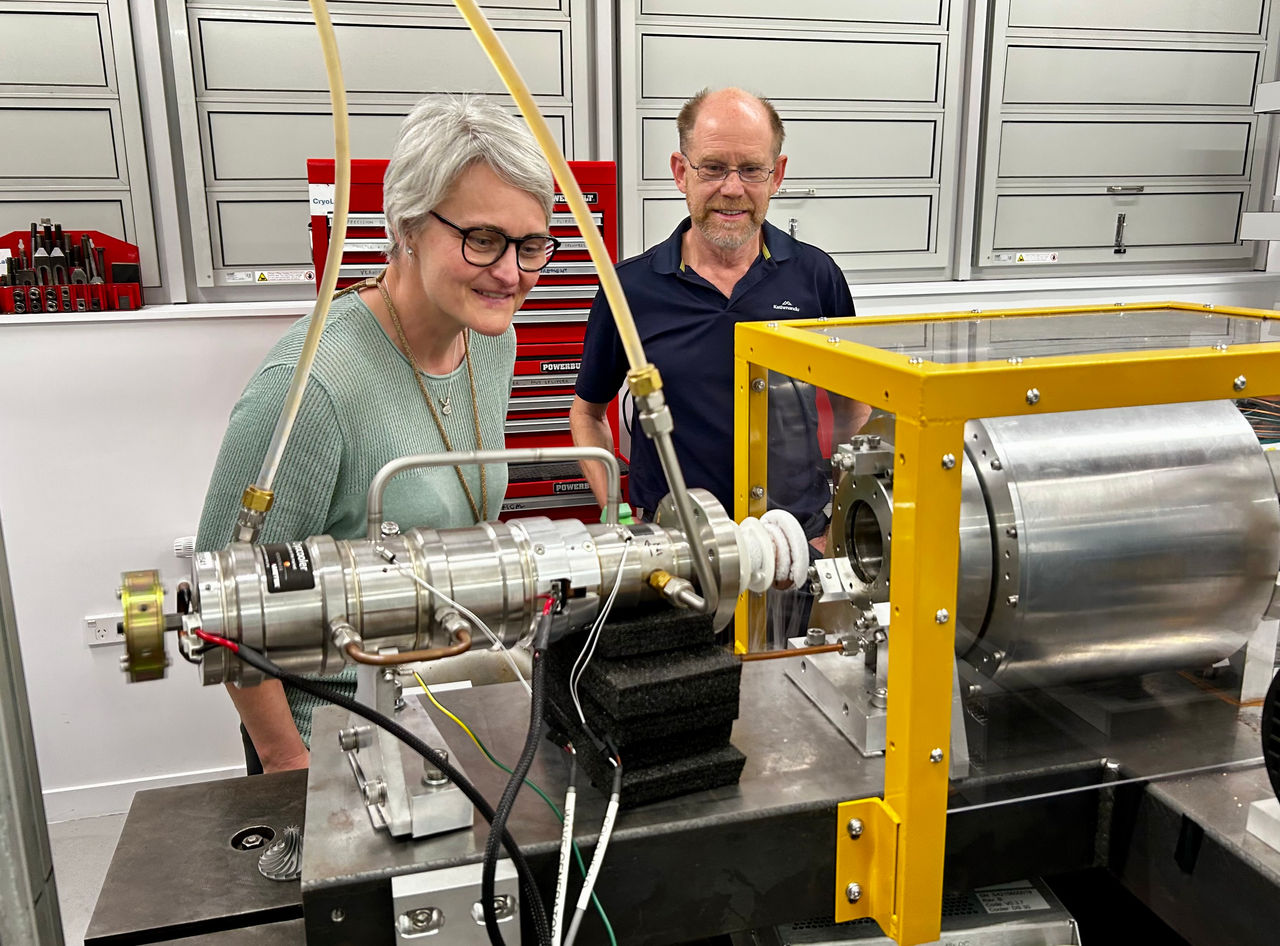


Photo caption: Professor Stefanie Gutschmidt, Head of UC’s Department of Mechanical Engineering, and UC Principal Researcher Dr Alan Caughley run the cyrocooler technology in the new CryoLab.
Opening this afternoon [3 December] in Te Whare Wānanga o Waitaha | University of Canterbury’s Department of Mechanical Engineering, the CryoLab will become Aotearoa New Zealand’s only research group combining cutting-edge cryogenic refrigeration research and development as well as consulting to industry in cryogenics, fluids and thermodynamics. University of Canterbury (UC) Principal Researcher Dr Alan Caughley will give a presentation at the opening, ‘At the Cryo-Tech Frontier’, and guests will then tour the new lab facilities.
Following the disestablishment of Callaghan Innovation’s Christchurch-based cryogenics operations, UC has provided a new home for the CryoLab team and its specialised equipment. The facility will support consulting for industry requirements and research opportunities for master’s and PhD students.
“CryoLab represents a powerful opportunity for collaboration between academia and industry,” Professor Stefanie Gutschmidt, Head of UC’s Mechanical Engineering Department, says. “The expertise of our researchers, combined with strong partnerships across the engineering and aerospace sectors, means we can accelerate innovation in areas that matter for Aotearoa and the world. We’re proud to provide a permanent home for this highly specialised capability.
”Cryogenics is a key enabler for technologies that rely on extremely low temperatures, including MRI scanners, superconductors, night-vision systems, low-noise sensors, satellites, space telescopes, biological storage, quantum computing and cryogenic fuels such as liquefied natural gas and liquid hydrogen — an emerging sustainable aviation fuel that must also be cooled to temperatures below –250°C.”
Much of this work is made possible by cryocoolers: small-scale mechanical refrigerators that are enabling breakthroughs in aerospace, medical and sensing technologies.
CryoLab’s flagship research programme focuses on providing cooling for a superconducting motor intended to power electric aircraft. The motor aims to replace conventional jet engines, enabling major efficiency gains while working with liquid hydrogen as a clean fuel. This technology is significant for New Zealand’s growing aerospace sector and contributes to global efforts to electrify aviation.
Dr Alan Caughley, Principal Researcher at CryoLab says cryogenics underpins the development of other cutting-edge technologies. “Cryogenics has increasingly become part of high-tech conversations. Over the past few decades it has become a crucial enabler for superconductors, night-vision systems, low-noise sensors, satellites, space telescopes, biological storage and quantum computing — made possible through small-scale mechanical cryocoolers.
“In the early 2000s, our Christchurch cryogenics programme developed a mid-sized, mid-temperature cryogenic refrigerator robust enough to operate 24/7 in electrical power environments — technology that is now central to Christchurch-based company Fabrum’s cryogenics business. Our team later contributed to superconducting motor development for electric aviation.
“The new CryoLab at UC allows us to continue this trajectory, advancing the superconducting aircraft motor project and supporting a wide range of consulting work powered by our expertise in fluids, thermodynamics, and modelling.”
To find out more about cryogenics research at UC, contact alan.caughley@canterbury.ac.nz