


Menu

Wananga Landing
Profile image
Topic

Allyship

08 July 2026

Most of us have grown up in a world with limited awareness of rainbow identities and experiences, it’s understandable if you feel like you don't know everything about rainbow identities or how to support rainbow people in your life.


We are glad you have made your way to our allyship page and that you want to learn more! 

HOW TO APPLY

Rainbow Equity are here to support our rainbow communities at UC, which means that we are also available to support people to grow in their allyship. 

We have collated a bunch of helpful resources on this page that can support you in becoming an active ally for rainbow communities. If you can't find an answer to your pātai on this page you can get in contact with us at rainbow@canterbury.ac.nz and we can point you in the right direction. 

Cultural Understandings of Gender and Sexuality

Most of the things we see and hear about gender and sexuality in Aotearoa (New Zealand) are framed from a pākehā worldview. These understandings are often centred around a cisgender, binary, heteronormative understanding of identity. However, many other cultures around the world have acknowledged and, in many cases, celebrated gender and sexuality diversity as being an inherent part of the human experience since before colonisation. As a country within Te Moana nui a Kiwa (Pacific Ocean), there are several cultural understandings of gender and sexuality that are important for us to acknowledge, in particular Māori and Pacific peoples. Some of the key terms from these cultural understandings are below:

 
Takatāpui

A traditional Māori term meaning ‘intimate companion of the same sex’. It has been reclaimed to embrace all Māori who identify with diverse genders, sexualities and sex characteristics such as whakawāhine, tangata ira tāne, lesbian, gay, bisexual, trans, intersex and queer. All of these and more are included within Rainbow communities.


MVPFAFF+

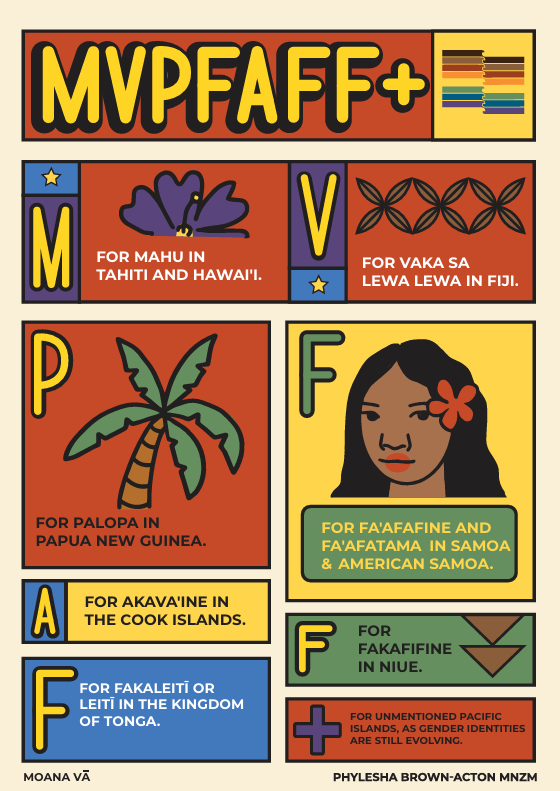
MVPFAFF+ was coined by Phylesha Brown-Acton, a Niuean fakafifine rainbow rights activist. In 2019, she was appointed a Member of the New Zealand Order of Merit to recognize her work with rainbow communities from the Pacific countries. She is the first Pacific trans woman to be recognised this way.

At the 2011 Asia-Pacific Outgames Human Rights Conference, she introduced, MVPFAFF+, as a Pacific community alternative to the LGBTQ+ acronym. MVPFAFF+ encompasses Mahu (Tahiti & Hawai’i), Vaka Sa Lewa Lewa (Fiji), Palopa (Papua New Guinea), Fa’afafine (Samoa & American Samoa), Akava’ine (Cook Islands), Favafinine (Niue), Fakaleitī or Leitī, and other Pacific rainbow identities.
Other Terminology

An umbrella term, like LGBTTQIA+ (lesbian, gay, bisexual, takatāpui, transgender, queer, intersex, asexual, and more), describing people of diverse sexualities, genders, and variations of sex characteristics. This term is sometimes used in place of LGBTTQIA+ in Aotearoa New Zealand.

A term referring to the gender or genders that a person is attracted to. A person's sexuality may also describe the type of or amount of attraction that that person feels. While specific sexuality-related terms are often dependent on the gender of the people involved, sexuality and gender are different concepts.

How a person expresses their sense of gender through their clothes, mannerisms, voice, pronouns, and other forms of expression. A person’s gender expression does not always align with their gender identity; sometimes as a part of self-expression, and sometimes out of safety or protection from being discriminated against.

How a person understands and describes their inner self, their experience, and their role within their social and cultural context. We are assumed to be a particular sex/gender at birth based on our sex characteristics, however not everyone’s sex or gender is the same as that which was assumed. Gender is understood differently across cultures and throughout history.

Someone whose gender is not the same as what was assumed at birth (e.g., a person who was assumed to be a boy at birth but is actually a girl, non-binary, etc.). This term includes people with binary (trans man, trans woman) and non-binary (genderfluid, genderqueer, etc.) genders. Not all people with this experience will use the term ‘trans’ to describe themself.

An umbrella term used to collectively describe a diverse range of genders other than cisgender, including transgender, non-binary, and culturally specific genders. 

A term used to describe people whose gender is outside of the 'binary' of boy/man or girl/woman. Non-binary can be used to describe a person's gender, or as an umbrella term for a number of genders that are beyond the binary. Since non-binary people have a gender that is different from what was assumed at birth, they fall under the umbrella of ‘trans’, though not every non-binary person will use this term to describe themself. 

Describes someone whose gender is the same as the gender that was assumed for them when they were born (i.e. not trans or non-binary).

A term used to describe a person born with an innate variation of sex characteristics such as chromosomes, reproductive anatomy, genitals, and hormones. People are born with these variations, or they may develop during puberty. There are 40 known intersex variations. Though the word intersex describes a range of natural body variations, many people will not identify with, or know, this term or related terms.

A person who is born without variations of sex characteristics, whose body aligns with normative medical understandings of a male or female body (ie. not intersex).

Resources and Support

Click any of the tiles below to visit the respective webpage:


Rainbow Equity Resouce for Allies


Check out our 'The Basics' zine to learn some rainbow terminology and places to find support and community in Ōtautahi.


The Basics Zine

Download (application/pdf, 21 MB)
Download
Privacy Preferences

By clicking "Accept All Cookies", you agree to the storing of cookies on your device to enhance site navigation, analyse site usage, and assist in our marketing efforts.
