

Menu

Wananga Landing
Profile image
Wananga Landing
Topic

X-ray Diffraction (XRD)

26 February 2026

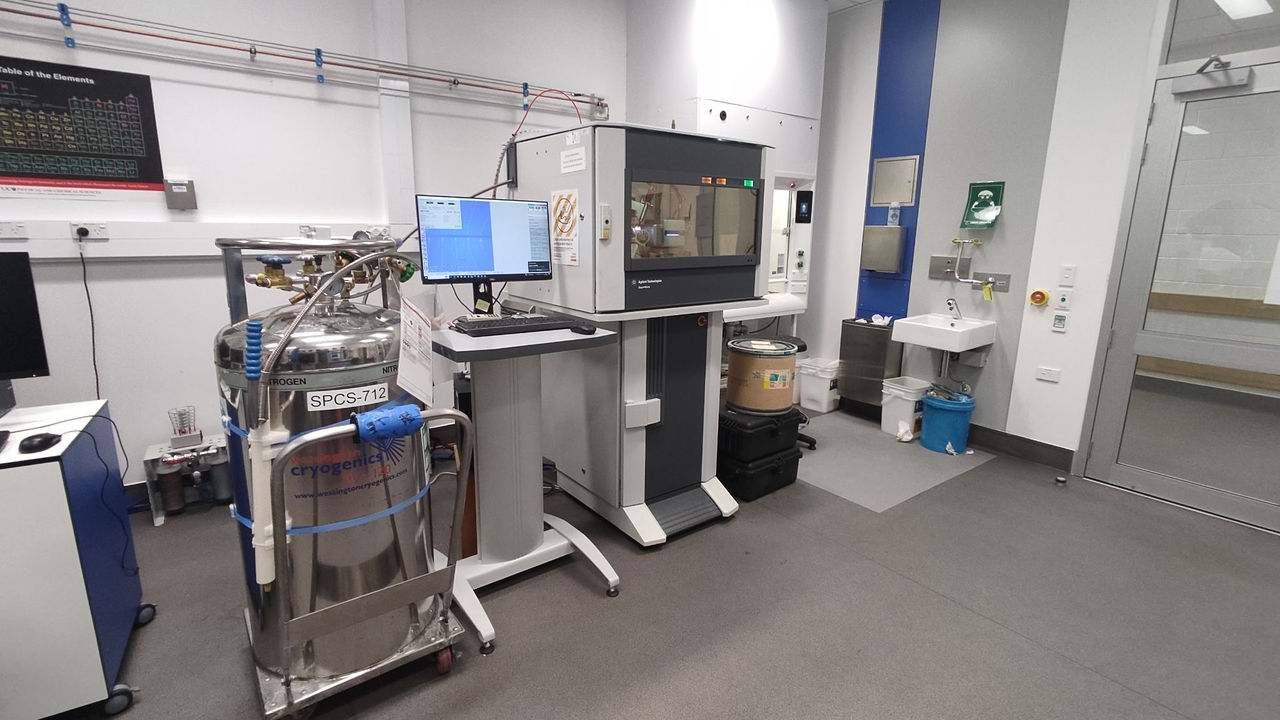
When it comes to understanding the atomic and crystalline structure of materials, there is no substitute for the sharp clarity of X-ray Diffraction (XRD).

HOW TO APPLY

When it comes to understanding the atomic and crystalline structure of materials, there is no substitute for the sharp clarity of X-ray Diffraction (XRD).

XRD probes deep into the material, revealing structural and composition characteristics of ordered materials in the form of bulk samples, powder or thin films.

Complementary techniques such as X-ray reflection (XRR) and Small Angle X- ray Scattering (SAXS), available at our facilities, can be used to obtain further information on thickness, density and coherence lengths of crystalline and amorphous thin films, and provide unique insights into porous systems.

Our advanced XRD services offer unmatched insight into material composition, phase identification, crystallinity, strain, and much more, making it an  indispensable tool in academic research and across industries from pharmaceuticals to metallurgy.

Whether you are developing innovative materials, validating synthesis or manufacturing processes, or troubleshooting product inconsistencies, our state-of-the-art XRD facilities provide rapid, reliable, and reproducible results. XRD reveals what’s beneath the surface—because the structure tells the story.

Applications

XRD is a cornerstone in a wide variety of fields: from materials science and pharmaceuticals, to mining, geology and metallurgy.

The technique typically probes deep into the material, allowing to identify crystal structures and determine lattice parameters and structural strain, enabling the analysis of phase composition and tracking transitions under varying temperature or pressure conditions, contributing to the unveiling of polymorphisms in pharmaceutics and studying multiple aspects of thin films and coatings.

XRD is especially vital in geology, metallurgy, chemistry, solid-state physics, and nanotechnology, where understanding atomic arrangements is key to innovation.

Energy

Analysis of battery materials, fuel cells and solar cell components, including their core mono- and poly-crystalline substrates.

PHARMACEUTICAL

Exploring crystallographic characteristics and ensuring correct polymorphs for drug efficacy and regulatory approval.

SOLID STATE

Crucial for evaluating crystalline structure, strain, orientation, defects and thickness and density of thin and ultra-thin films.

MINING & GEOLOGY

Identifying mineral phases and quantifying ore content. Analysis of phase transitions with temperature and pressure.

Privacy Preferences

By clicking "Accept All Cookies", you agree to the storing of cookies on your device to enhance site navigation, analyse site usage, and assist in our marketing efforts.