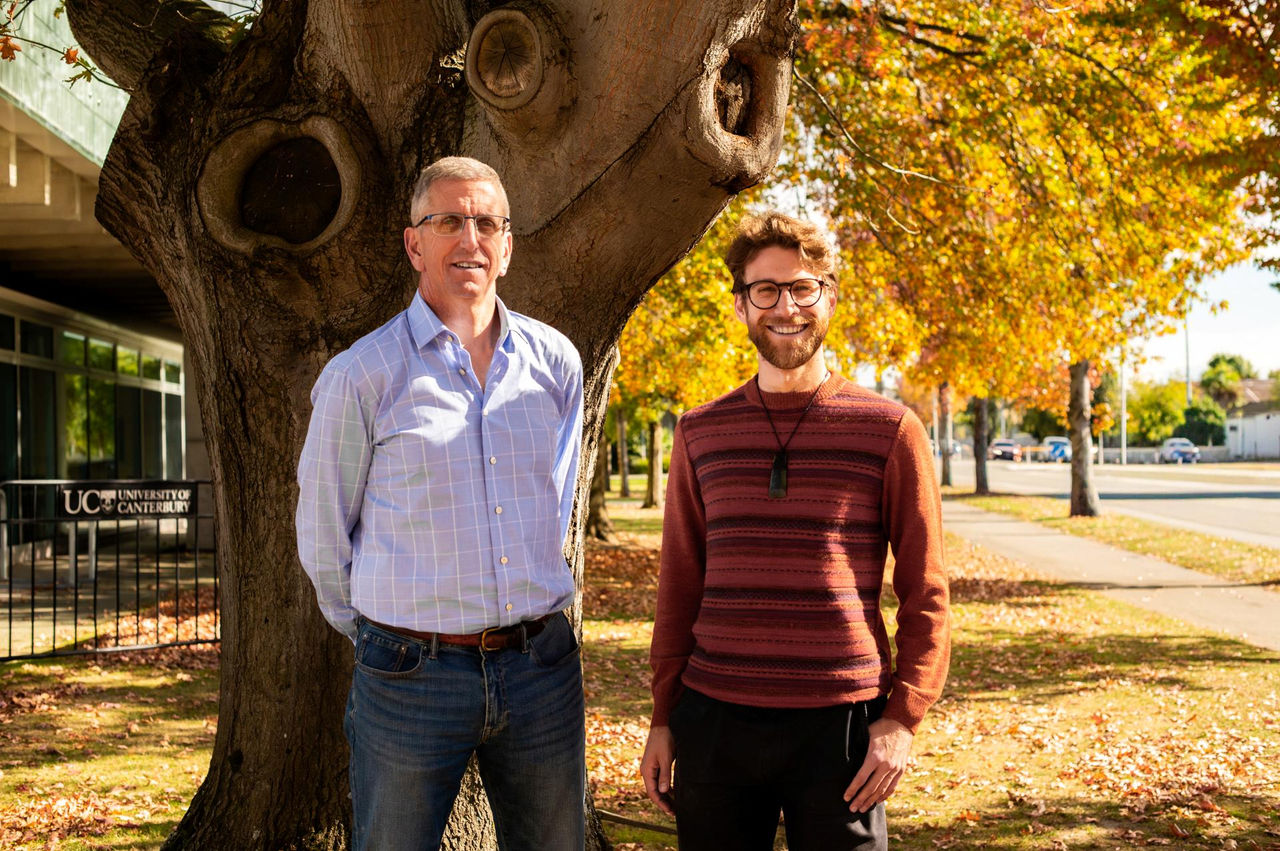


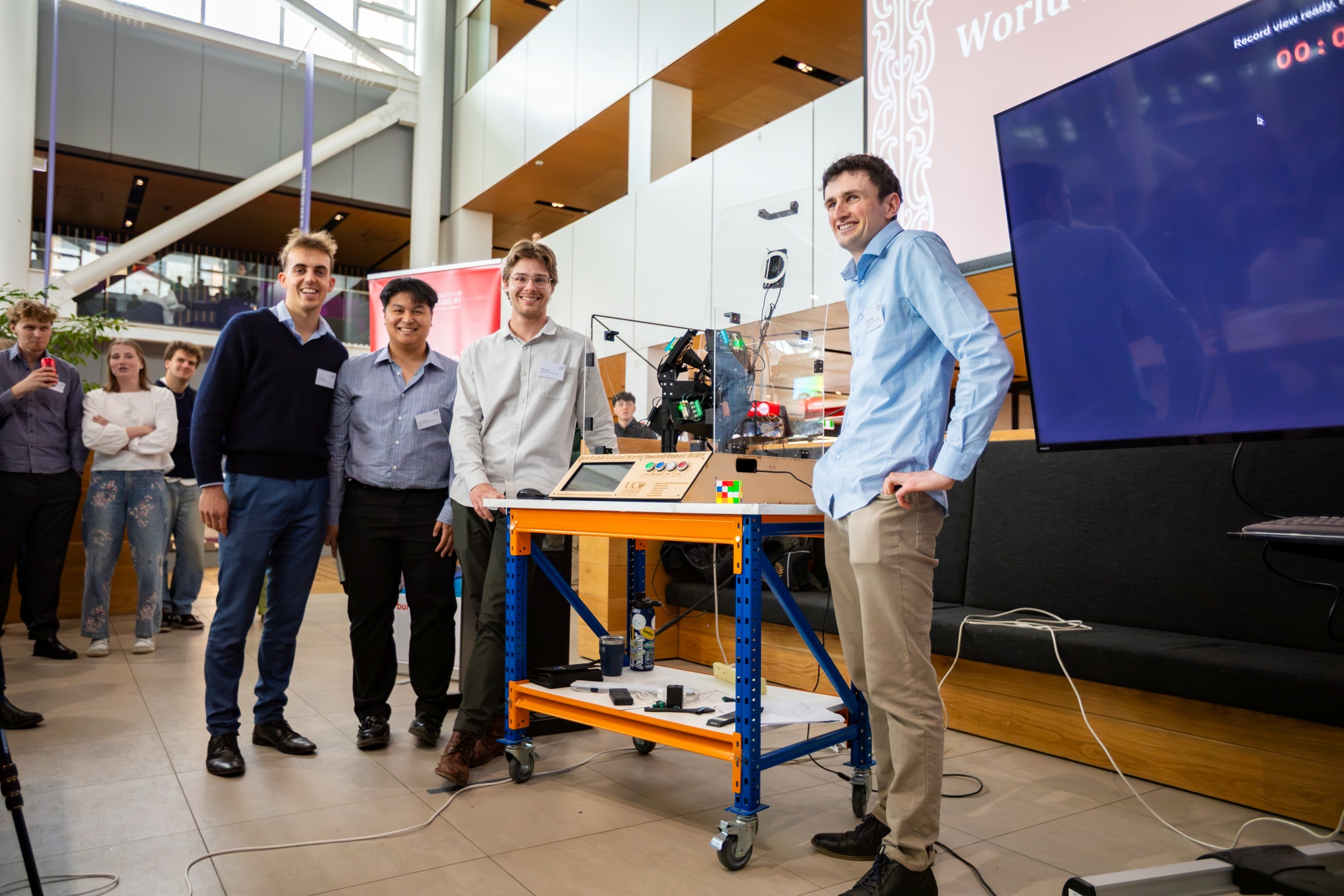
Main photo: Distinguished Professor Geoff Chase (left) and his 100th PhD student, Nicolas Davey.
Over more than two decades at Te Whare Wānanga o Waitaha | University of Canterbury (UC), the Mechanical Engineering Professor has built a global network of researchers, innovators and industry leaders whose work now spans universities, research institutes and technology companies around the world.
Distinguished Professor Chase began supervising PhD students shortly after joining UC in 2000. His first doctoral student graduated in 2003, and since then he has averaged more than four PhD completions each year – an extraordinary pace sustained over more than two decades.
While the number itself is impressive, Distinguished Professor Chase says what matters most to him is the depth of the mentoring relationship. The 100 milestone includes only students he has worked closely with – collaborating on research papers, editing theses and supporting them throughout their doctoral journey.
“For me, supervision has always been about engagement. These are people I’ve worked alongside in the lab, written papers with and helped guide through their research careers,” Distinguished Professor Chase says.
PhD student Nicolas Davey, who will become Distinguished Professor Chase’s 100th doctoral graduate when he defends his thesis this week, says the milestone reflects the care and commitment he brings to every student.
“This is so deserved for Geoff. He’s always working to make sure we succeed, and even with so many students, he makes sure we’re all taken care of,” Davey says.
“I once sent him three thesis chapters in the early hours of the morning, and by mid-afternoon they were all reviewed and back to me. That level of support is incredible.
“He also strikes a great balance, staying close enough to know we’re on the right track, while giving space for post-docs to step up and develop as supervisors and leaders themselves. It’s been a privilege to be part of this research community.”
Many of Distinguished Professor Chase’s PhD graduates have built successful careers in academia, while others have moved into industry leadership or founded startups translating research into real-world impact. Several former PhD students are now academics at UC themselves, continuing the cycle of mentorship and research.
Former student and now UC colleague Professor Geoff Rodgers says Distinguished Professor Chase’s influence goes far beyond traditional supervision.
“Geoff has an incredible ability to challenge students while giving them the freedom to explore their own ideas,” Dr Rodgers says. “He doesn’t just supervise research – he helps shape independent thinkers who go on to build their own careers and research programmes.
“Many of us who trained under him still collaborate with him years later. That kind of mentorship is rare.”
Distinguished Professor Chase’s supervision style reflects a philosophy built around curiosity, independence and shared values. Rather than placing students into narrow research projects, he encourages them to follow where the science leads, which often results in unexpected discoveries and new research directions.
“If students are motivated and curious, the rest tends to follow,” he says. “My job is to create the environment where they can do their best work.”
Over time, those collaborations have extended well beyond UC’s campus. Former students are now based across Europe, Asia and North America, and Professor Chase continues to work with many of them on new research projects and publications.
That ongoing collaboration has created what he jokingly refers to as a growing family tree of “academic grandchildren” – students supervised by his former students, some of whom he co-supervises.
Even as he approaches the milestone of 100 PhD supervision completions, Distinguished Professor Chase shows no signs of slowing down. He currently supervises more than a dozen doctoral candidates and expects many more to join his research group in the coming years.
For him, the milestone is less about reaching a round number and more about the people behind it.
“The most rewarding part is seeing what students go on to achieve,” he says. “When they succeed, the impact of that research spreads far beyond any one lab or university.”

.png)