

Published in the journal Nature Scientific Data, the dataset provides publicly available projections of energy demand across three major sectors — electricity, heating and transport — under multiple future scenarios.
Lead author Rafaella Canessa, who will soon defend her PhD at Te Whare Wānanga o Waitaha | University of Canterbury (UC) and is now a postdoctoral researcher at ETH Zurich's Research Center for Energy Networks, says the work fills a critical gap in national energy planning.
“Reaching net zero is not only about expanding renewable energy supply, but also about how energy is used across homes, transport and industry,” she says.
“Our research presents a nationwide energy-demand dataset for New Zealand to 2050 across five transition pathways. The dataset provides regional detail for solid, liquid and gaseous fuels, including fossil, bio-based and synthetic carriers, and hourly resolution for electricity demand across sectors.”
The work provides a foundation for modelling New Zealand’s future net-zero energy system, Canessa says. “At UC’s Sustainable Energy Research Group (SERG), we are building on this dataset with deeper demand-side analyses and full energy-system optimisation, including the required electricity generation capacity and synthetic fuel production needed to achieve net zero.”
New Zealand’s shift toward electrification — including electric vehicles, heat pumps and new industrial demand — is expected to reshape the country’s energy system over coming decades.
Until now, there has been limited open data combining hourly demand patterns, regional differences, multiple sectors beyond electricity, and long-term projections to 2050.
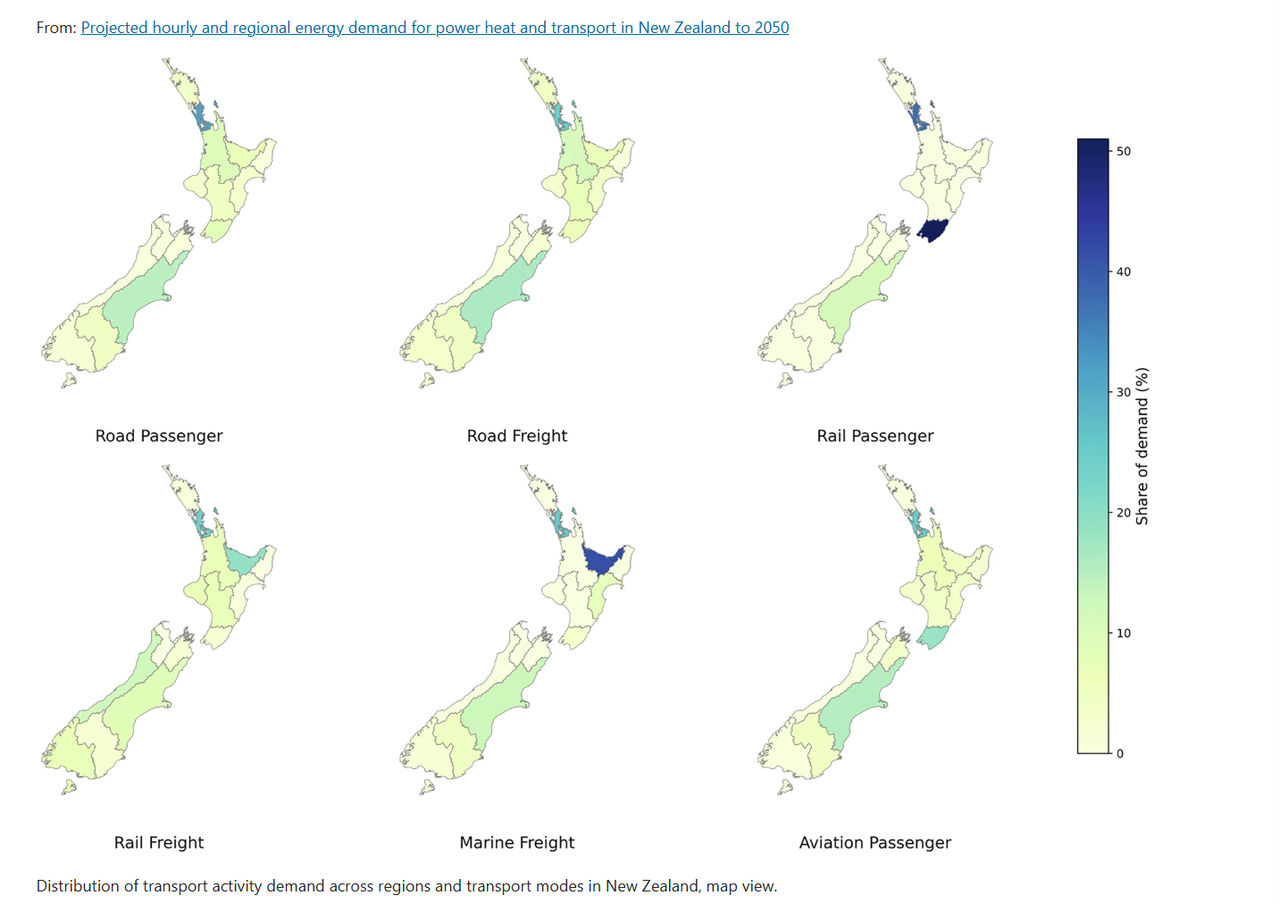
The dataset is designed for broad reuse and highlights several important trends: transport and heating transitions are expected to play a major role in shaping future energy use; hour-by-hour modelling shows how future demand peaks could change, with implications for grid resilience and renewable integration; energy demand pathways vary across New Zealand’s regions; and increased electrification in transport and heat may progressively shift demand onto the electricity system.
UC project supervisor and co-lead of SERG, Dr Rebecca Peer, says the research strengthens understanding of future energy needs.
“This work helps contribute to our understanding of what our future energy needs might be. This is important for planning our future energy system and understanding different pathways to meet our net-zero commitments.
The main technical challenge was turning big-picture energy transition plans into detailed data that computer models can use, Dr Peer says. This meant combining national and regional data, modelling how different fuels and technologies might change over time, and making sure every scenario was internally consistent.
The dataset is published as a Data Descriptor article in Scientific Data, part of the Nature Portfolio, and is freely available for reuse.




.png)