

Te Whare Wānanga o Waitaha | University of Canterbury (UC) botanist Professor Pieter Pelser has been recognised with one of the highest honours in taxonomy, with a newly established South American daisy genus named Pelseria in acknowledgement of his decades-long contribution to studying the family tree of plants.
Professor Pelser’s research found that a plant species long classified within the large and complex Senecio genus had in fact evolved along a distinct evolutionary pathway.
“Back in 2007, our team discovered that this species did not belong to the genus Senecio but needed to be placed in a different or new genus,” Professor Pelser says.
At the time, Professor Pelser’s work was based on DNA evidence, but researchers from Argentina have now confirmed his conclusion using non-molecular data, specifically the shape of its leaves, pollen, grains and anthers.
“These researchers decided there is indeed enough evidence to place the species in a new genus. They named it Pelseria to acknowledge my previous research and wider contributions to improving our understanding of the family tree of the Senecioneae,” he says.
Despite the honour, Professor Pelser has never seen Pelseria growing in the wild.
“I have never seen it alive myself,” he says. “In 2007, all I had to work with was a dried and preserved plant specimen.”
While new species are named regularly, the recognition of a new genus is far less common.
“It is a great honour to have a species named after you, and an even greater privilege if a genus carries your name,” Professor Pelser says.
Professor Pelser also has a Philippine orchid species named in his honour — Bulbophyllum pelseri — while his wife Dr Julie Barcelona, a research fellow at UC, is also recognised with as many as three species names. These species were named to acknowledge their scientific contributions in plant biology in the Philippines through their Co’s Digital Flora of the Philippines website and associated citizen science project.
The daisy species now known as Pelseria otites was not newly discovered; it was previously known as Senecio otites and is relatively widespread, growing from 600 to 1300 metres in elevation in southern Argentina and Chile.
Senecioneae is a large and complex group within the daisy family, one of the biggest plant families in the world. Knowledge of this family is constantly evolving as new molecular tools allow scientists to reassess long-held classifications, which leads to changes in plant names and even groupings.
“As technology improves, particularly in molecular biology, we can see more clearly how plants are related and how they have evolved,” Professor Pelser says. “The names and classification of species, genera and larger groups of species aim to communicate their evolutionary relationships, so names need to change as our knowledge of evolutionary history changes.”
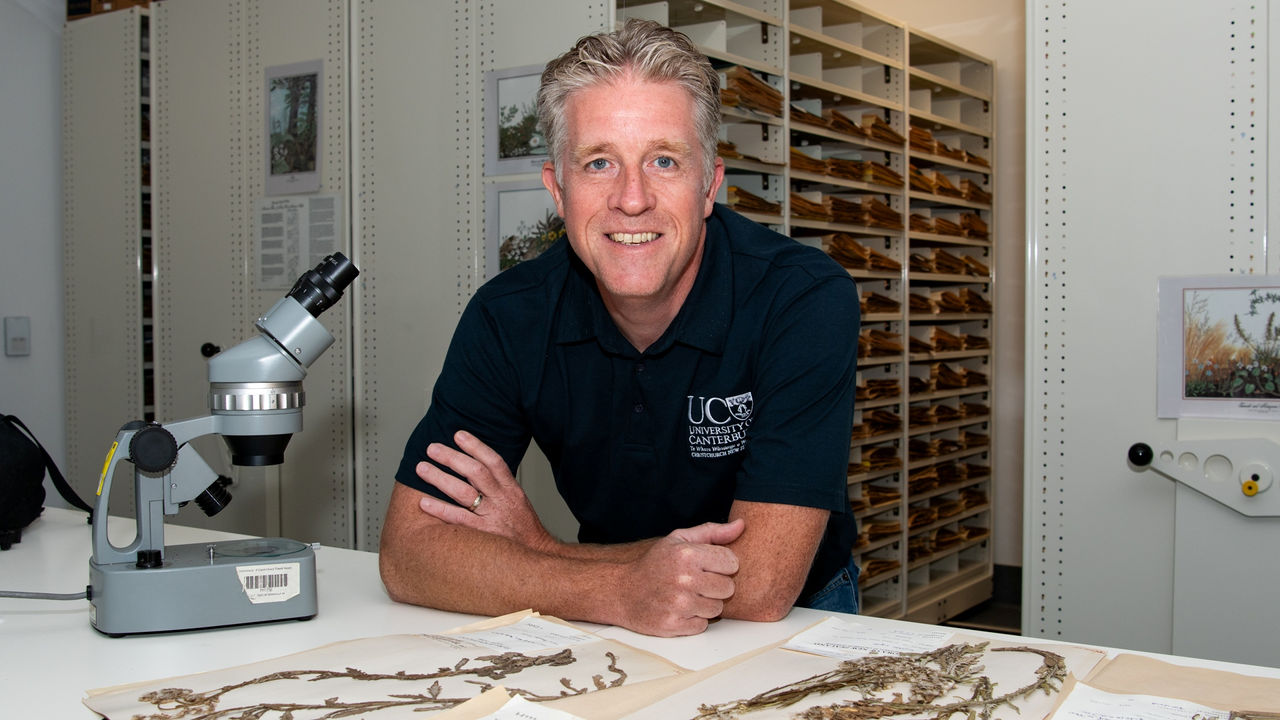
The work highlights the enduring importance of herbaria — collections of preserved plant specimens — which allow scientists to revisit material collected decades ago and apply new techniques to long-standing questions.
“Most of this work happens in the herbarium,” says Professor Pelser who is also Curator of UC’s Herbarium. “They’re not just collections — they’re repositories of scientific data that help us understand biodiversity, track changes over time, and ultimately protect species.”
Just this month, Professor Pelser contributed to the discovery of two new Philippine species – a species of Amorphophallus (a foul-smelling ‘corpse flower’) and a new species of Medinilla (a genus containing popular ornamental plants).

.png)