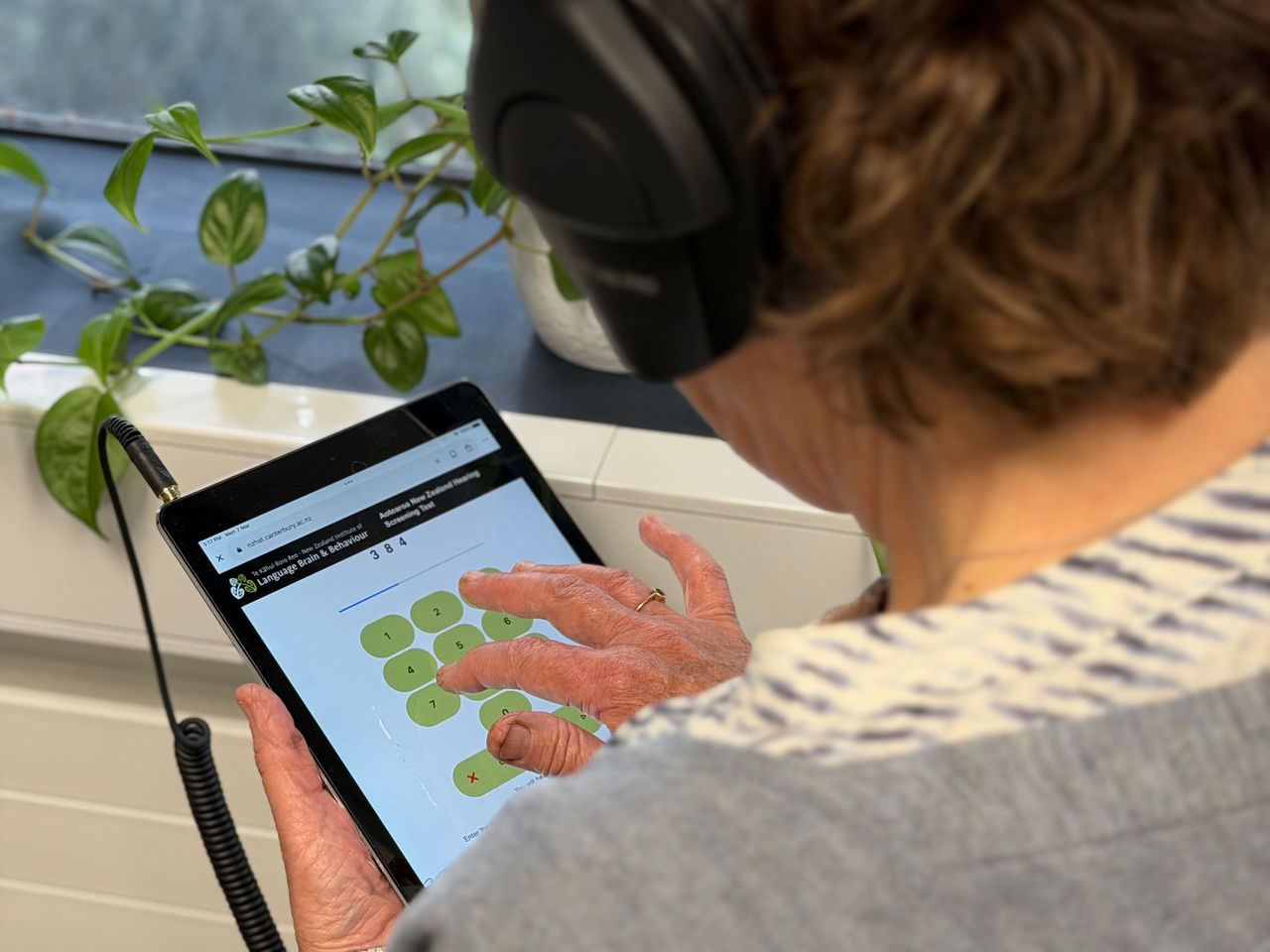


Photo caption: Hearing self-tests are now available in te reo Māori as well as New Zealand English, and can be used to screen hearing at home using a phone, computer or ipad, and headphones.
The self-tests, developed by a team led by Professor Greg O’Beirne from the New Zealand Institute of Language, Brain and Behaviour, and Dr Jennifer Smith (Ngāti Whātua, Ngāpuhi) from Te Kāhui Pā Harakeke | The Child Wellbeing Research Institute at UC, allow people to screen their hearing in te reo Māori in the comfort of their own home using a phone, tablet or computer.
The New Zealand English version of the test, which has been available for about a decade, has also been updated and improved. Both tests are designed as guides to let people know whether they should get a full hearing check by an audiologist.
Professor O’Beirne, from UC’s School of Psychology, Speech and Hearing, says people who suspect they have hearing loss often wait several years before finally going to see a professional.
“Having these self-tests available for people reduces that time and allows them to get help faster. The results are a very good guide as to whether they need to see a professional audiologist for a full hearing test and treatment.”
Being able to communicate well is an important part of healthy aging and supports both cognitive and social wellbeing, so seeking help sooner rather than later is important, Professor O’Beirne says.
People curious about their hearing can visit nzhst.canterbury.ac.nz to sit the test, which takes about four or five minutes, and only requires headphones and a quiet place. This is half the time the previous New Zealand English self-tests took.
The test involves listening to sets of three numbers presented with background noise. Trouble hearing voices against background noise is often one of the first signs of hearing loss, Professor O’Beirne says.
“The updated test assesses both ears at once so takes half the time of the old one, and it is also sensitive to more types of hearing loss than the previous versions were.”
The Māori version of the test has been used for research purposes at UC for many years, but this is the first time it has been available to the public. Dr Smith says it has been validated in the community using kaupapa Māori methodology by Māori and non-Māori audiology students at UC using a He Awa Whiria (or “braided rivers”) model, weaving together mātauranga Māori and Western biomedical science.
“It’s meeting the needs of people who want to be tested in their own language. We’re seeing more and more interest from te reo speakers, and our trials have been really positive,” she says. “People have been really excited by having the test available and have said they would recommend it to their friends.”
.png)