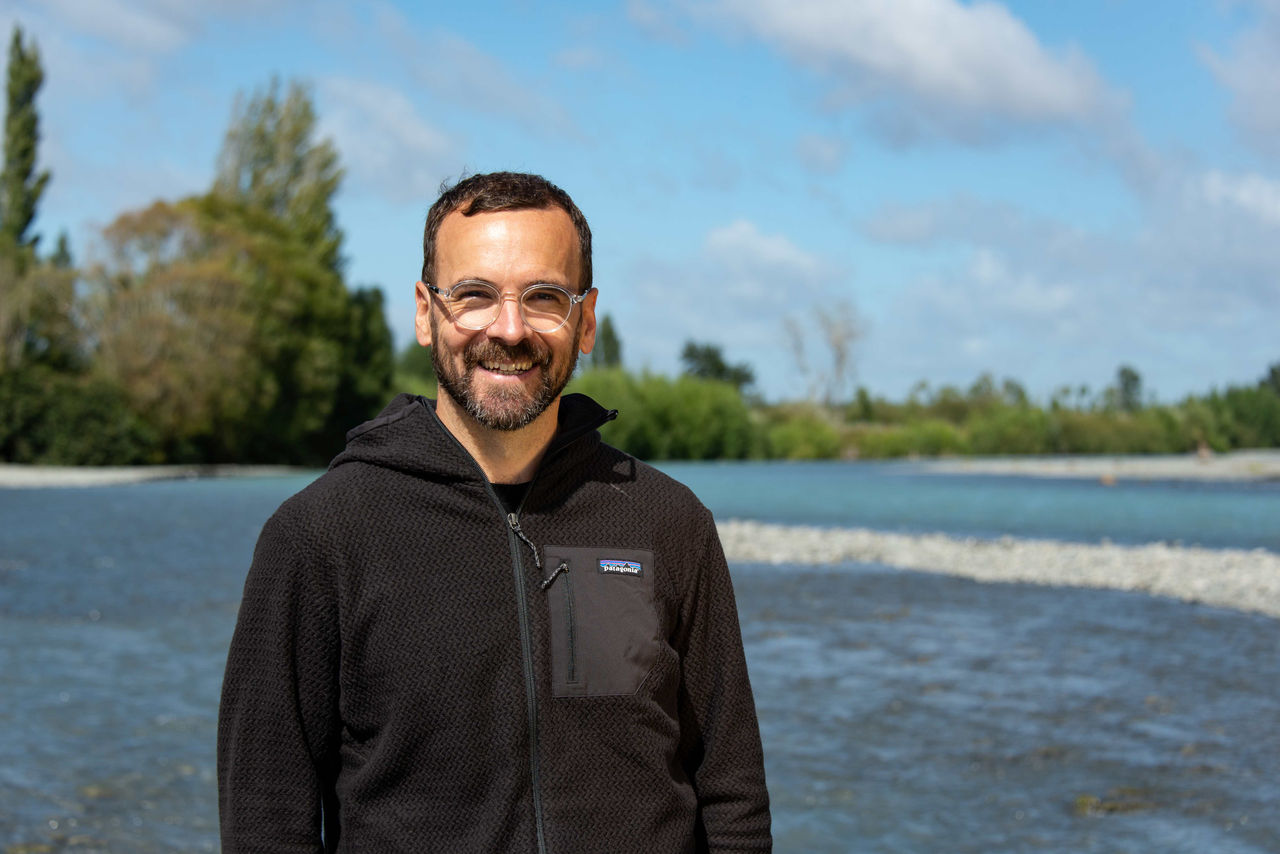


A new global review paper, led by Te Whare Wananga o Waitaha | University of Canterbury’s (UC) Professor Jonathan Tonkin, highlights the need for shifting management strategies from local, reactive interventions to catchment-scale, resilience-focused approaches.
The review paper ‘Extreme events and river biodiversity under climate change’ published in Nature Reviews Biodiversity yesterday, explores how extreme climatic events (ECEs) including floods, droughts and heatwaves are increasing in severity and frequency, fundamentally reshaping riverine ecosystems, and what can be done to adequately prepare for increasing and compounding ECEs.
Professor Tonkin says the research points to a shift away from reactive, local fixes towards proactive, catchment-scale strategies that build river resilience, including nature-based solutions that restore habitats at large scales and reconnect floodplains, improving monitoring and forecasting, and giving rivers “room to move” — an approach he has also explored in previous research, which argues that allowing rivers more space to behave naturally can reduce flood risk while also supporting biodiversity.
“It becomes more of a win-win solution for both biodiversity and society because we give them more capacity to flood into, but we also give them the capacity to act more like a natural ecosystem, creating diverse habitats, cycling nutrients and sustaining life,” Professor Tonkin says.
Professor Tonkin says freshwater biodiversity is declining at a greater rate than in the world’s oceans or on land, placing river ecosystems among the most at risk under climate change.
“Rivers are central to our society. We get food and clean drinking water from them, we use the water for irrigation, energy generation and recreation – they're important providers of ecosystem services,” Professor Tonkin says.
ECEs can affect rivers at every level, from eroding genetic diversity and reducing species populations to causing local extinctions, reshaping river communities and disrupting essential functions such as filtering water and processing nutrients, Professor Tonkin says.
“We live on their boundaries and we're very much at the mercy of them becoming more extreme. So we're also faced with this challenge of thinking how we live with them in a future that's going to be more extreme?
“When individual events combine into multiple events, or compound events, that's when the impacts become really bad, because it might be that as things are recovering from the first event, they get hit again.”
“We can't focus purely on restoring to historical conditions. What we'll be seeing in the future are completely different conditions, so we have to do things that we know are helping the system become more resilient.”
The review also points to emerging decision-support frameworks, such as the Resist–Accept–Direct approach, to help river managers decide when to resist change and protect ecosystems, when to accept unavoidable shifts, and where to actively direct rivers towards more resilient future states.
Professor Tonkin says ECEs are pushing both the resilience of river ecosystems and the ability to manage them to the limit and more research is required to better understand how rivers respond to these shocks, particularly the growing risk of compound events and the feedback between extreme weather, river flows, habitat change and biodiversity resilience.
Professor Tonkin says studying the events is difficult because they often strike without warning, leaving little chance to capture before-and-after data. He argues that far more frequent and long-term monitoring, at least seasonal sampling of river communities rather than the current annual collection, would be needed to properly understand and anticipate their impacts.



.png)