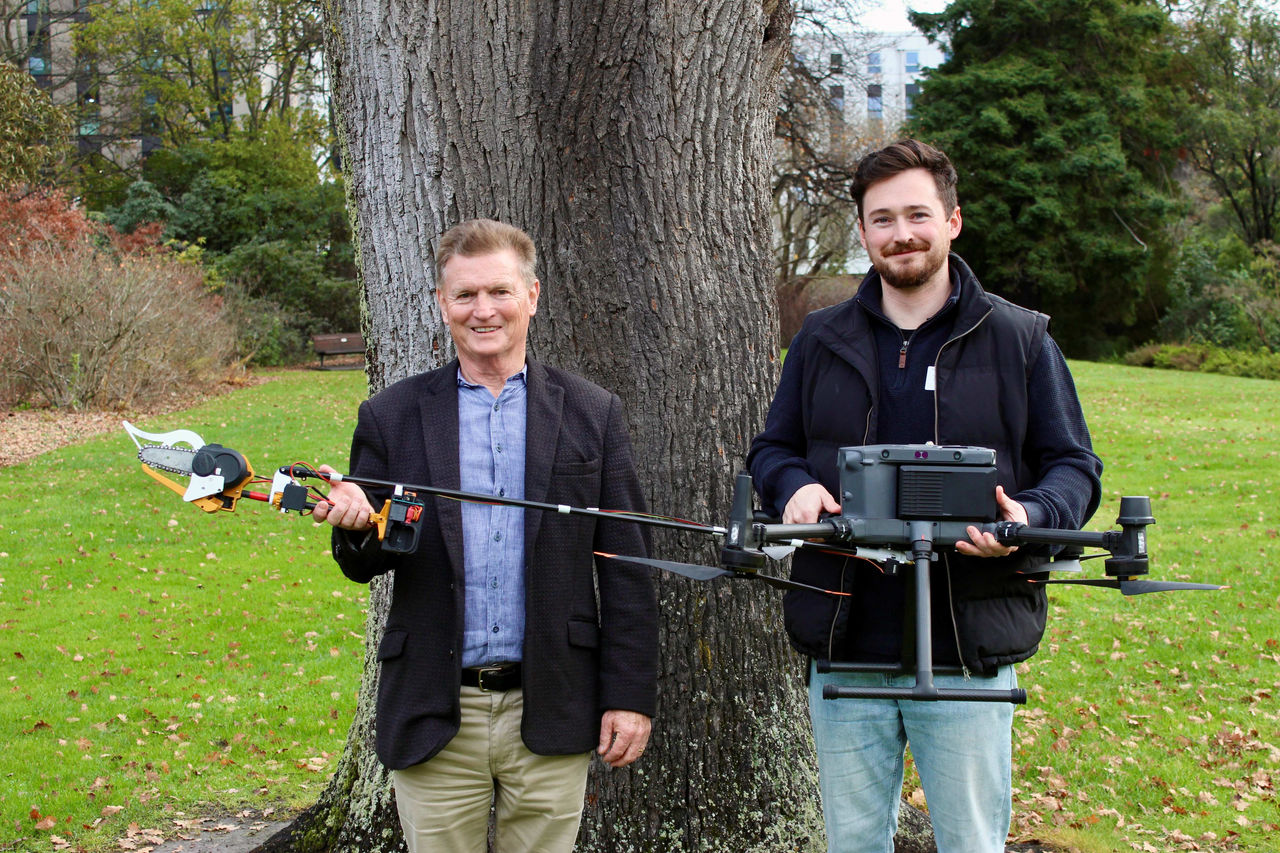


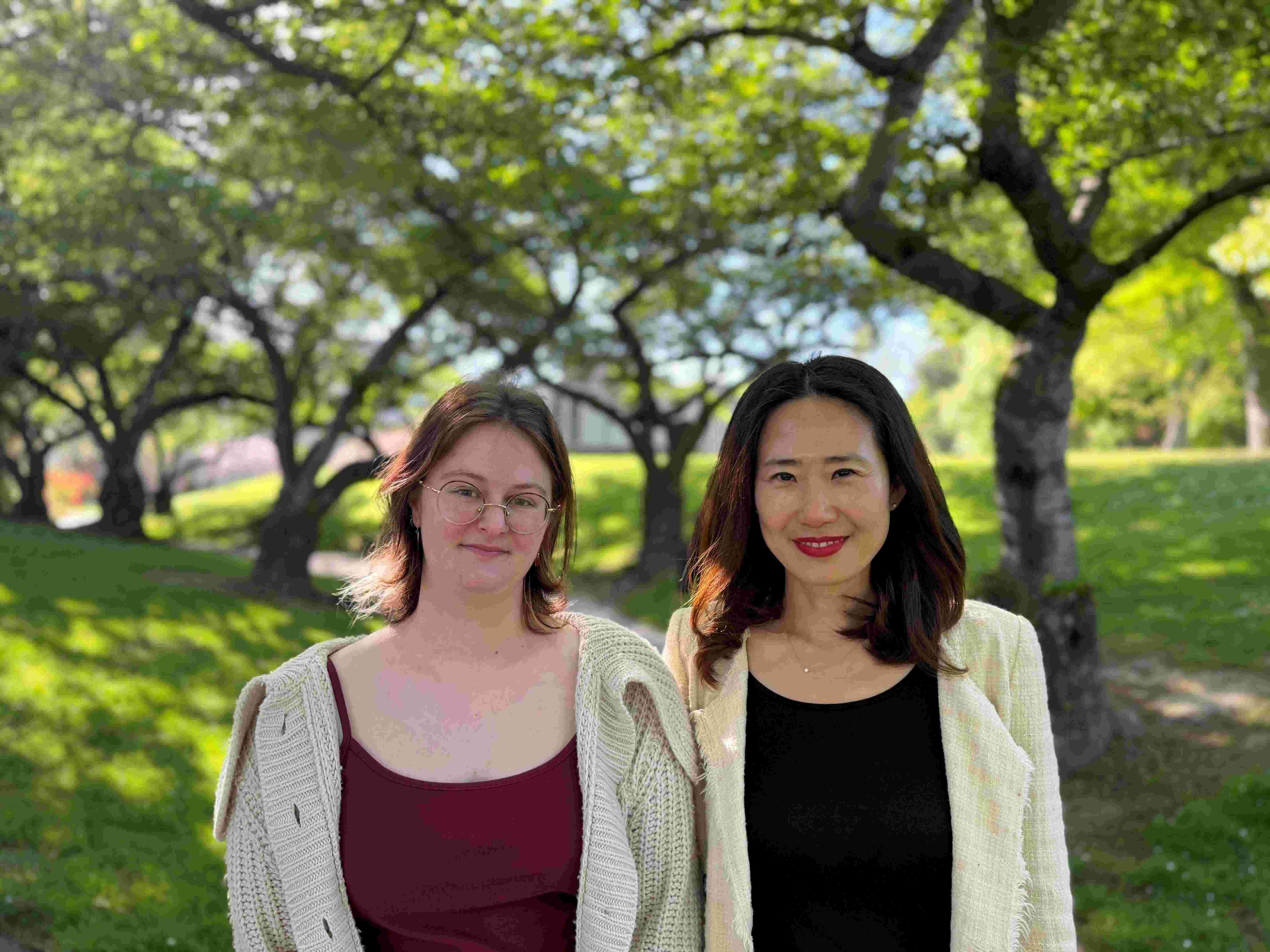
Photo caption: Professor Richard Green and Dr Sam Schofield with the new chainsaw drone they’ve developed as part of the UC Vision research team project.
Te Whare Wānanga o Waitaha | University of Canterbury (UC) research team UC Vision has spent the last eight years developing unmanned aerial vehicles (UAVs or drones) that can use precise tools in complex, dynamic environments.
Led by UC Computer Science Professor Richard Green and UC Mechanical Engineering Professor Dan Zhao, the team demonstrated their prototype chainsaw drone to industry representatives yesterday.
Professor Green says the new drone is a breakthrough with potential to make trimming trees around power lines and pylons safer and more efficient without the need for ladders and scaffolding.
“Last year we developed a drone that was capable of carrying a pruning tool, but we’ve refined and adapted the technology to attach a chainsaw that allows thicker branches to be cut.
“We believe this tool will be transformative across a range of different industries where jobs are inaccessible and hazardous for humans, making them safer, more cost-effective and more efficient. This includes arboriculture, electricity infrastructure industry and civil construction.”
The technological challenges of the project included accurate estimation of the drone’s motion and the branch it is going to cut, as well as achieving the aerodynamics and precise control required for the drone to cut branches autonomously in a wide range of dynamic environments, Professor Green says.
Other researchers involved in the project, funded over five years by a $10 million grant from the Ministry of Business, Innovation and Employment, include UC Senior Research Engineer and UAV expert Dr Sam Schofield and University of Auckland Mechanical Engineering Professor Karl Stol.
The team is working in collaboration with a number of Kiwi UAV experts, international researchers, and UAV manufacturers and users. Professor Green hopes to have the chainsaw drone ready for commercialisation next year.


What to read next
Are Kiwi businesses jumping blindly on the AI bandwagon?
AI doesn’t have to play an inevitably dominant role in our lives, businesses and future, argues a guest speaker for an upcoming UC public lecture.

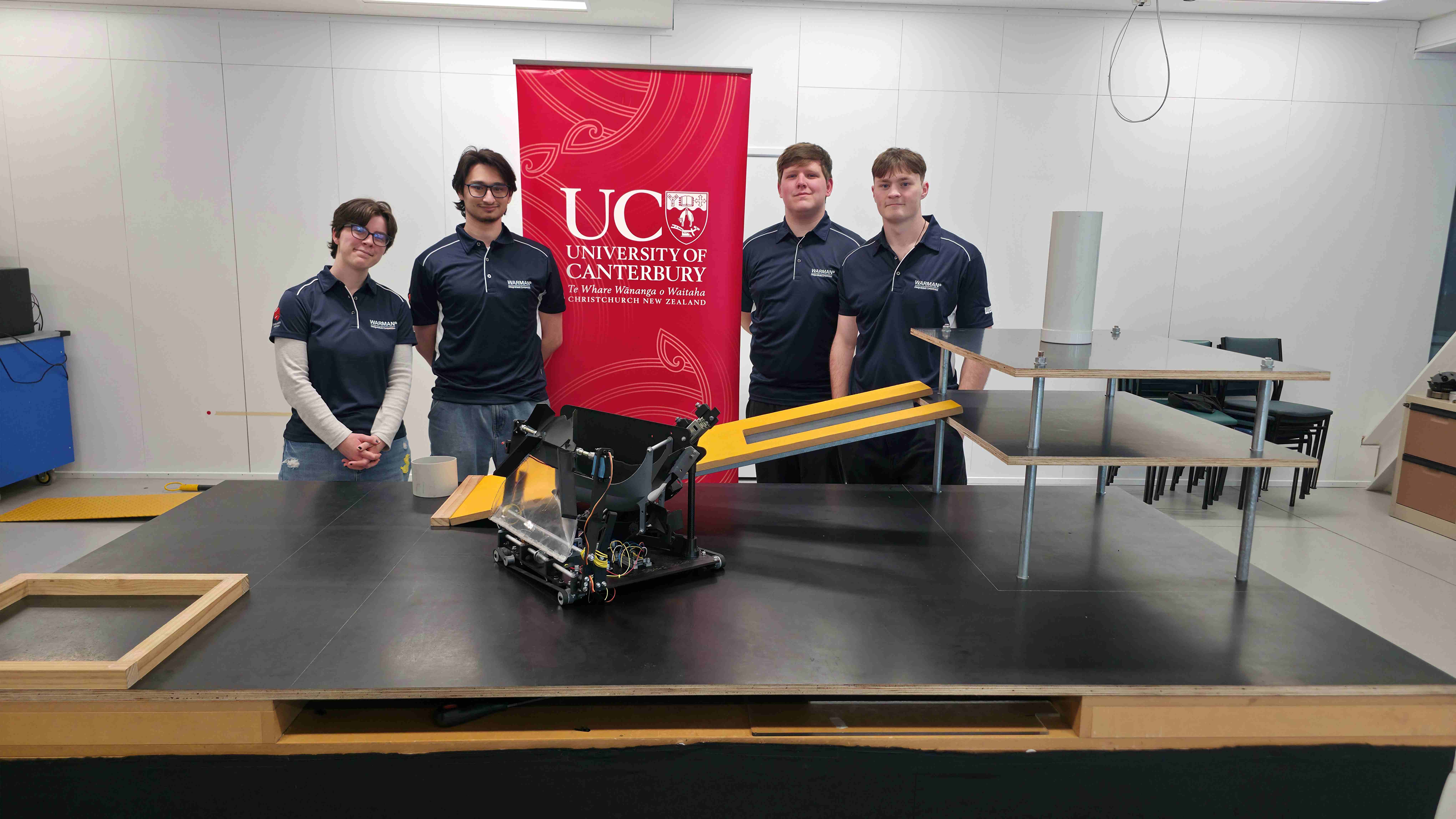
UC engineering students win international competition
A robot designed to transport rocks automatically has helped four UC engineering students claim an international title.
UC wins national award for employability service
UC has been recognised for excellence in helping students develop career-ready skills and connect with employers.

Fair suppliers strengthen business resilience
Businesses are better able to withstand disruption when suppliers make fair decisions and turn strong relationships into flexible action, UC research finds.
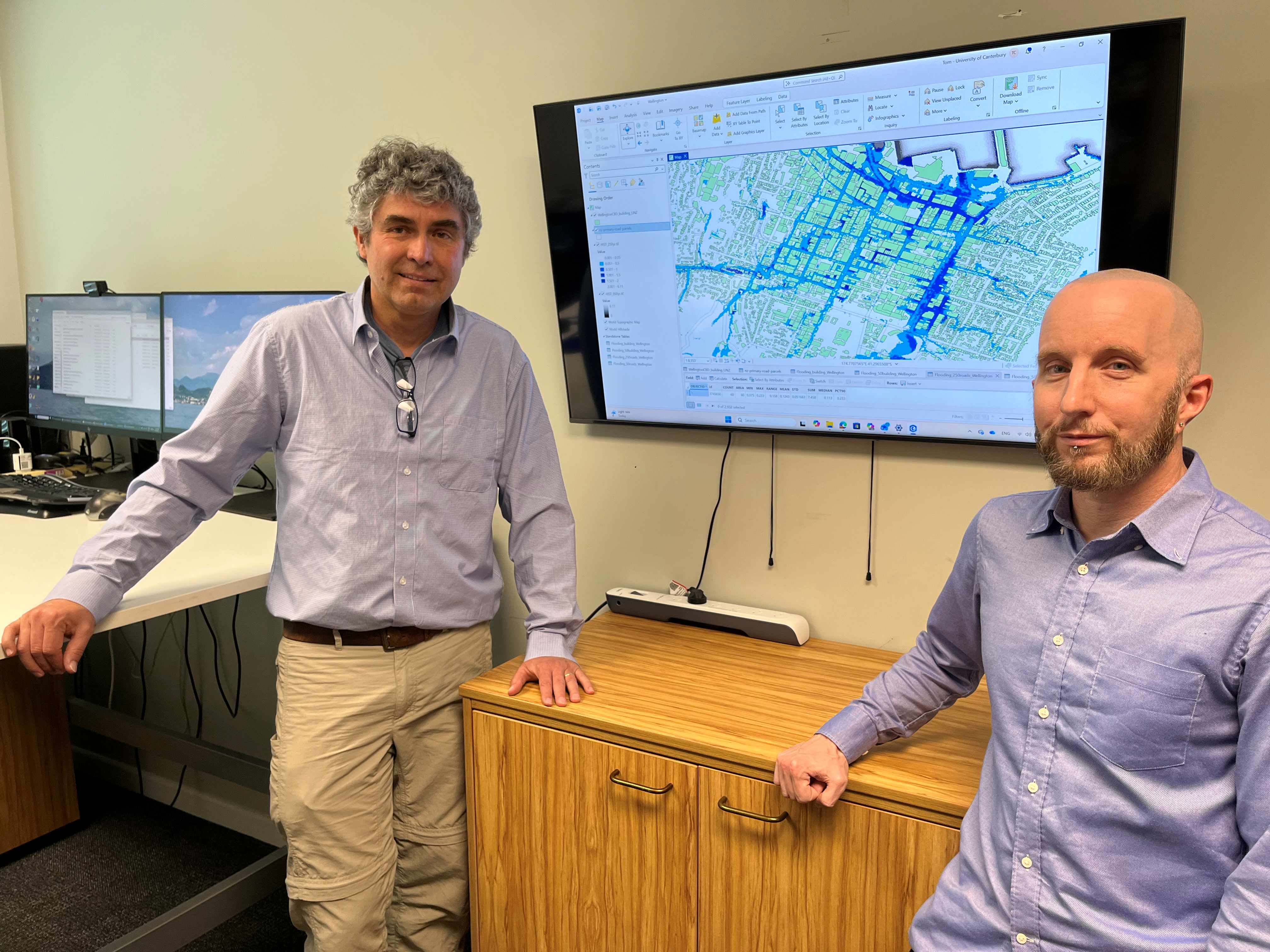
Digital models to help predict natural hazards in Kiwi capital
An innovative project using digital simulations to predict future hazards in New Zealand’s capital city takes its name from science fiction.
UC research challenges how we think autistic children learn
New UC research is challenging assumptions about how autistic children learn language.
Tiny robots, big potential: UC PhD explores new frontier
A UC researcher is pioneering laser-controlled robot swarms thinner than a human hair — work he believes could one day transform medicine and manufacturing.

UC research puts local knowledge at heart of resilience
UC research explores how Pacific Island nations can better use place-based knowledge to strengthen disaster planning and resilience.
Innovative UC research takes a closer look at AI in education
Researchers from UC's Faculty of Education are exploring the influence and reach of generative AI in New Zealand higher education.