

University of Canterbury Geospatial Research Institute researcher Dr Lukáš Marek
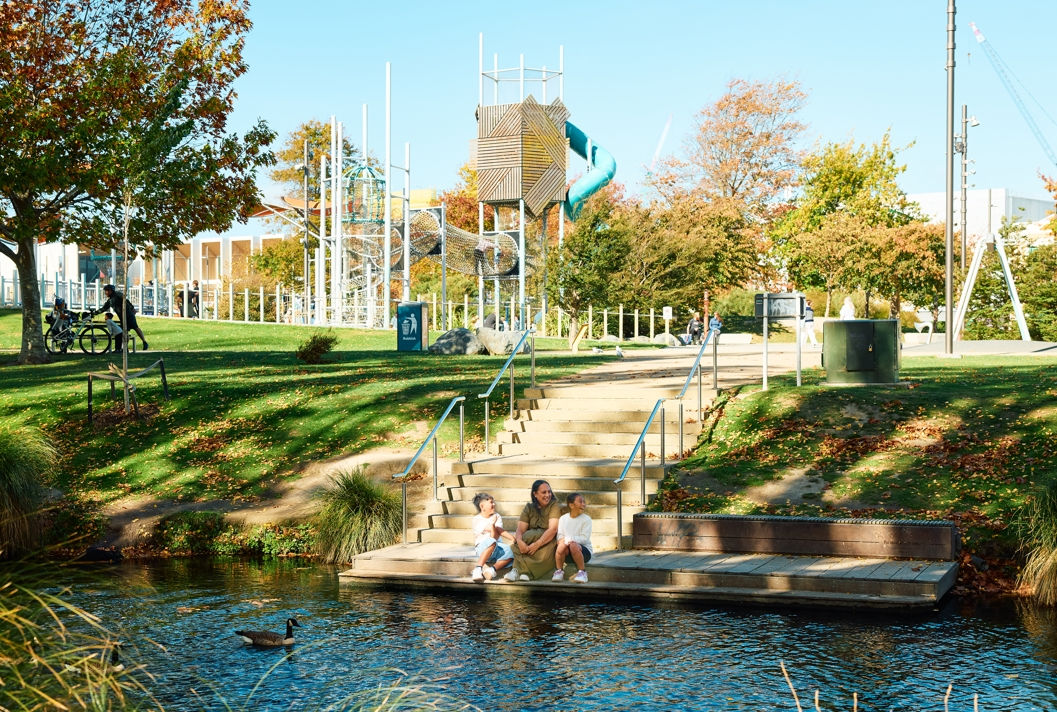
Photo caption: Families enjoying Ōtākaro Avon River near Margaret Mahy Family Playground. Photo credit: ChristchurchNZ.
Te Whare Wānanga o Waitaha | University of Canterbury (UC) researcher Dr Lukáš Marek, Geospatial Research Institute, says the findings add important evidence to conversations about how communities, neighbourhoods and cities are planned.
“The main message is that the environment actually matters,” Dr Marek says. “People who experience better environments tend to have better mental health, but what a better environment means can be different for different people.”
The study, published in the Journal of Exposure Science & Environmental Epidemiology, used data from 2013 to 2018 to follow 957,381 young people aged 10 to 24. Researchers linked mental health outcomes with the environments young people lived in, using a measure called the Healthy Location Index (HLI).
The HLI brings together 10 features of the built and natural environment, including health-promoting features such as supermarkets, places for physical activity, green spaces such as parks and reserves, and blue spaces such as rivers, lakes and coastlines, as well as health-constraining features such as fast-food outlets, alcohol outlets and gaming venues.
Most research tends to look at one environmental factor in isolation, such as access to parks or proximity to alcohol outlets. This study took a more holistic approach.
“If we want to plan for better mental health, we need to consider what is in the area as a whole,” Dr Marek says.
The findings suggest the places young people live, and the mix of features they are surrounded by, may play a role in supporting or constraining mental health. Access to natural environments, particularly a mix of green and blue spaces, was associated with better mental health outcomes.
Associate Professor Matt Hobbs, from UC’s Faculty of Health, says the clearest pattern was that greater exposure to health-constraining environments was associated with poorer mental health, particularly emotional disorders.
“Young people living in areas with less access to those health-constraining features had lower odds of emotional disorders, while living in predominantly health-constraining environments was associated with higher odds. There was also some evidence of higher odds of substance use and self-harm hospitalisations in these environments.”
He says the findings also have implications for how neighbourhoods and communities are designed.
“Where young people live shapes the opportunities and exposures they experience every day. Our findings suggest that creating healthier places is not just about changing individual behaviours or singular aspects of the environment – it is also about designing environments that make healthy choices easier and reduce exposure to features that may negatively affect wellbeing.”
The scale of the study allowed researchers to examine how multiple aspects of the environment may work together over time.
“By looking across almost one million young people, we can start to move beyond studying single environmental features in isolation and build a much more complete picture of how place may influence mental health across adolescence and early adulthood,” Associate Professor Hobbs says.
That broader picture is complex, Dr Marek says, particularly when considering how people experience and use natural spaces. “It is not always as simple as saying build more of one thing. The question is whether people use those spaces, whether they feel accessible, and what else is around them.”
The study adjusted for factors that are known to strongly influence mental health, including deprivation, access to healthcare, age, gender and ethnicity. Even after accounting for those factors, the findings suggest the built and natural environment has an important role to play.
“The evidence could support more localised planning decisions and provides an important baseline for future research using more recent data,” Dr Marek says.
“We are building an evidence base that can be very localised. It can support mental health research, environmental research and potentially spatial planning of places.”
The study was part of a Cure Kids-funded project, Do the environments young people grow up in promote or obstruct mental health? A nationwide geospatial study, involving researchers from UC, the University of Otago and the University of Auckland.


University of Canterbury Faculty of Health Associate Professor Matt Hobbs,
What to read next
UC film takes a scalpel to the looksmaxxing trend
A gruesome procedure in the back of a car drives a new UC short film exploring looksmaxxing, bodily autonomy and the hidden costs of perfection.

Te reo Māori teaching pioneer awarded UC medal
A teenage language class in Hokitika began a lifelong journey that has earned Professor Jeanette King UC’s highest teaching honour.

Climate conference co-hosted by UC wins national award
Adaptation Futures 2025 (AF2025) has received further national recognition, taking home the Legacy Impact Award at the recent 2026 Bizzies Awards.

UC students bring horror film to life in new facility
A stubborn patch of mould inspired UC student Maddy Sweetman to create Stain, a short horror film brought to life with specialist facilities and a multidisciplinary crew.

UC celebrates its Manaaki New Zealand scholar
After completing their studies at the University of Canterbury, 15 Manaaki New Zealand scholars are preparing for the next chapter of their journeys.

NZ study reveals gaps in women's heart healthcare
A review of 25 years of New Zealand research has revealed significant gaps in women's heart healthcare, highlighting opportunities to improve diagnosis, treatment and outcomes.

History goes hi-tech at Awaroa Godley Head
The University of Canterbury's HIT Lab is helping Awaroa Godley Head visitors enjoy a more immersive experience of the World War II heritage site.

UC geography graduate honoured for global science leadership
UC alumnus Distinguished Professor Emeritus Iain Hay has received a prestigious international Fellowship recognising his contributions to geography and scientific collaboration.

Are Kiwi businesses jumping blindly on the AI bandwagon?
AI doesn’t have to play an inevitably dominant role in our lives, businesses and future, argues a guest speaker for an upcoming UC public lecture.