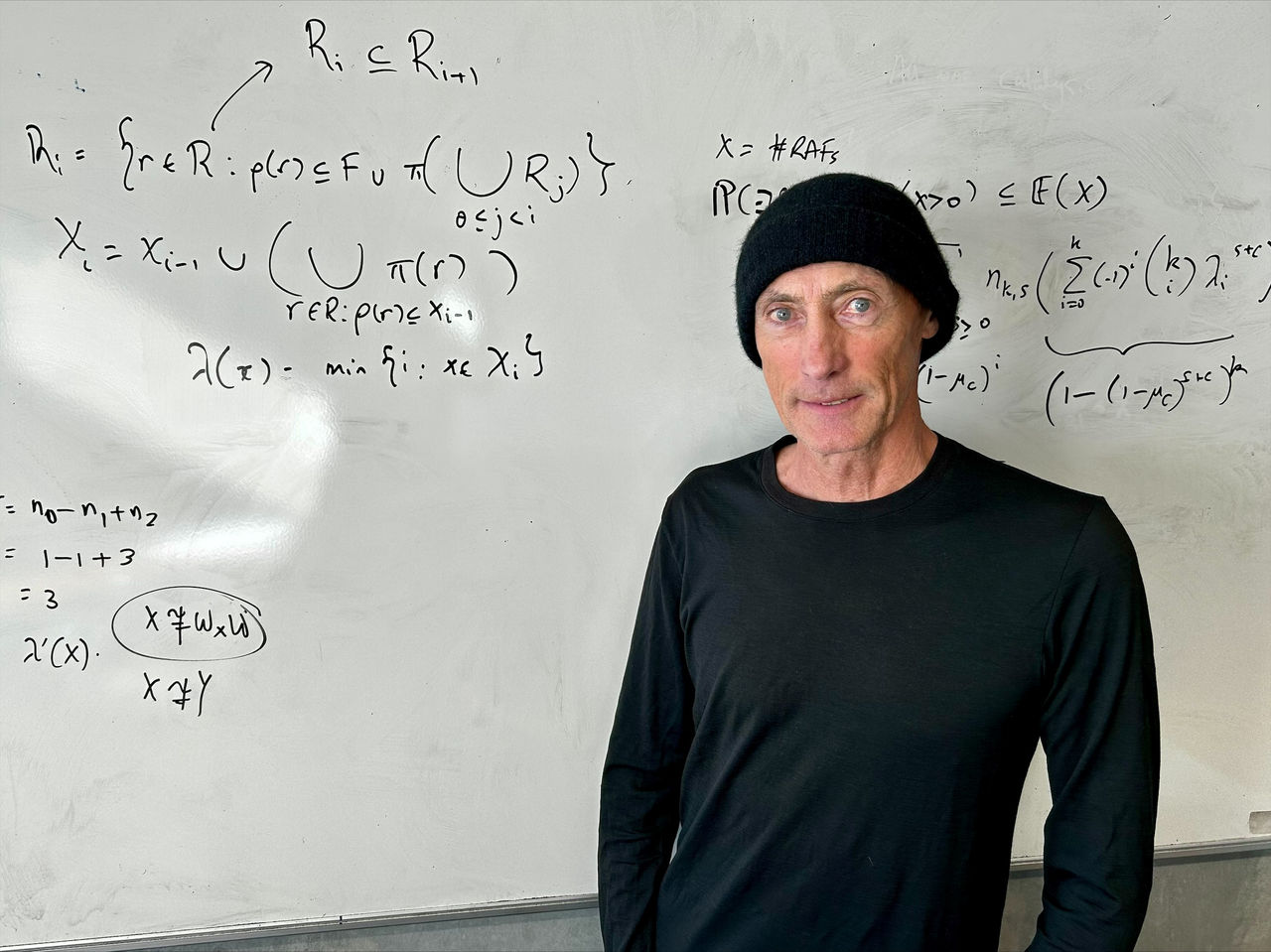


Photo caption: Distinguished Professor Mike Steel from UC’s School of Mathematics and Statistics, Faculty of Engineering.
Te Whare Wānanga o Waitaha | University of Canterbury (UC) Distinguished Professor Mike Steel has contributed to a new study that reconstructs possible pathways from simple chemical compounds found around hydrothermal vents to the more complex molecules and metabolic processes needed for early life.
The international research, led by evolutionary biologists at Heinrich Heine University Düsseldorf in Germany, investigated a network of 420 chemical reactions involved in producing the fundamental building blocks of life.
Professor Steel, a mathematician in UC’s School of Mathematics and Statistics, developed fast mathematical methods that allowed the researchers to organise this highly interconnected network from simpler to more complex reactions and identify plausible pathways through it.
“The origin of life, around four billion years ago, is still a largely unsolved problem,” Professor Steel says.
“We may never know exactly how life began. A more achievable question is: how might it have happened? Mathematics gives us a way to test whether plausible routes exist through what is otherwise an extremely complicated network of chemical reactions.”
The study focuses on the last universal common ancestor (LUCA) – the ancient common ancestor from which all life alive today ultimately descends.
One leading theory is that life began around warm, alkaline hydrothermal vents on the ocean floor, where naturally occurring compounds and metals could have provided the raw materials and conditions needed for early metabolism.
The researchers investigated how simple molecules in such environments might have been transformed through a sequence of reactions into amino acids, ribonucleic acid (RNA) bases, vitamins and other compounds needed by the earliest cells.
Professor Steel says the mathematical challenge was to establish whether the 420 reactions could be arranged in a meaningful order.
“The first question was whether a plausible ordering of these reactions was possible. Once we could show that it was, finding that order computationally became much more tractable.”
The algorithms were implemented by Professor Daniel Huson of the University of Tübingen, a frequent visitor to UC, enabling Professor William Martin’s Düsseldorf group to apply the methods to their biochemical data.
The researchers also found evidence that, as bacteria and archaea diverged, each evolved different enzymes to carry out some of the same essential reactions.
Professor Steel says this supports one of the study’s key conclusions.
“This isn’t saying that life began twice, completely independently. The picture emerging from the study is of a common early ancestry, followed by two separate evolutionary routes towards the first free-living bacterial and archaeal cells.”
Professor Steel has collaborated with Professor Martin’s group on several previous studies. During a visit to Düsseldorf in June 2025, he worked with lead author Natalia Mrnjavac and other researchers to explore how mathematics and algorithms could help make sense of their biochemical data.
“By bringing together biology, chemistry, geology, mathematics and computer science, we can narrow down the possibilities and better understand how the transition from chemistry to biology might have occurred.”
The latest research involved scientists from New Zealand, Germany, Canada, France and Spain.
The paper, Intermediate stages in the origin of metabolism at a phosphorylating hydrothermal vent, is published in Science Advances.
.png)