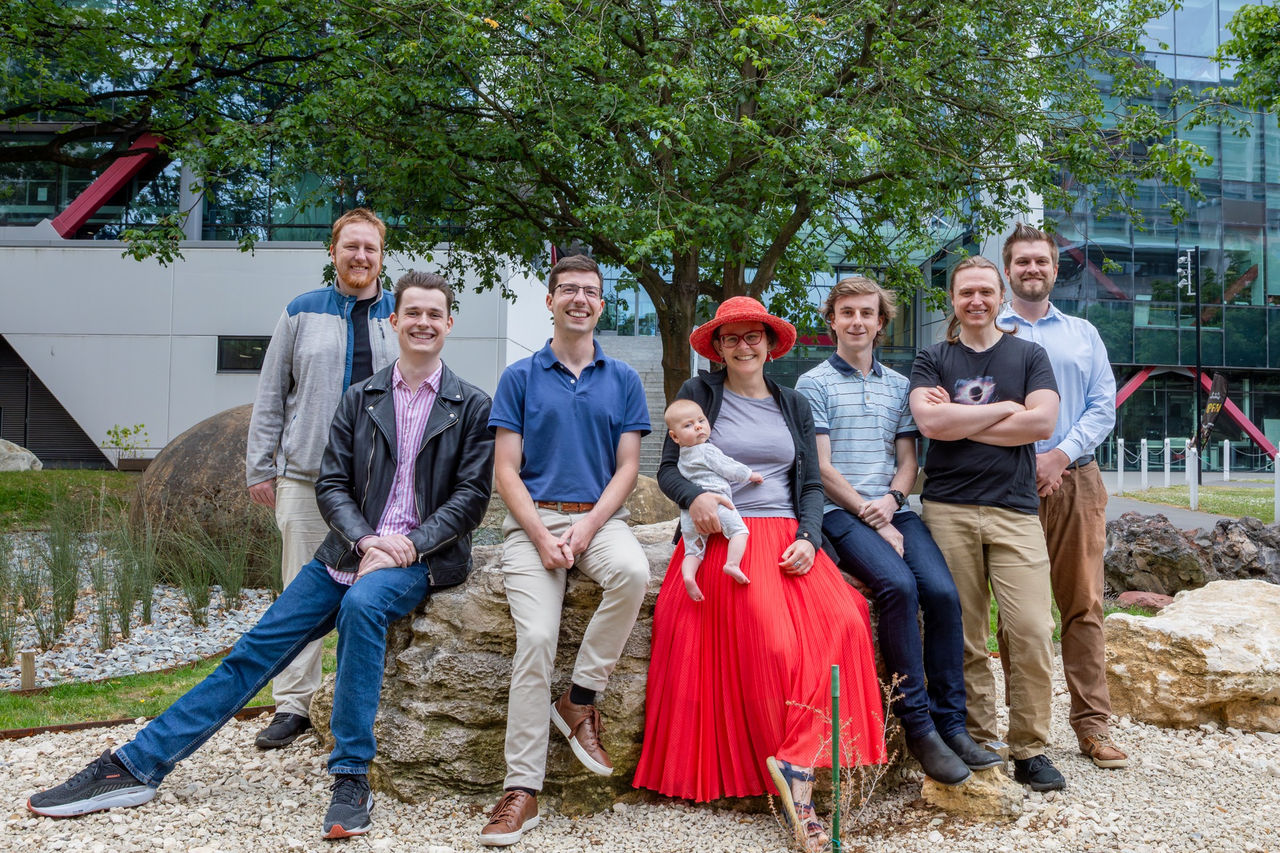


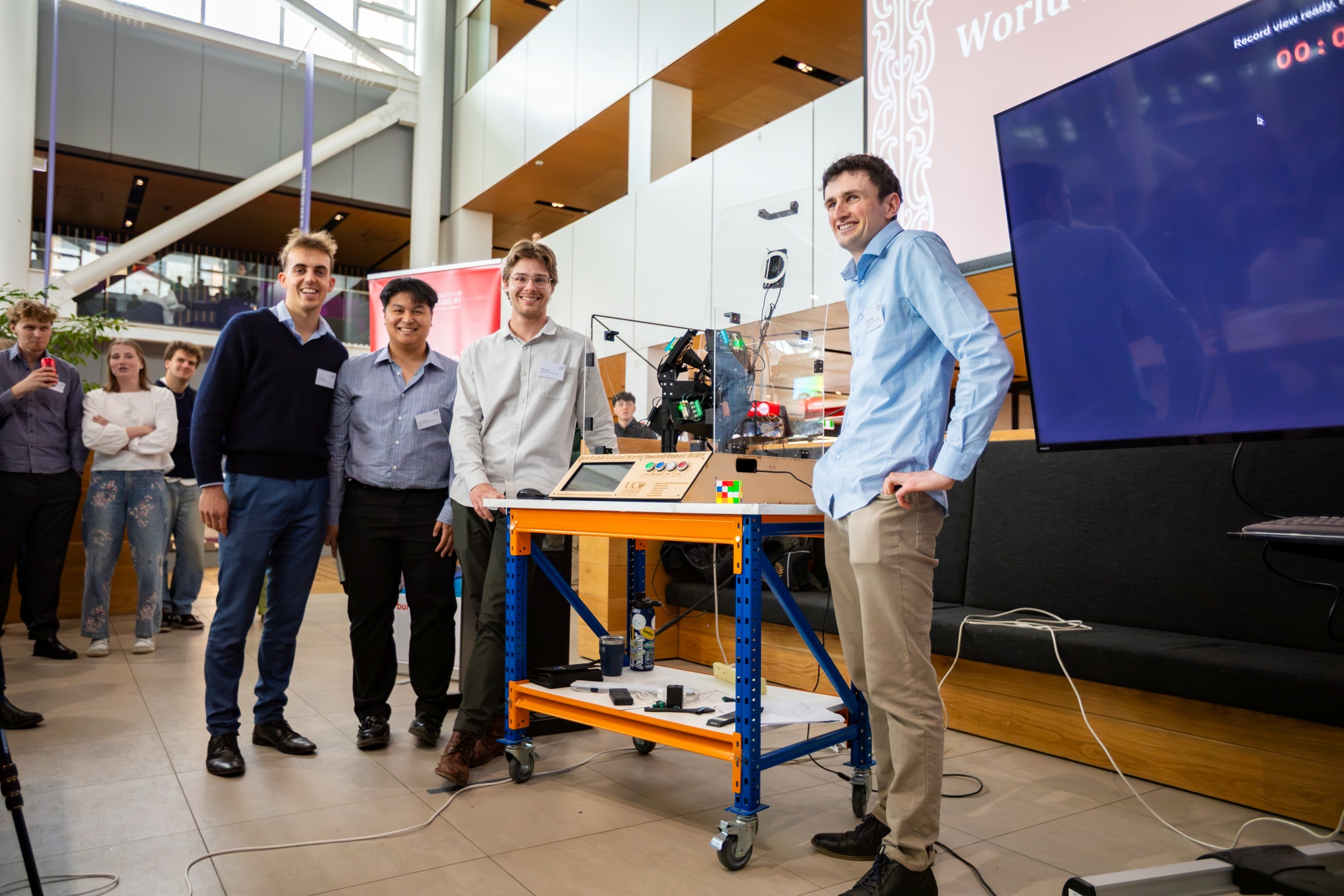
Photo caption: The University of Canterbury team includes, from left: Dr John Forbes, Angus Forrest, Dr Matthew Hopkins, Associate Professor Michele Bannister, Brayden Leicester, Dr Ryan Ridden and Jack Patterson.
The comet 3I/ATLAS, discovered by an international team in July this year, is only the third interstellar object ever found in the history of astronomy. It is the first that is bright enough to be seen through amateur telescopes and is currently visible in the Northern Hemisphere. It will make its closest approach to Earth on 19 December.
Associate Professor Michele Bannister, from the School of Physical and Chemical Sciences at Te Whare Wānanga o Waitaha | University of Canterbury (UC), is leading a research team studying the observational characteristics and theoretical aspects of 3I/ATLAS, in partnership with the University of Oxford.
Associate Professor Bannister says the new comet is a “once in a lifetime opportunity” that she has spent her career preparing for. “Our team has discovered that 3I/ATLAS is between 8 and 14 billion years old, much older than our entire solar system, which has existed for 4.6 billion years.
“The UC team, in partnership with Professor Chris Lintott at the University of Oxford, was the first to provide the theoretical study that showed how old the comet was based on its velocity, just days after it was first identified.”
The UC team has been working for several years on an extensive theoretical model, called the Ōtautahi-Oxford model, covering how interstellar objects form, how they move in the Galaxy, and what their chemical properties are likely to be like.
Associate Professor Bannister’s specialty area is spectroscopy; studying the chemical composition of the comet and its coma, a cloud of gases and other material that surrounds it. She says the visible tails of the comet are made up of grains of ice and dust, which reflect sunlight, which is why she affectionately describes it as “a dusty wee snowball”.
“The chemistry of 3I/ATLAS is distinctive relative to our solar system comets, which is one of the things that will tell us what its home environment was like,” she says. “We saw unusually rich atomic nickel and iron emission as it entered our skies and we’ll be continuing to observe it throughout January.
“That’s the great joy of interstellar objects, they’re giving us clues, because they’re made up of the building blocks of planet formation elsewhere in the galaxy. They’re telling us about a star that’s so ancient it might not even exist anymore. This comet is a calling card from the past, and we only have a few hundred days to try and interpret what it’s telling us.”
The work is published in Monthly Notices of the Royal Astronomical Society: Letters and The Astrophysical Journal Letters, and is forthcoming in Astronomy and Astrophysics.
Associate Professor Bannister says 3I/ATLAS doesn’t pose any risk to life on Earth. “The closest it will get to Earth is nearly twice the distance from the Earth to the Sun.”
The team’s research is funded by her Rutherford Discovery Fellowship, and for the next three years, the UC team will be involved in a project led by Professors Renate Meyer and Richard Easther at the University of Auckland that was recently awarded a $3 million Marsden Council grant.
For their part of the Marsden-funded project, the UC researchers will use interstellar objects to better understand our Milky Way Galaxy, with observations from the newly commissioned, billion-dollar Vera C. Rubin Observatory in Chile, South America.
In return for access to Rubin data, New Zealand will share observations from the University of Canterbury’s Mt John Observatory at Takapō (Tekapo).
Associate Professor Bannister says these collaborations will enable a national, investigator-led strategy for astronomy and fundamental science in New Zealand.
“The new Rubin telescope will provide a six-colour movie of the entire southern night sky every few nights for the next 10 years, providing information on topics ranging from small objects passing through the solar system, to the overall structure of the universe.”
She expects Rubin will detect up to 50 fainter interstellar objects over the next decade.
Other members of Associate Professor Bannister’s team include UC postdoctoral fellows Dr Matthew Hopkins (Elaine P. Snowden Fellow), Dr John Forbes and Dr Ryan Ridden, along with PhD students Jack Patterson and Nicole Tan, and master’s students Angus Forrest and Brayden Leicester. They are also collaborating with recent UC PhD graduate Rosemary Dorsey, now based at the University of Helsinki, Finland, and UC graduates Leah Albrow at Massachusetts Institute of Technology, USA, and Sophie Deam at Curtin University in Australia.
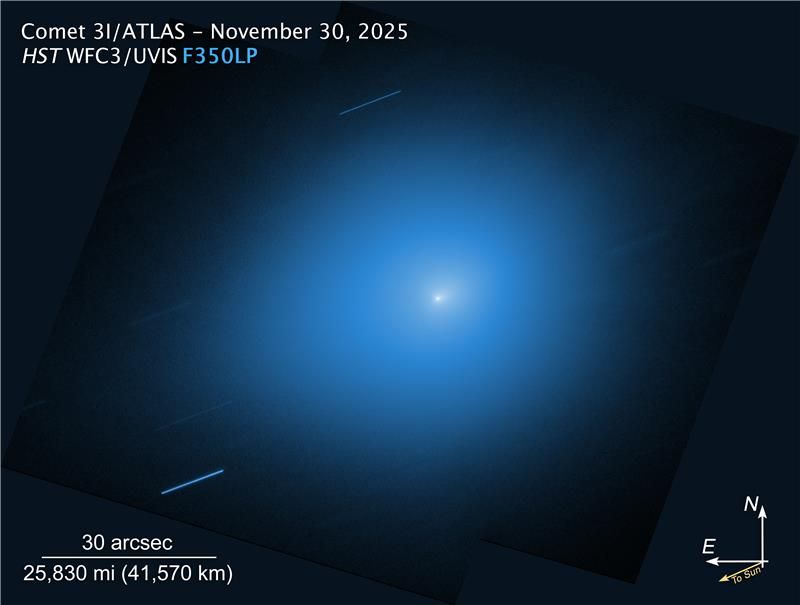 NASA image of interstellar comet 3I/ATLAS from Hubble Space Telescope.
.png)