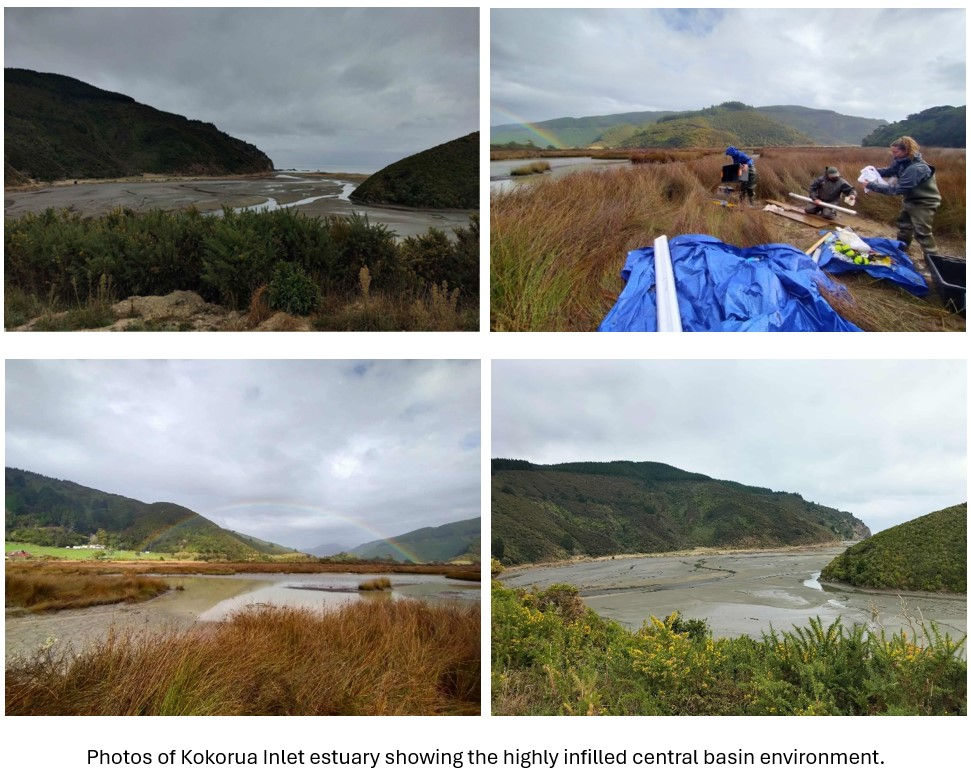


Join an exciting research project exploring the evolutionary history of the Kokorua Inlet estuary and its response to changing marine, fluvial, and tectonic processes. Located about 40 minutes northeast of Nelson, Kokorua Inlet is the seaward portion of the Whangamoa River valley. Today, the estuary is heavily infilled with sediment, and recent increases in mud content and turbidity are degrading water quality and natural habitat. This has been suggested to result from recent catchment land use change however these changes need to be situated within the context of the estuary’s long-term evolution. Understanding how the estuary has evolved and what may have triggered this recent acceleration in sedimentation is critical for managing the site and predicting future change.
This Master's project will apply geochemical and sedimentological analyses to reconstruct the Holocene infill history of Kokorua Inlet using sediment cores, dating, and analysis of geochemical proxies. The research will explore how sea-level rise, tectonic uplift, and catchment land-use change have influenced the estuary’s evolution from its formation around 8,000-6,000 years ago to the present day. The project will offer hands-on experience in fieldwork (including a field trip to the site), sediment coring/sampling, and sedimentological and geochemical (e.g. Itrax) analyses in the lab. There is also potential for paleo proxy work. GIS analyses of Lidar and aerial imagery can also form part of the project however we are happy to tailor the approach to student interests and strengths.
The project findings will provide valuable insights into Holocene estuary evolution, sediment dynamics, and contemporary coastal management in Aotearoa New Zealand.
Supervisors
Primary Supervisor: Dr Sarah McSweeney
Other Supervisor(s): Prof. Catherine Reid, Dr Kate Pedley
Key qualifications and skills
We are looking for a motivated student with a background in geology or physical geography, an interest in coastal and environmental change, and a willingness to get a little muddy in the field.
Does the project come with funding
Yes, project costs will be covered (e.g. field work). Travel to one local or national level conference will likely be covered. Tuition fees and stipend are not covered.
Final date for receiving applications
1 February 2026
How to apply
Via email, to sarah.mcsweeney@canterbury.ac.nz. Please include a brief introduction about yourself and explain why the project interests you (in 1-2 paragraphs max)
Keywords
Estuaries; sedimentology; geology; geomorphology