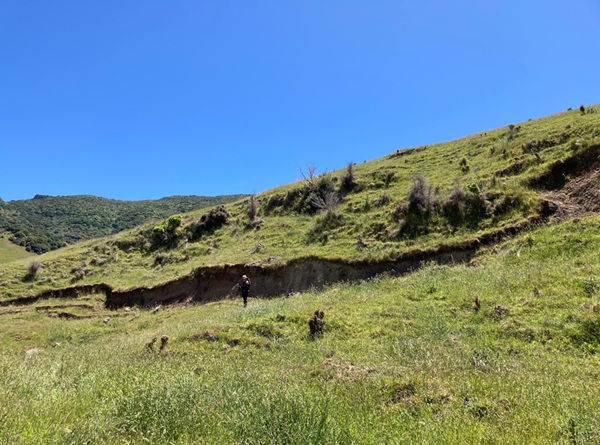


Landslides in New Zealand are estimated to cost the local economy between $250 – $300 Million annually. While many of these landslides can be associated with rainfall or seismic triggering events, there also exists many large, deep and slow-moving landslides that have persisted for generations, gradually damaging homes and infrastructure. Under specific driving conditions e.g., long periods of wet weather or anthropogenic changes, these creeping landslides have the potential for catastrophic slope failure, transforming into devastating landslides with fast debris flows.
As part of the Landslide Watch Aotearoa research programme, this Ph.D. project is part of a large 5-year research programme, which is developing new approaches to model slow-moving landslide hazards. The programme is utilising real-time satellite-based deformation data, and field monitoring data from active landslides, to develop and validate physics-based forecast models for large deep-seated landslides across New Zealand.
This PhD project will utilise temporal records of landslide displacement to explore correlations between the factors that drive landslide movement – such as climatic, anthropogenic, tectonic, and environmental factors – and changes in landslide velocity. For several case-study landslide sites, lab testing of landslide-material behaviour will be carried out to develop constitutive models, which will be coupled with physics-based numerical modelling of past landslide behaviour, to correlate drivers, material behaviour and displacements. Once calibrated, these models will then be tested to see if they can be used to forecast the behaviour of other similar landslides in similar materials.
Supervisors
Primary Supervisor: Katherine Yates
Key qualifications and skills
The scholarship supports study towards a PhD in Engineering Geology. The successful candidate must have an Honours or Master’s degree (with a Research Thesis component) in a relevant subject such as Geology, or Engineering Geology with a strong background in landslide hazard and earth surface processes. Field experience and a good grasp of geomechanical properties of material and laboratory skills are necessary. The scholarship is open to domestic and international candidates, and international candidates moving to New Zealand pay domestic tuition fees. The successful candidate will be enrolled full-time at the University of Canterbury and reside full-time in New Zealand for the duration of the PhD project. Candidates must meet the PhD eligibility criteria for enrolling at University of Canterbury.
Does the project come with funding
Yes:
- Annual stipend of NZ$35,000 for 3 years
- Fees paid for 3 years
Final date for receiving applications
1 October 2026
How to apply
Email primary supervisor with curriculum vitae, contact details for two academic references, academic transcript, 1page cover letter outlining your motivation, experience and interest in the topic
Keywords
Landslides, geomechanics, engineering geology