

Menu

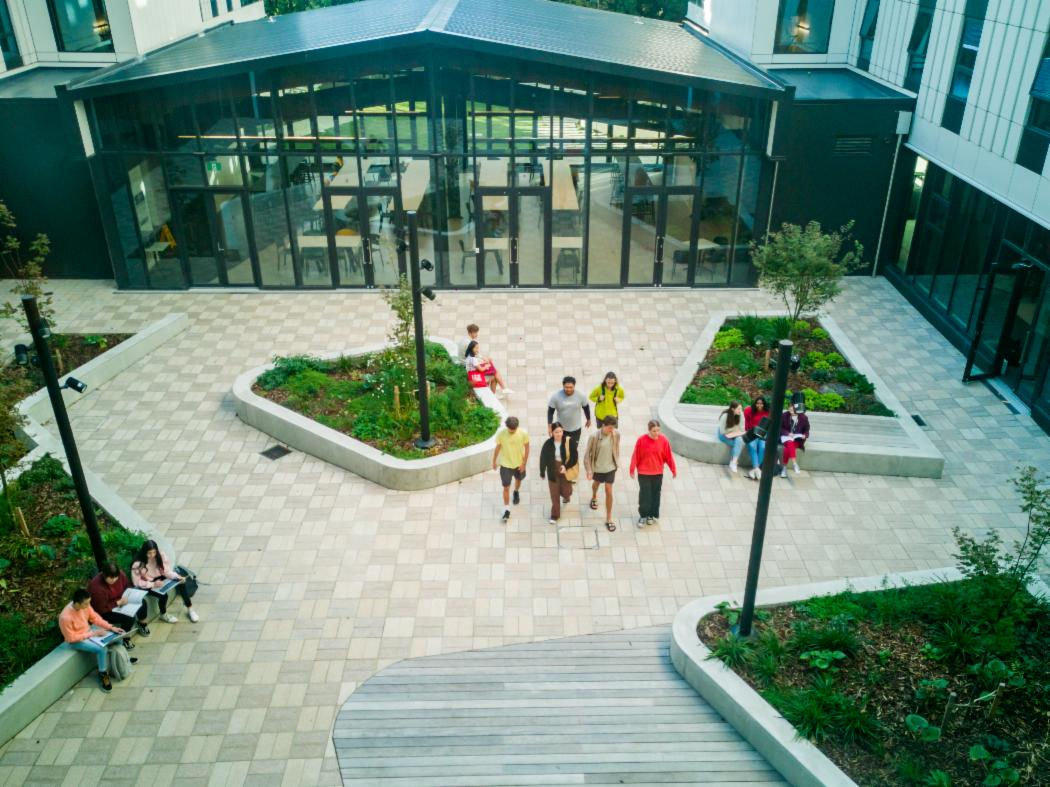
Aerial photo of the Tupuanuku Student Halls of residences showing the courtyard and raised garden beds with students sitting and walking around them.
Topic

Green buildings and spaces

08 September 2026

UC's commitment to green buildings on campus includes existing buildings constructed with green building principles, remediation of older buildings, and proposed new buildings that incorporate green building principles, including building on brownfield sites. Find out more about green buildings at UC.

HOW TO APPLY


New building projects must use UC's UC Design Guidelines 9 Environmentally Sustainable Design. UC is a proud member of the New Zealand Green Building Council.

 The New Zealand Government aims to have zero-carbon buildings by 2050 and in this media release our Beatrice Tinsley building, home of UC's College of Science, is shown as an example of how our architecture industry is making moves towards that goal.

Existing certified green buildings on campus include:

  • Haere-roa UC Students' Association
  • Health Centre
  • John Britten Engineering Facility
  • School of Biological Sciences

UC has employed an Energy Manager since 2009 to work with UC Staff, consultants, contractors, and Energy Efficiency and Conservation Authority (EECA), to find ways to increase energy efficiency in the built-environment and reduce water consumption on campus. EECA works with UC to identify and provide energy audits; feasibility studies and design/commissioning advice to deliver energy efficient projects.

UC has invested significantly in Ground Source Heat Pump technologies, with many of our new buildings such as UCSA’s Haere-roa, Tupuānuku, and Tupuarāngi designed with enhanced thermal envelopes and low-grade heating systems to support Ground Source Heat Pump (GSHP) technology.
This system has been operational since March 2025, providing heating and cooling for five buildings which have been designed or retrofit for lower grade heating via Ground Source Heat Pump’s. The Science and Innovation Precinct GSHPs are a key step in delivering UC’s transition to low carbon energy sources as the project is expected to achieve a reduction in carbon emissions by approximately 2,000 tonnes annually.

Adopting class leading equipment, UC has installed three new 1,200kW water-cooled heat pumps connected via an indirect ground water system which enables simultaneous heating and cooling with heat recovery. Each heat pump is configured such they can reject or absorb heat from the ground or from the building heating and cooling circuits (moving energy between buildings, rather than rejecting it).

In heating mode, the system extracts heat from either the campus chilled water system or, when there is insufficient cooling demand, uses heat exchangers to extract heat from the ground water bores. When the system is running in cooling mode the heat generated is used to meet the science precinct heating demand, with any excess heat being rejected back into the ground.

System efficiency is further enhanced with an outdoor air temperature compensation logic which varies the heating water temperature from 55 degrees down to 45 degrees to allow operation at a more energy efficient operating point. This is a simple, well-established strategy for efficient heating network operation (intended to limit heat losses) which when applied to heat pump technologies (to optimize for refrigerant and compressor type) can have a transformative effect on overall system energy consumption.

Aside from exceptional energy efficiency, the new GSHP’s operate on a future ready R-1234ze refrigerant, a low Global Warming Potential (GWP) hydrofluoroolefin (HFO) with a GWP of less than 1, and is non-toxic, non-flammable, and ozone-friendly.

The Science and Innovation precinct GSHP system delivers reliable, low-carbon heating and cooling.

Profile of an example green building on campus 

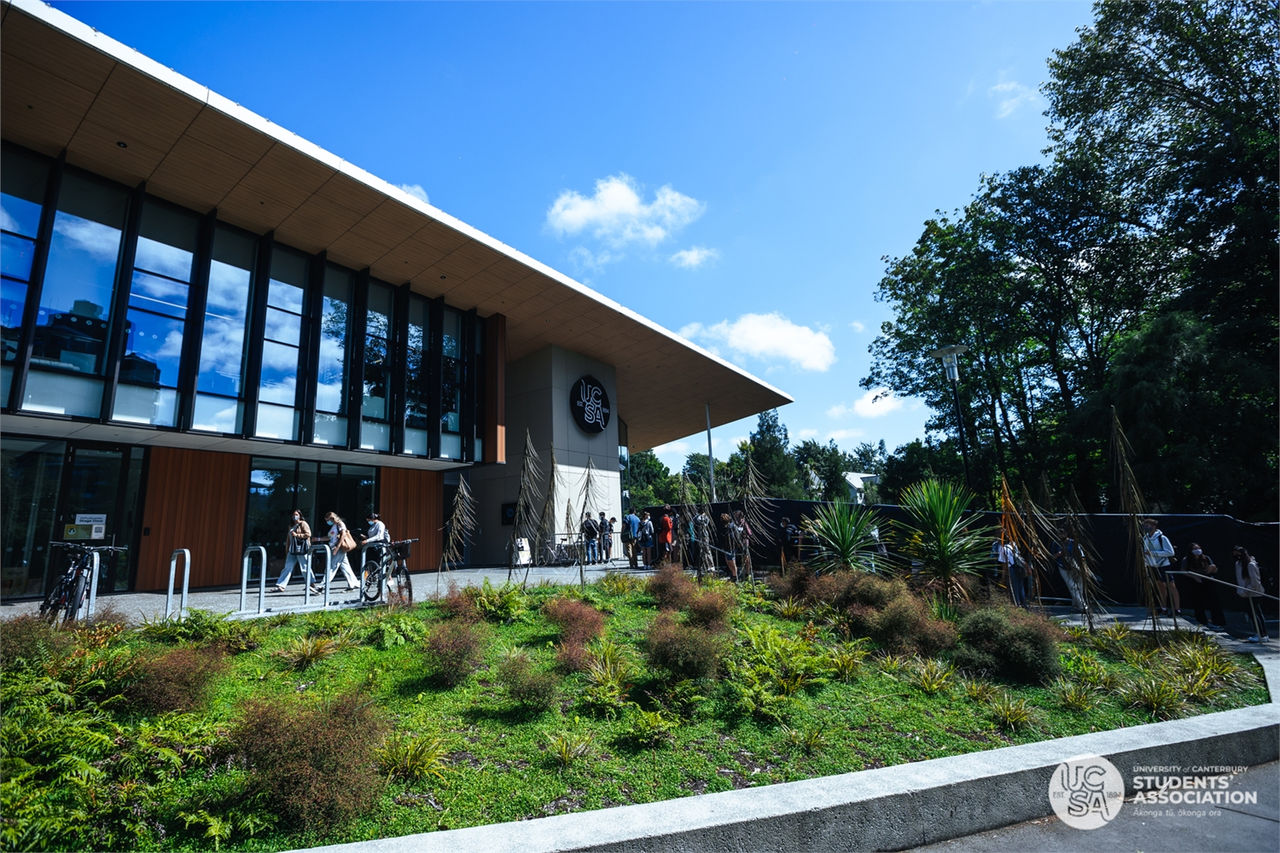
Opened in July 2019, the UCSA building, Haere-roa, includes student welfare and advocacy spaces, an outdoor amphitheatre overlooking the Ōtakaro Avon River, as well as club, meeting, hospitality, office and event spaces.

UCSA Te Rourou A Haere Sustainable Building

In July 2017 the UCSA announced the building's name, Haere-roa, which translates to the longest stream or the long wanderer. It recognises the UCSA building as a space that hosts and welcomes people. The name has been gifted to the UCSA by mana whenua, Ngāi Tūāhuriri and is linked to the Ōtākaro Avon River, which flows past the UCSA site.

Key sustainability features of this building include:

  • Haere-roa was built on a brownfield site, replacing the Ilam Student Union building which was damaged during the 2011 earthquakes.
  • Haere-roa is heated with renewable energy in the form of a ground-source heat-pump system. These pumps draw stable, latent heat from the ground through the building. 
  • The building has interior and exterior ‘Innowood’ cladding (a low VOC formaldehyde emission, recycled product). 
  • Carpet tiles are made from recycled material, in no recognisable pattern allowing partial replacements without need for full replacement. 
  • 5,782 native plants were planted around Haere-roa between late-2019 and early-2020 in collaboration with the Christchurch City Council’s waterways partnership. This has helped improve the ecological health, indigenous biodiversity and the amenity value of our local urban waterways. 


Privacy Preferences

By clicking "Accept All Cookies", you agree to the storing of cookies on your device to enhance site navigation, analyse site usage, and assist in our marketing efforts.
