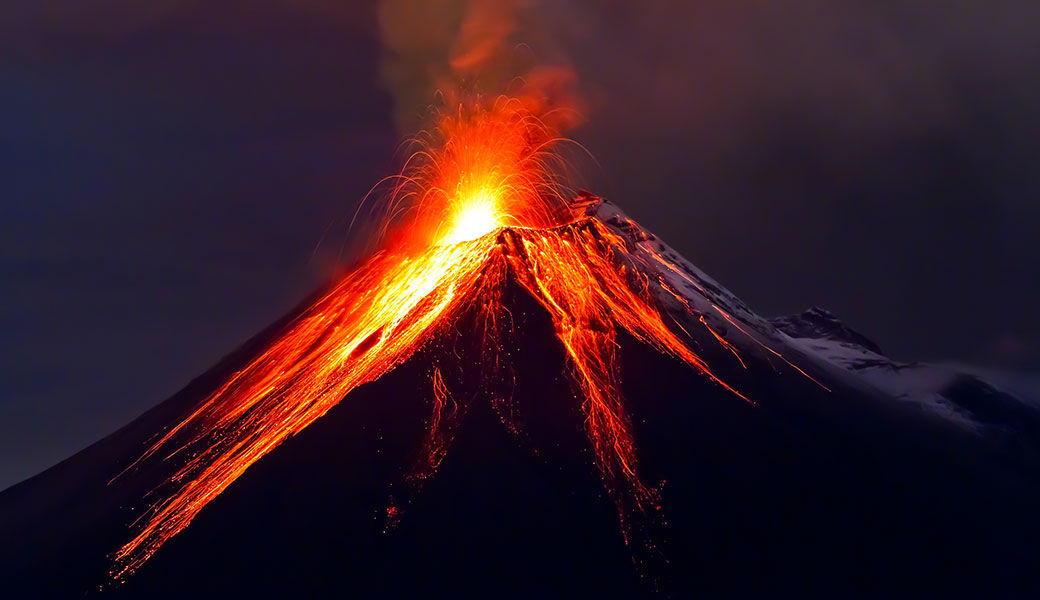


Volcanic eruptions pose significant risks to lives and infrastructure in New Zealand and around the world. Traditional seismic networks, while effective at detecting deep magmatic movements, lack the sensitivity to monitor small magnitude earthquakes near volcanic vents, which are critical for predicting phreatic eruptions. These eruptions, driven by the rapid expansion of steam, can occur without warning and have historically caused substantial damage and loss of life.
This project aims to enhance volcanic monitoring by leveraging Distributed Acoustic Sensing (DAS) technology. DAS transforms standard fibre optic cables into dense arrays of seismometers, capable of detecting ground deformations with high spatial resolution. This innovative approach can record 10-100 times more earthquakes, including smaller magnitude events, than conventional seismic networks.
Building on successful pilot studies at Ruapehu and Yasur volcanoes, this project will develop DAS from a research tool into an operational monitoring system. This project will focus on creating real-time data processing workflows using advanced machine learning algorithms and edge computing. These workflows will enable the rapid identification and localisation of seismic events, providing actionable information to improve volcanic hazard assessments.
The project involves domestic collaborators at Earth Sciences New Zealand (Jonathan Hanson, Oliver Lamb) and University of Auckland (Kasper van Wijk), as well as international collaborators in the USA (Eileen Martin, Brad Lipovsky) and UK (Jessica Johnson).
The University of Canterbury PhD scholarships are for 3 years at NZ$35,000/year + tuition fees and student levies. The project also includes funding for fieldwork and conference travel.
This is a readvertisement of a previously advertised position. If you have previously applied, you will be automatically reconsidered and do not need to apply again.
Please note that this is the first step in the application process. The successful candidate will then have to apply to the University of Canterbury and, if an international student, will need to apply for a student visa. For information about the formal application process for a PhD at the University of Canterbury, see here: https://www.canterbury.ac.nz/study/uc-graduate-school/future-research-students/become-a-research-student. International students may need to take an English language test and will be required to submit their academic transcripts to a grade conversion website to convert different grading scales into a New Zealand scale. The successful candidate should expect to start by August 2026.
Supervisors
Primary Supervisor: Leighton Watson
Second Supervisor: Ben Kennedy
Key qualifications and skills
The successful candidate must have an Honours or Master's (with a research component) in geology, geophysics, data science, mathematics or a related discipline. Programming experience is essential, as is mathematical and computational expertise. Field experience and prior experience working with DAS or other geophysical data are advantages, but not required.
Does the project come with funding
Yes: Scholarship for 3 years at NZ$35,000 + tuition fees and student levies.
All fieldwork and travel/conference costs will come from the project.
Final date for receiving applications
Ongoing
How to apply
Interested candidates should apply via email with the subject line “DAS PhD Application” to Dr Leighton Watson leighton.watson@canterbury.ac.nz. Applications should include: (1) Curriculum vitae, (2) Academic transcript(s) (with a translation to English if required), (3) A cover letter outlining your motivation, experience, interest in this topic, (4) Contact details for two references, (5) A writing sample (This could be a journal publication, report from a class project, blog post etc), and (6) A max one-page discussion of your plans post-PhD and description of how completing a PhD advance your career objectives.
Keywords
Volcano, monitoring, geology, geophysics, seismic

