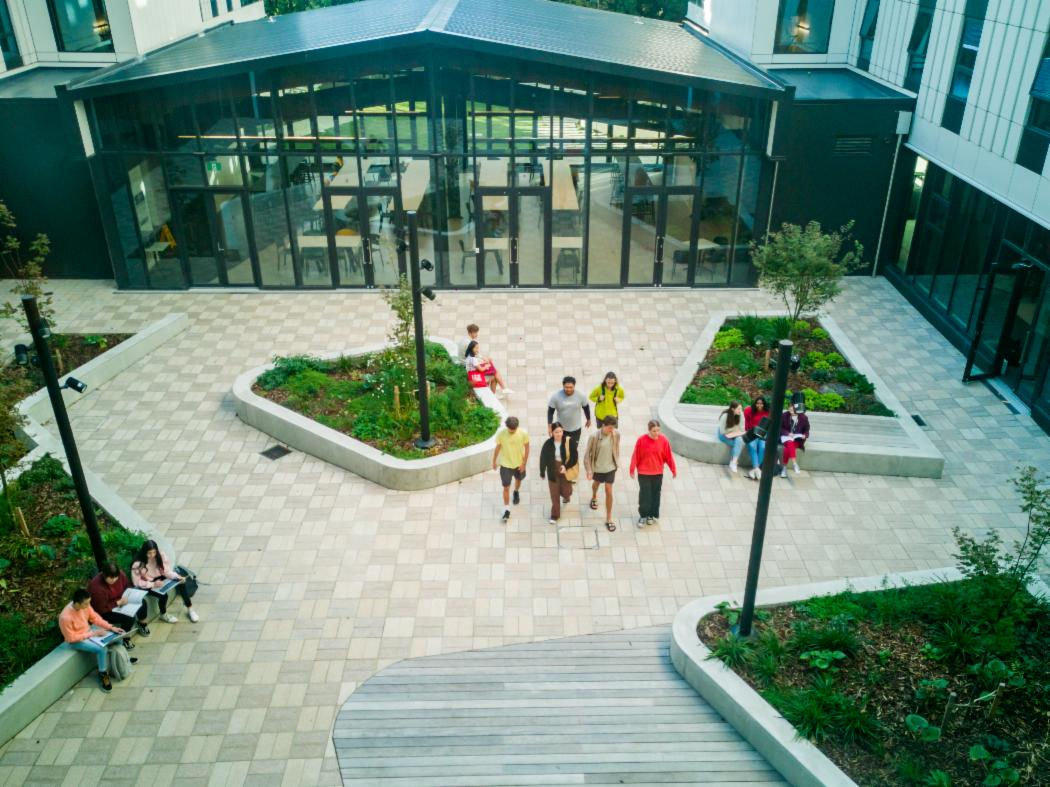
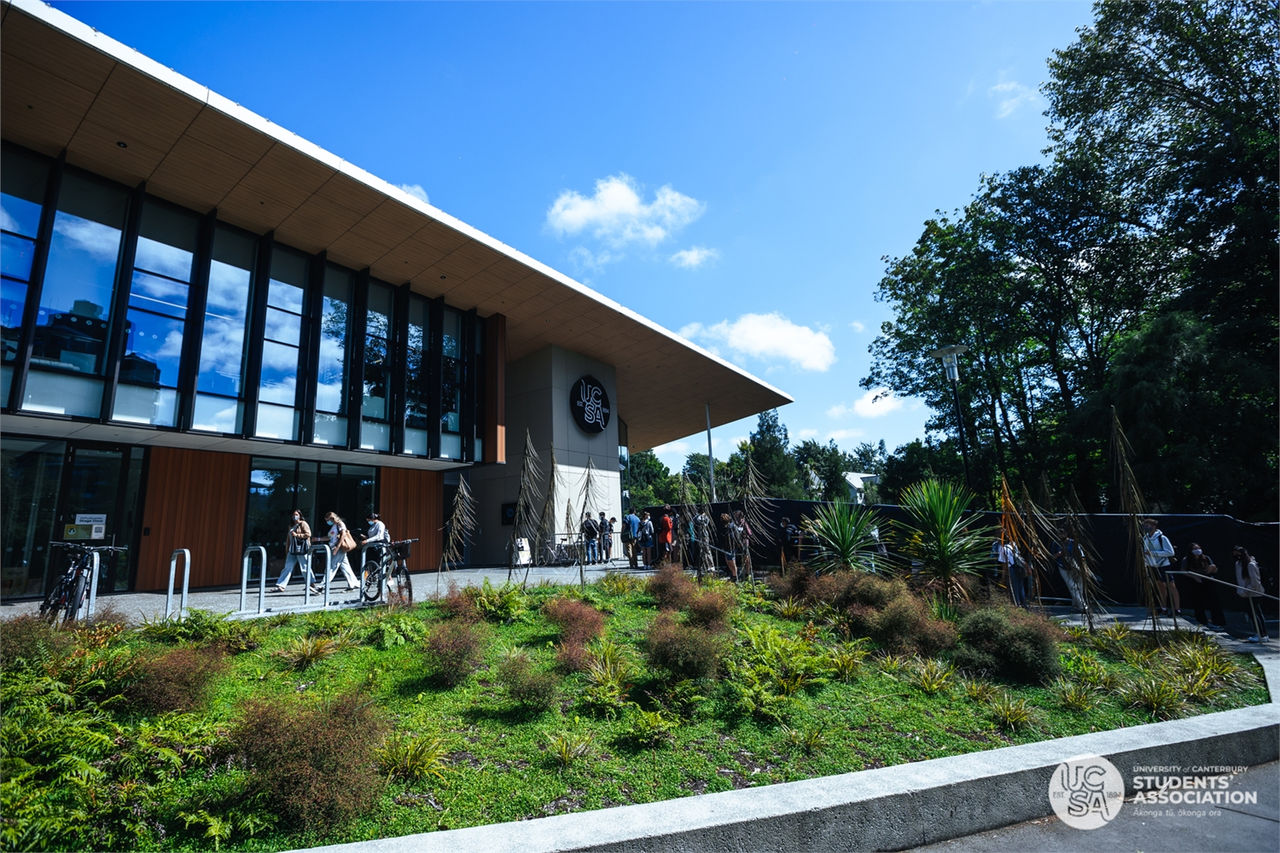
Opened in July 2019, the UCSA building, Haere-roa, includes student welfare and advocacy spaces, an outdoor amphitheatre overlooking the Ōtakaro Avon River, as well as club, meeting, hospitality, office and event spaces.
In July 2017 the UCSA announced the building's name, Haere-roa, which translates to the longest stream or the long wanderer. It recognises the UCSA building as a space that hosts and welcomes people. The name has been gifted to the UCSA by mana whenua, Ngāi Tūāhuriri and is linked to the Ōtākaro Avon River, which flows past the UCSA site.
Key sustainability features of this building include:
- Haere-roa was built on a brownfield site, replacing the Ilam Student Union building which was damaged during the 2011 earthquakes.
- Haere-roa is heated with renewable energy in the form of a ground-source heat-pump system. These pumps draw stable, latent heat from the ground through the building.
- The building has interior and exterior ‘Innowood’ cladding (a low VOC formaldehyde emission, recycled product).
- Carpet tiles are made from recycled material, in no recognisable pattern allowing partial replacements without need for full replacement.
- 5,782 native plants were planted around Haere-roa between late-2019 and early-2020 in collaboration with the Christchurch City Council’s waterways partnership. This has helped improve the ecological health, indigenous biodiversity and the amenity value of our local urban waterways.
Low Carbon Energy Strategy
In 2018 UC launched our Low Carbon Energy Scheme (LCES), a framework for transitioning campus heating systems from fossil fuels to low carbon technologies. The strategy is intended to be delivered as a 15-year program to transition UC’s existing boilers from coal to sustainable woody biomass. In accordance with UC’s 2030 Sustainability Plan, the project is a significant enabler for delivering on UC’s Carbon emission goals.
· Cut the coal-based carbon footprint emissions by 80% by 2023.
· Ilam campus Coal Free by 2025
· Carbon Net Neutral by 2030
Converting boilers to fire biomass typically results in a reduction of peak heating output from the boiler, as biomass fuels such as woodchip and wood pellets have lower energy density than coal. To enable the transition to biomass and address the shortfall in boiler house heating output, a complementary Ground Source Heat Pump system was installed serve the recently constructed Science Precinct buildings with sustainable and efficient low-grade heating (>55°C).
UC has invested significantly in Ground Source Heat Pump technologies, with many of our new buildings such as UCSA’s Haere-roa, Tupuānuku and soon to be completed Tupuarāngi are designed with enhanced thermal envelopes and low-grade heating systems to support Ground Source Heat Pump (GSHP) technology.
Older legacy buildings on Ilam campus presented a challenge as they do not have the high thermal specifications required for GSHP. The biomass boiler will provide high grade heat to these campus buildings as they are progressively upgraded.
Ilam Boiler Biomass Conversion (2024)
Following the installation of new fuel handling equipment, storage silos and emissions control equipment, UC’s coal fired boilers were re-tuned for operating on woody biomass for the start of the 2024 heating season.
Operating the boilers on sustainably sourced woodchips and wood pellets offset a verified 3,904 t-CO2e (55% reduction) in the first year of operation and is on track to provide a similar reduction for 2025. With the recent completion of the GSHP systems, and program of system upgrades planned for the summer 2025 shutdown, UC is well on the way to eliminating fossil fuels from campus heating systems