Menu

Wananga Landing
Profile image
Course

Generative AI Bootcamp

22 October 2026

Learn how to effectively use AI in your workplace by building your AI Literacy.

HOW TO APPLY

If you are interested in this course, please contact us:

Our Executive Education offering is focused on tailored learning solutions developed and delivered in partnership with organisations. If you’re looking for flexible professional development options for individuals or teams, explore the range of online courses available through UC Online: uconline.ac.nz Contact UC Online’s Partnerships Manager, Lisa Burdes to discuss any group or organisational online learning: partnerships@uconline.ac.nz

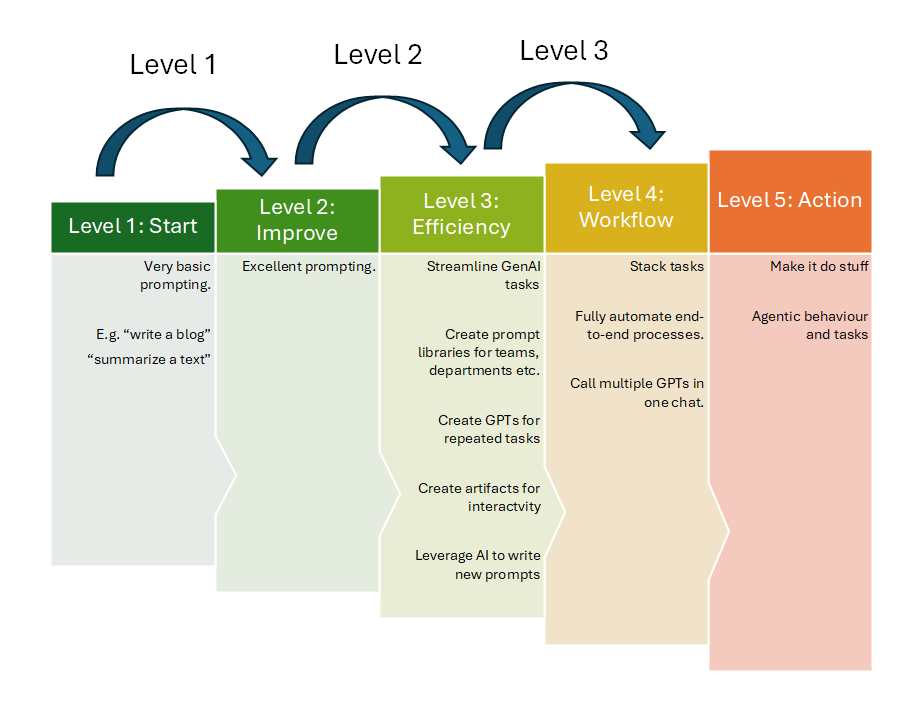
This AI Literacy series gives you the tools to unlock real value from Generative AI, moving from basic prompt crafting to full-scale automation. In the first session, which covers Levels 1 & 2, you’ll learn how to shape clear, effective prompts that get better results from AI, setting the stage for more advanced use cases. Then, you’ll create reusable prompts and automate everyday workflows to save time and boost team efficiency. In the second session, which covers Levels 3 & 4, you'll move beyond individual prompts into structured, repeatable ways of working with AI.

This course empowers you to streamline tasks, enhance productivity, and make Generative AI a part of your daily operations.


Session One - 2 October 2026

Levels 1 & 2

Generative AI (GenAI) Foundations and Basic Prompting

Content:

  • Introduction to GenAI: Overview of how GenAI works, with a focus on next-token prediction, scaling trends, and some of its emergent capabilities.
  • Few-shot Prompting: Learn the essentials of prompt formulation, including how to provide templates to the AI

Learning Outcomes:

  • Understand how GenAI uses next-word-prediction to build complex conversations.
  • Understand why models keep getting bigger and what this means for training data.
  • Write a few-shot prompt and know how to improve it.

Getting Better at Prompting

Content:

  • Prompt refinement: The first attempt is never great – we’ll look at how to make your first prompt better.
  • Multi-modal prompting: How to combine your prompts with images, screenshots and documents.
  • Meta-prompting: Even more outsourcing, this time getting the AI to write its own prompts.

Learning Outcome:

  • Try out advanced prompting techniques for different kinds of problems.

Common Use Cases and Practical Applications

Content:

  • Tutor and Peer Review: Prompts to learn new ideas and get feedback.
  • Identifying misinformation: Classify the four ways that GenAI output can be wrong and know how to spot them.
  • Text and Tone Modification: Experiment with prompts to adjust style, tone, and level of formality in text.
  • Document Query and Summarization: Practice using models like NotebookLM for querying long documents and generating summaries.

Learning Outcomes:

  • Build a workflow prompt that can replicate complex organisational tasks.
  • Use GenAI to augment your own learning in information-rich environments.
  • Understand and engage in text modification while checking underlying messages haven’t been changed.
  • Effectively look for mistakes in GenAI output.
  • Build a simple GenAI computer program to automate simple tasks for you.
  • How to start thinking about GenAI and organisational responsibility.

To get the most out of this session, participants should have access to either ChatGPT or Claude before attending.

If you do not already have an account, please create one prior to the session. A free account is sufficient for participation in session one.

You can sign up here:

Please ensure you can log in successfully on the device you plan to use during the session.

Session Two - 16 October 2026

Prerequisite

Completion of Levels 1 & 2 or equivalent foundational AI knowledge.

Participant Requirement

Participants are encouraged to bring a real workplace challenge, project, or workflow they would like to explore throughout the day.

Overview

Levels 3 and 4 are designed for people who have already developed confidence with AI tools and are ready to move beyond individual prompts into structured, repeatable ways of working with AI.

Using real business scenarios, practical exercises, and hands-on experience, participants will explore how AI can support their day-to-day work, improve workflows, and create greater value across teams and organisations.

The course focuses on principles and capabilities that can evolve alongside rapidly changing AI technologies and platforms.

Level 3: Efficiency

Level 3 focuses on helping participants build more capable and personalised AI working environments that can support ongoing tasks, projects, and decision-making.

Participants will explore how modern AI platforms can be organised, customised, and connected to better reflect the way they work.

Topics may include:

  • AI safety, governance, and responsible use
  • Personalising AI tools for individual and team needs
  • Working with Projects, Knowledge Bases, and Persistent Context
  • Using Skills, Custom Instructions, and reusable AI workflows
  • Connecting AI to relevant information sources and documents
  • Managing AI-supported research, planning, and content development
  • Evaluating outputs and maintaining human oversight
  • Applying these approaches to a real-world workplace use case

Outcome

Participants gain practical, hands-on experience creating a more structured and effective AI working environment that extends beyond individual prompts and conversations.

Level 4: Workflow and Scaling AI

Level 4 expands the focus from individual use to organisational opportunity.

Designed particularly for SMEs and organisations where people often perform multiple roles, this session explores how AI can support common business functions, improve workflows, and help identify areas where greater value can be created.

This is a survey-depth course covering six business functions: marketing, sales, finance, compliance, operations, and project delivery. Participants will explore how AI can support each area while identifying the opportunities most relevant to their own organisation.

Topics may include:

  • Mapping existing workflows and business processes
  • Identifying repetitive work, friction points, and bottlenecks
  • Improving information flow and decision support
  • Exploring AI applications across:
    • Marketing
    • Sales and customer engagement
    • Finance and administration
    • Compliance and risk management
    • Operations
    • Project delivery
  • Understanding what organisational readiness for AI adoption looks like
  • Identifying priority opportunities for future AI capability development

Outcome

Participants develop a clearer understanding of where AI can create value across their organisation and identify opportunities for further learning and implementation.

To get the most out of this session, participants should have access to either ChatGPT or Claude before attending.

If you do not already have an account, please create one prior to the session. A paid account will be required for participation in session two.

You can sign up here:

Please ensure you can log in successfully on the device you plan to use during the session.

Upcoming Course Dates

There are currently no scheduled sessions of this course for 2026/2027. Please explore the range of short courses available through UC Online here.

    Course Facilitators


    Dr David Dempsey

    Dr David Dempsey - is an Associate Professor at UC’s Department of Civil and Natural Resources Engineering. He delivers Generative AI training for the 800 undergraduates, PhD students, and staff within his department. His research uses Artificial Intelligence to provide advanced warning of volcanic eruptions, floods and wildfires. He has previously worked at Los Alamos National Laboratory, Stanford University, and the University of Auckland.

    David will lead session one.

    Elsamari Botha

    Elsamari Botha is an Associate Professor at the University of Canterbury, where she previously served as Director of the MBA and Executive Education Programmes. Her research and practice focus on AI governance, implementation, and responsible digital transformation, bridging technical systems with organisational strategy and human-centric change.

    She has co-authored several studies on AI adoption, including the AI Implementation Compass for managing socio-technical change in AI implementations, the CARE Framework for human-centric governance of generative AI, and the GenAI Prompt Protocol for human–AI knowledge co-construction. Her earlier work on the AI-enabled Retail Value Chain mapped one of the first conceptual frameworks for AI integration across value-chain activities.

    Beyond academia, Elsamari is a recognised voice in AI strategy and governance, is frequently invited to speak with boards and senior leaders on the responsible adoption of AI, and has been recognised by LinkedIn as a Top Voice in both Higher Education and Consulting. With a PhD in Industrial Economics and Management from KTH Royal Institute of Technology (Stockholm), Elsamari combines 15 years of consulting experience with academic leadership.

    Elsamari will lead session two.

    If you have any questions about our Executive Education & Professional Development Programme

    Privacy Preferences

    By clicking "Accept All Cookies", you agree to the storing of cookies on your device to enhance site navigation, analyse site usage, and assist in our marketing efforts.