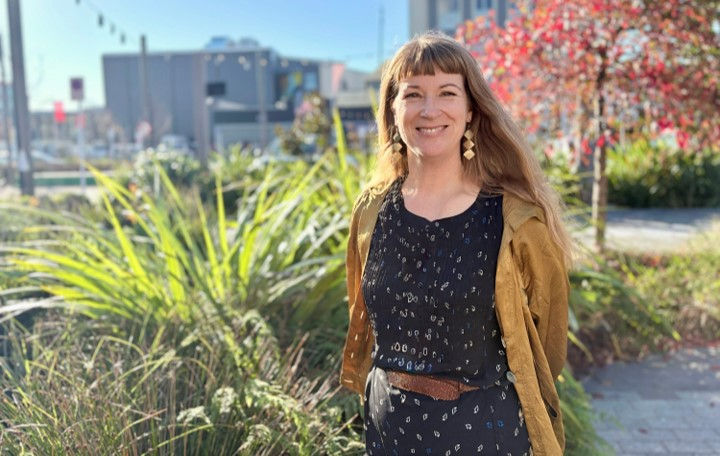


Julieanne has spent her career creating immersive worlds, from experiential theatre and digital installations in Europe, to game production and large-scale public art projects and game production here in Ōtautahi Christchurch. Her creative journey has been driven by curiosity, collaboration and saying yes to new experiences.
What drew you to pursue both a BFA and BA at UC, and what made it the right fit for you?
UC enabled me to be in a drum and bass gig at 2am doing theatre studies, and then in the film studio arguing about Tarkovsky by 9am. I desperately wanted to study both theatre and Fine Arts without being a student for a whole decade, and UC was one of the few places where that was possible and achievable to do alongside each other, within 4 years.
Looking back, what moments or experiences from your time at UC have stayed with you?
In Fine Arts I majored in film. My lecturers at the time, Bill de Friez and Sean Kerr, were very social and encouraged all us students to go to events and get involved with anything to do with film & arts in Christchurch. Once a year Bill would book one of the university's camps somewhere in the South Island for us, and everyone studying film at that time would go there for the weekend. Bill would bring a huge bag of second-hand clothing from Toffs. On the Saturday afternoon we'd open up the bag, and everyone would fossick around for their costume. That evening we'd come dressed in character to dinner at a huge banquet table. They were always the craziest and most fun nights.Once we had a power blackout and had to scurry around finding candles to see our pasta.
From second year I also studied physical theatre, which included a big focus on physical exercise and resilience. This was around the same time there was a scene of excellent drum and bass going off in Christchurch. I used to sleep in the late afternoon, and wake up in time to go dance to a DJ at one of the local clubs. I'd literally just go by myself, and go hard for a few hours for immersive exercise experiences.
At that time the Theatre degree was based at the Free Theatre in the Arts Centre (where the Lumière currently is). It was very inspiring and magical to be based in those buildings. I was also holding down about 3 parttime jobs, one of which was working part-time at the Academy Cinema in the Arts Centre, so I would often be running across the Arts Centre’s North Quad from rehearsals at the Free Theatre to go sell tickets to the Friday night screening of Trainspotting. Hearing the first beats of "Lust for Life" by Iggy Pop immediately takes me back to the rush of that ticket counter, and the smell of popcorn. Very apt.
During my four-year degree I experienced a shift in technology, from shooting in 16mm film to SVHS editing and then to digital editing. The only way you could edit your digital films was in one of two Final Cut Pro editing suites on campus. Getting any kind of visual effect rendered would take at least an hour. It was excruciating. The suites were booked around the clock, especially in the lead-up to submission, so there were more than a few all-nighters, and there was always someone sleeping on the couch in the common room between bookings. The worst was getting the night in November when the clocks go back for Day Light savings, losing a precious hour of editing time.
It was also where I first learnt about the internet. We had a tutorial session in the Design Lab on how to set up our email accounts. We had no idea what they really were or would mean for us in the future, so mine was sataybeancurd@yahoo.com. (One of my many part-time jobs was working at a Chinese restaurant at the time, and I was pretty much living off the leftover food I was allowed to take home at the end of a shift. Sataybeancurd was my lifesaver.)
We Arts students were all extremely poor, quite competitive, and very social, so we were always going to gallery openings, which gave us not only art but also beer. There were three prominent galleries besides the university gallery: High Street, the Physics Room, and Jonathan Smart. It was a great night when all the galleries had an opening on the same evening. We'd all be on bikes stumbling from one to the other, drinking beer and creating drama, trying to get invited to the older students' house parties. We all lived in very old, characterful wooden houses in the central city back then, most of which either came down in the earthquakes or are now boutique hotels. Although freezing, they were so dilapidated that it meant we could paint the walls, put posters everywhere, live radically by our own rules, and make our own spaces. We were creative full-time and our learning and experimenting never stopped outside of uni hours. We had heaps of in-house film screenings, film recordings, banquets, limbo competitions, and many parties with fires in the backyard, often fuelled by old pianos.
How has your career journey unfolded since graduating?
Straight after graduating I became a founding member of a theatre company called The Clinic. We were a group of friends who had all studied together and wanted to make immersive, multidisciplinary theatre. In the initial shows I was acting, but soon found my ideal place in creating the world of the performance through animation, video mapping, scenography, lighting. We all had part-time jobs but theatre was our passion, and we dedicated all our waking moments to making many different shows that we performed in galleries, theatres and random locations all over New Zealand.
I received a DAAD scholarship to complete my master's degree in Germany. I was accepted at the Universität der Künste (UDK) in Berlin, where I studied interactive media for a year with some amazing resident artists and professors, including Pipilotti Rist and Stefan Sagmeister. Once the scholarship finished I moved to Barcelona with my partner at the time. There I found work in video editing, but more exciting was being in the midst of some extraordinary theatre and creative moments, such as Teatro de los Sentidos, my friends who create wonderful sensorial labyrinthine theatre experiences, who had a permanent residency in a 1755 warehouse that Philip V had built after the War of the Spanish Succession to store gunpowder.
I was also making my own digital installations at festivals in Barcelona, and often travelling to cities across Europe to teach interactive documentary storytelling through the Amsterdam based Art Centre Mediamatic, a connection I had made through professors at UDK. My partner was a sculptor and needed more space for his creations, so bought an old 11th-century ruin in the countryside north of Barcelona to restore. Despite it initially being a ruin, completely offgrid and with no running water, it was incredibly gorgeous, and we moved there fulltime and turned our artistic focus to house restoration. We rebuilt the house in stone, and I wired our own electricity, in a beautiful land of fig trees, cork trees, and hazelnut groves, scorpions and wild pigs, old traditions, and creative, resilient, strong people.
During that time, with a residency in the nearby town of Girona and funding from Creative New Zealand I also directed my own theatre show. It was called Love You Approximately, a Spanish / New Zealand co-production that was devised using webcams, online chats and texting to produce a ‘real-time’ romantic comedy about a New Zealand woman and a Catalan man, that fused classic themes with the complex tools of current communication. It toured both Spain and New Zealand and had one live actor in each country, the other’s performance fully recorded and projected on stage.
After about four years of living in the countryside my marriage broke up, and heartbroken and extremely forlorn, I moved back into Barcelona city. I was a complete wreck but gradually ramped into another extraordinary chapter - got a fantastic job in the photography industry as a digital project manager, travelling all over the world managing incredible photo libraries, from National Geographic to Scandinavian architecture to English food photography. Barcelona was a treasure trove of fun, so passionate and radical, with arts and events and beautiful things popping up on any street corner. I had a very tight and wonderful group of friends. I can't ever remember sleeping, we were so busy being gloriously awake, going to every DJ, show, gallery, festival - Sonar, Primavera Sound, and OFFF amidst dozens.
In 2014 an old friend from Christchurch crashed at my apartment while he was in town for a conference. And then life took another turn - somewhere that summer weekend, between an outdoor dance performance at the roman ampitheatre and a workshop on digital fabrication, we completely fell in love. And then Carl returned to Christchurch. We had a long-distance relationship for about two years while I unpicked myself from my life in Europe and got ready to move back to New Zealand, the place I never thought I would return to. It was so crazy; I was acting out my own script in that my theatre show came true, except I was the one in Barcelona and he was in Christchurch. It was hard coming back to a city still repairing itself from the earthquakes, but it wasn’t hard to step into love. We moved to Lyttelton Harbour and I got a job in digital production, doing project management for digital projects like websites and apps, which eventually led to my current role working in games and immersive experiences. Carl and I also started to create art installations together under the name Shades Arcade, our art duo which is fast becoming a trio, with our seven-year-old son now starting to add his own creative voice to our projects.
Do you have a favourite artwork or installation you've created?
The Pompoms, which is one of the first larger scale pieces ShadesArcade made. It is a kinetic art installation, with eleven enormous pompom-like shapes hanging in the space, which would swirl in a sequence, and I just love the twirling, rich red dance of it. It was installed as both an Enliven Places project and at Coca Gallery.
Can you tell us about your role with CerebralFix? What could a typical day look like?
At CerebralFix we work on a huge variety of games, from local projects such as the creation of Luge racing simulators for Skyline in Queenstown, to working companies such as Disney or Nintendo, as well as producing our own original video games. I started out as a Digital Producer, where I'd be assigned to a team of any number of 2D and 3D artists, designers, engineers, and QA testers, and we'd all be working together to make a game or experience, or updates to an existing one. The digital producer's role is to ensure the team delivers on time, to budget, and on objectives, while making sure the team is supported and happy.
After a few years I became Production Manager. This involves supporting the Producers directly, while also keeping a check on our methodologies, tools, and resources to keep them current with our needs and industry standards. We all want to make sure our people have what they need, in terms of direction, processes, wellbeing and enjoyment, to contribute their best skills and talent to any project and keep our workplace enjoyable and wholesome.
A typical day at CerebralFix starts with a coffee and checking my calendar to see what's on. There'll be a bunch of hui, some with the producers I support, some with my leadership and management teams. There are a lot of messages on Slack, a lot of to-do lists, Post-it notes, creative idea sessions, many spreadsheets, reports, Jira tasks, impromptu wall sits to keep energy levels up, and quiz chats around the coffee pot. There’s also lots of game testing (fun!) and other seasonal shenanigans, including a few trips overseas to attend or speak at conferences.
Digital gaming studios barely existed when I was a student, and I spent years trying to find the right balance between my personal creative work and my day job, so I'm really grateful to have landed here, in a role that encompasses both. It really does feel like one of the best jobs in the world.
What do you love most about living and working in Ōtautahi Christchurch?
Most things are on hand as they would be in a large city, but with the added advantage of the countryside at our fingertips. It makes me really happy to bike or walk to school / work every day, grab an ice cream from our delicious local gelateria on the way home, and eat it overlooking the ducks and kayaks on the Ōpāwaho river. It's the freedom of being able to get out to the sea or into the countryside easily, but then come back to a rich smorgasbord of theatre, arts, gigs, and cultural events.
CerebralFix is based at the Epic Centre next to Little High, and it’s fascinating to see the inner city landscape around us growing to become wonderfully textured and varied, so if I can make any meeting a ‘walk and talk meeting’ I do. If we have 30 minutes we often walk down the lanes to Margaret Mahy Playground, choose one thing to play on, then walk back.
What advice would you give to current students looking to build a creative career?
I used to say to myself, "you don't get famous lying on the beach." It's not really about being famous quite so much - it's about the fact that everyone in the world has thousands of good ideas, but an idea sitting in your head is worthless. It's the artists who actually get up, pursue it, persist with it, and make it happen who create change.
Say yes to everything, until you have to say no. Immerse yourself. Find your heroes and try to work for them, learn from them. Things will feel uncomfortable, but that's okay, comfort will come later once you have more experience and have found your groove. Don't beat yourself up about having a shitty job, being bored or frustrated, or feeling like you're chasing a hundred different directions at once for a while. Those are exactly the conditions where soft skills grow, and soft skills are what will carry you further than talent alone.
Keep being creative, and keep trying - your dream job might not even exist yet.

