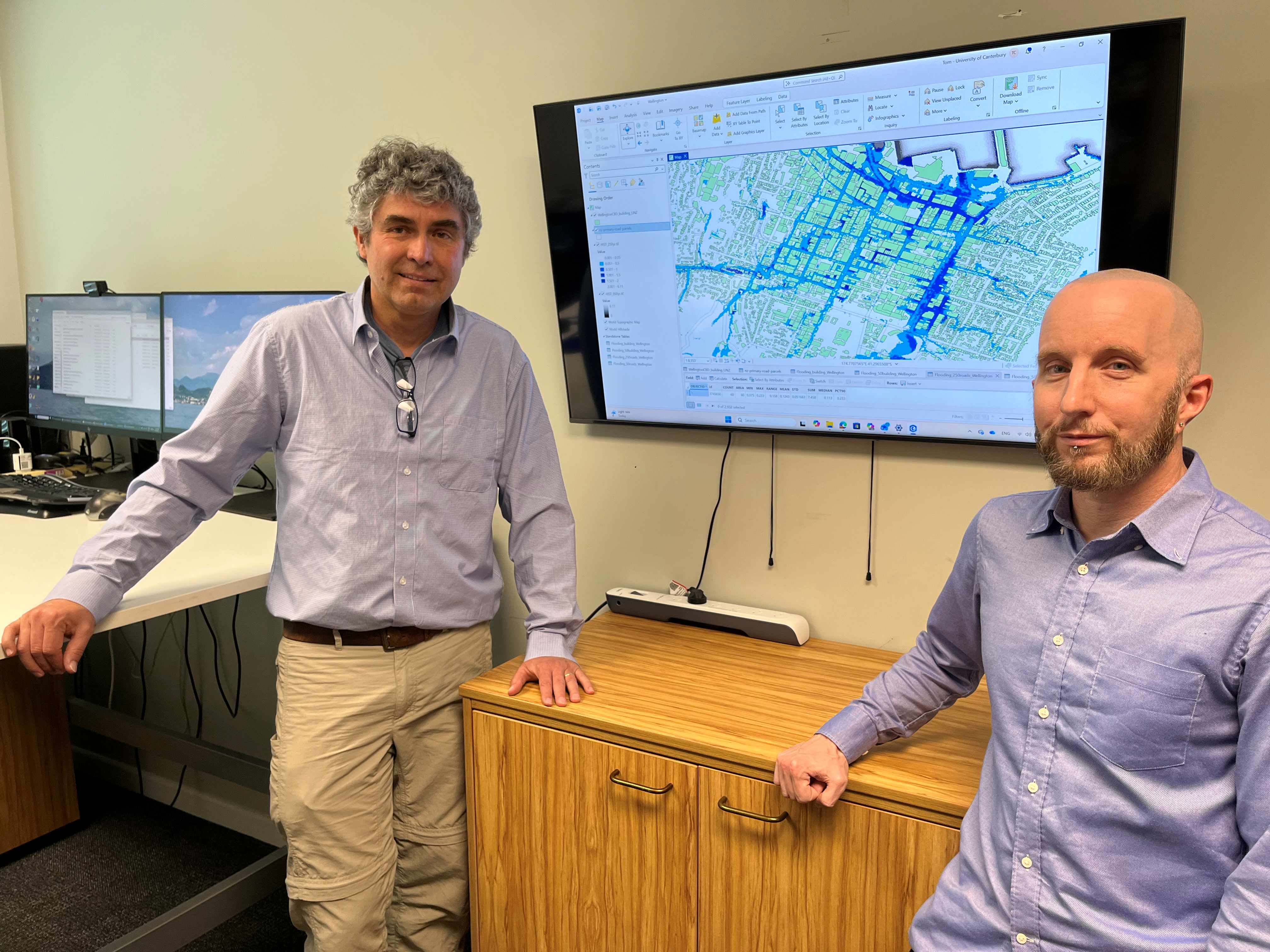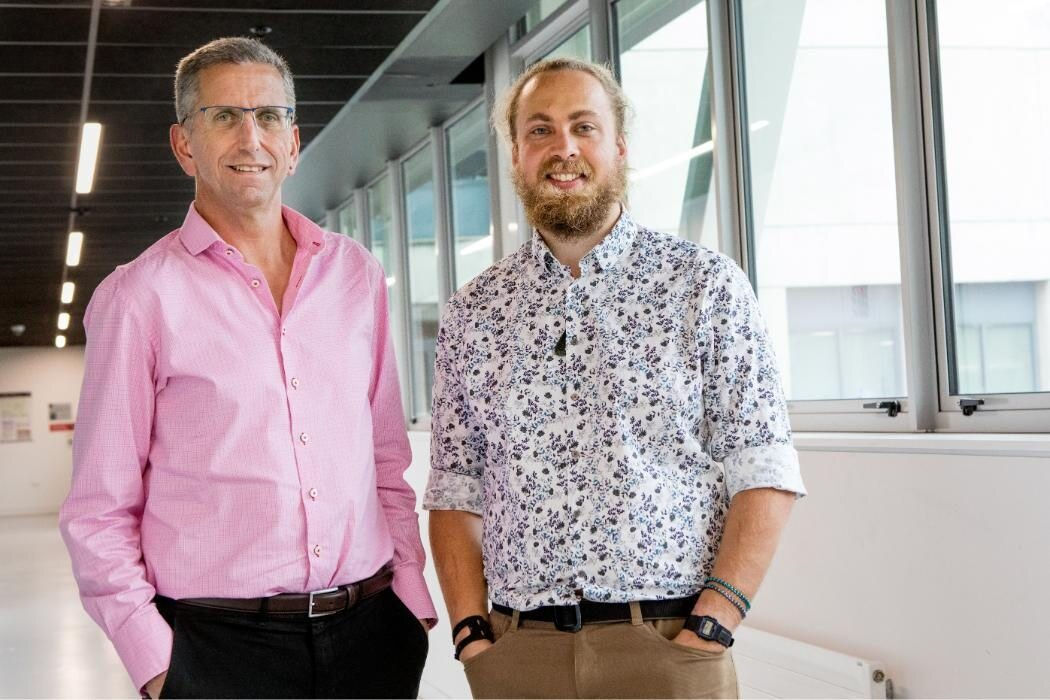


Photo caption: Distinguished Professor Geoff Chase (left) and Dr Lui Holder-Pearson (right) explore new technology to ease pressure on ICUs.
ICU spending accounts for around 1% of New Zealand’s Gross Domestic Product and approximately 10% of the country’s total healthcare expenditure. As demand for healthcare continues to outpace funding and resources, the pressure on ICUs is intensifying.
University of Canterbury (UC) | Te Whare Wānanga o Waitaha researchers Distinguished Professor Geoff Chase and Dr Lui Holder-Pearson aim to boost ICU productivity through digitally-led, personalised, and automated care, using world-leading Digital Twin (DT) and Digital Cockpit technologies.
“We are at a tipping point in being able to provide quality healthcare for everyone. What we do next will be key,” Distinguished Professor Chase says.
“Despite growing demand and abundant data from medical devices and systems, healthcare still lacks effective automation. Effective healthcare automation hinges on accurately predicting how patients will respond to treatment.”
Distinguished Professor Chase says the portion of healthcare costs not funded by the government, and instead borne by New Zealanders, grows by 4–5% annually.
His research team aims to tackle two major challenges to ICU efficiency: the lack of a central system to access and manage data from medical sensors and devices, and the absence of validated DT models that can predict how individual patients will respond to treatment.
“Our research programme will develop both the foundational automation platform – our Digital Cockpit – and state-of-the-art, clinically validated, natively integrated DT applications that, together, will unlock healthcare automation.”
Distinguished Professor Chase says Health DTs are a digital model of someone’s response to care. They use available data to guide care in real time and accurately predict how someone will respond to treatment to optimise outcomes. A Digital Cockpit will turn the paper sheets used at hospital bedsides into a digital format. This will allow automated use of approved medical devices that can easily work together.
Distinguished Professor Chase believes this research programme could put New Zealand at the forefront of the emerging MedTech industry and deliver significant economic benefits by reducing Health/ACC costs and improving patient outcomes.
This research is a collaboration with the UC Centre for Good Work, the Johner Institute, the Auckland Bioengineering Institute and Taiuru Associates.
 Sustainable Development Goal (SDG) 3 - Good health and wellbeing.
What to read next
UC celebrates its Manaaki New Zealand scholar
After completing their studies at the University of Canterbury, 15 Manaaki New Zealand scholars are preparing for the next chapter of their journeys.

NZ study reveals gaps in women's heart healthcare
A review of 25 years of New Zealand research has revealed significant gaps in women's heart healthcare, highlighting opportunities to improve diagnosis, treatment and outcomes.

History goes hi-tech at Awaroa Godley Head
The University of Canterbury's HIT Lab is helping Awaroa Godley Head visitors enjoy a more immersive experience of the World War II heritage site.

UC geography graduate honoured for global science leadership
UC alumnus Distinguished Professor Emeritus Iain Hay has received a prestigious international Fellowship recognising his contributions to geography and scientific collaboration.

Are Kiwi businesses jumping blindly on the AI bandwagon?
AI doesn’t have to play an inevitably dominant role in our lives, businesses and future, argues a guest speaker for an upcoming UC public lecture.

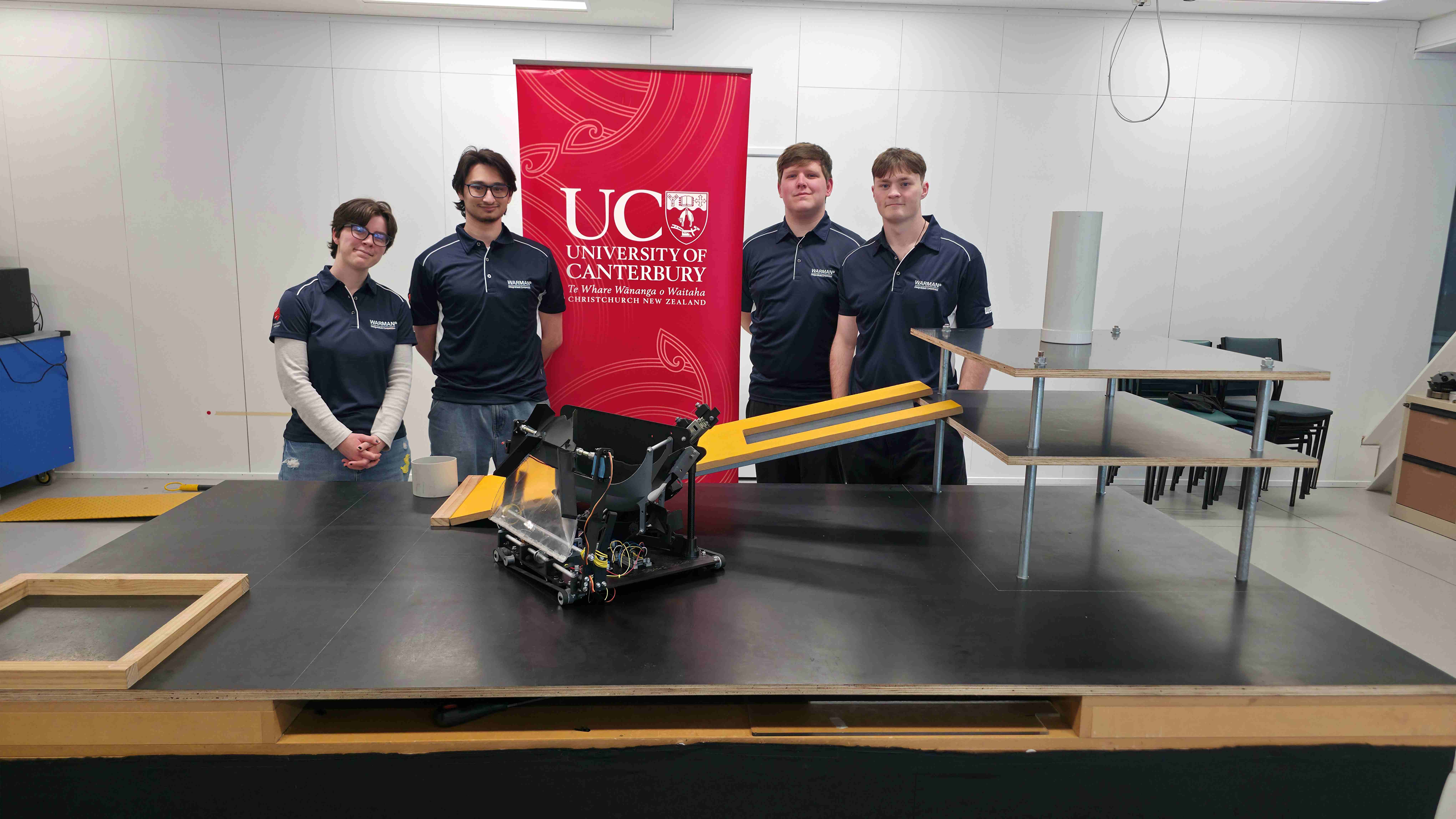
UC engineering students win international competition
A robot designed to transport rocks automatically has helped four UC engineering students claim an international title.
UC wins national award for employability service
UC has been recognised for excellence in helping students develop career-ready skills and connect with employers.

Fair suppliers strengthen business resilience
Businesses are better able to withstand disruption when suppliers make fair decisions and turn strong relationships into flexible action, UC research finds.
Digital models to help predict natural hazards in Kiwi capital
An innovative project using digital simulations to predict future hazards in New Zealand’s capital city takes its name from science fiction.