

About the Observatory
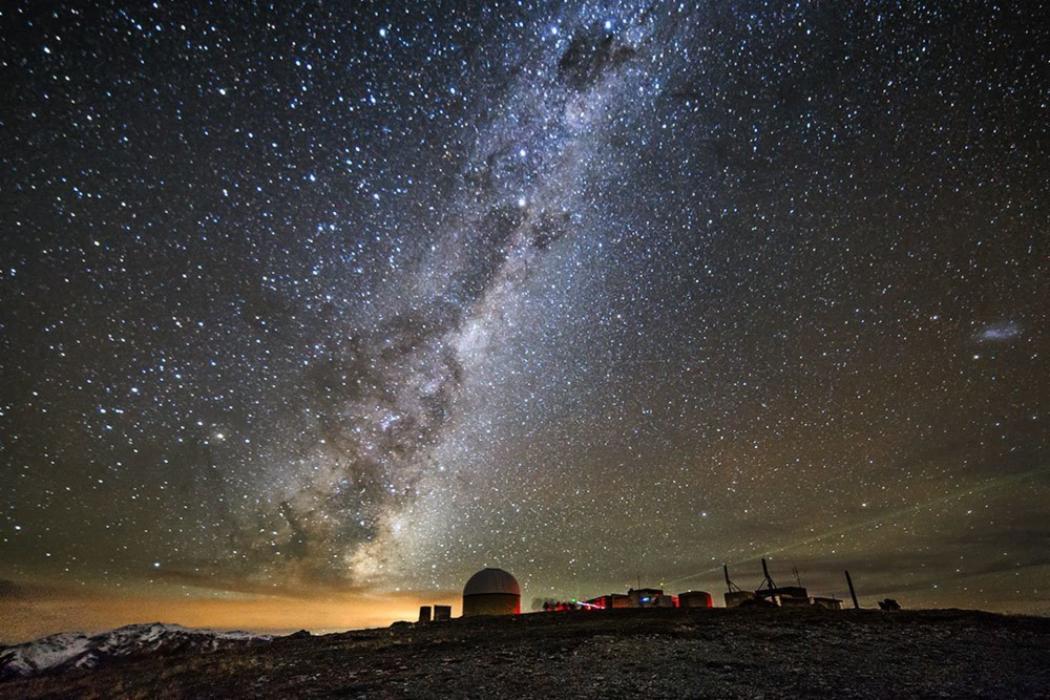
The Observatory at Mt John is part of the School of Physical and Chemical Sciences research facilities. It provides outstanding conditions for observations and discoveries of the southern sky.




Overview
Perched above Lake Takapō in the Te Manahuna Mackenzie Basin, Mt John Observatory is the University of Canterbury's premier astronomy field station and one of New Zealand's most important astronomical research sites.
Located within the internationally recognised Aoraki Mackenzie Dark Sky Reserve, the station combines world-class observing facilities with spectacular natural surroundings.
Since its official opening in 1965, Mt John has supported generations of students and researchers, contributing to major discoveries in astronomy, atmospheric science and environmental research.
Today it remains a hub for teaching, research, international collaboration and public engagement with science.
Mt John provides students with a rare opportunity to learn astronomy in a professional observatory environment.
Through residential field trips, students gain hands-on experience using research-grade telescopes, collecting and analysing data, and working alongside experienced researchers.
The observatory is central to courses such as ASTR211 Observational Astronomy, where students spend multiple nights conducting observing projects using the same facilities employed for active research.
The immersive environment helps students develop technical skills, scientific thinking, teamwork and problem-solving abilities that cannot be replicated in a classroom.
Mt John provides students with a rare opportunity to learn astronomy in a professional observatory environment.
Through residential field trips, students gain hands-on experience using research-grade telescopes, collecting and analysing data, and working alongside experienced researchers.
The observatory is central to courses such as ASTR211 Observational Astronomy, where students spend multiple nights conducting observing projects using the same facilities employed for active research.
The immersive environment helps students develop technical skills, scientific thinking, teamwork and problem-solving abilities that cannot be replicated in a classroom.
Mt John is nationally significant for astronomical and atmospheric research.
Its location in the Dark Sky Reserve provides exceptionally dark, stable skies, while its position in the Southern Hemisphere enables participation in global observing networks and international monitoring campaigns.
Research at the site spans stellar astronomy, exoplanets, comets, near-Earth objects, space science and atmospheric studies.
The observatory also provides access to the unique ecosystems of Te Manahuna/Mackenzie Basin, supporting environmental research alongside astronomy.
Mt John is nationally significant for astronomical and atmospheric research.
Its location in the Dark Sky Reserve provides exceptionally dark, stable skies, while its position in the Southern Hemisphere enables participation in global observing networks and international monitoring campaigns.
Research at the site spans stellar astronomy, exoplanets, comets, near-Earth objects, space science and atmospheric studies.
The observatory also provides access to the unique ecosystems of Te Manahuna/Mackenzie Basin, supporting environmental research alongside astronomy.
Mt John Observatory combines specialist scientific infrastructure with accommodation for researchers and teaching groups, up to 12 people.
The observatory's research facilities include four telescopes, a weather station, sky camera and high-speed data connectivity. These resources enable year-round observations and support both local and international research programmes.
Mt John Observatory combines specialist scientific infrastructure with accommodation for researchers and teaching groups, up to 12 people.
The observatory's research facilities include four telescopes, a weather station, sky camera and high-speed data connectivity. These resources enable year-round observations and support both local and international research programmes.
For decades, Mt John has generated valuable scientific datasets that support astronomy research around the world.
The observatory maintains long-running photometric and spectroscopic archives, alongside datasets associated with international observing collaborations.
These records provide an important foundation for understanding long-term changes in stars, planetary systems and other astronomical phenomena.
The continuity of observations from Mt John adds significant value to global research efforts that depend on long-term monitoring.
For decades, Mt John has generated valuable scientific datasets that support astronomy research around the world.
The observatory maintains long-running photometric and spectroscopic archives, alongside datasets associated with international observing collaborations.
These records provide an important foundation for understanding long-term changes in stars, planetary systems and other astronomical phenomena.
The continuity of observations from Mt John adds significant value to global research efforts that depend on long-term monitoring.
Mt John's Southern Hemisphere location makes it an important partner in international astronomy networks.
Researchers regularly contribute observations that help provide around-the-clock monitoring of astronomical events by linking with observatories in other parts of the world.
Current collaborations include studies of magnetic stars, exoplanets, comets, near-Earth asteroids and major international sky surveys.
The observatory also hosts research partnerships with institutions such as Osaka University through the MOA telescope programme.
Mt John's Southern Hemisphere location makes it an important partner in international astronomy networks.
Researchers regularly contribute observations that help provide around-the-clock monitoring of astronomical events by linking with observatories in other parts of the world.
Current collaborations include studies of magnetic stars, exoplanets, comets, near-Earth asteroids and major international sky surveys.
The observatory also hosts research partnerships with institutions such as Osaka University through the MOA telescope programme.
Mt John has long played an important role in science outreach and education.
The observatory supports the annual Elaine P. Snowden Astronomy School, a residential programme that introduces Year 13 students to university-level astronomy and physics.
Through philanthropic support, participation is provided at no cost to students.
The observatory team also shares astronomy with the wider community through public resources, educational activities and partnerships that promote the protection and appreciation of New Zealand's dark skies.
As a university research facility the Mount John Observatory is not open to the public, but is included in a number of UC outreach activities each year.
Mt John has long played an important role in science outreach and education.
The observatory supports the annual Elaine P. Snowden Astronomy School, a residential programme that introduces Year 13 students to university-level astronomy and physics.
Through philanthropic support, participation is provided at no cost to students.
The observatory team also shares astronomy with the wider community through public resources, educational activities and partnerships that promote the protection and appreciation of New Zealand's dark skies.
As a university research facility the Mount John Observatory is not open to the public, but is included in a number of UC outreach activities each year.
For more than 60 years, Mt John Observatory has helped position New Zealand at the forefront of Southern Hemisphere astronomy.
Continued support can help maintain critical infrastructure, enhance student learning opportunities and strengthen the observatory's contribution to international research.
Investment in Mt John supports not only scientific discovery, but also education, community engagement and the preservation of one of the world's most remarkable dark-sky environments.
For more than 60 years, Mt John Observatory has helped position New Zealand at the forefront of Southern Hemisphere astronomy.
Continued support can help maintain critical infrastructure, enhance student learning opportunities and strengthen the observatory's contribution to international research.
Investment in Mt John supports not only scientific discovery, but also education, community engagement and the preservation of one of the world's most remarkable dark-sky environments.
Contact the Field Facilities Centre
For any enquiries, please contact the Field Facilities Manager.

