

Conserving water on campus
The water we use
UC is connected to the Christchurch City Council’s mains water supply. As stated on the Environment Canterbury Regional Council website, Christchurch has a plentiful supply of fresh clean drinking water. Christchurch’s aquifers are replenished with 375 billion litres of water each year, most of which is not used and flows out to sea.
Water is used on campus for a wide range of purposes including for drinking water, in bathrooms, in many lab practices, to provide air cooling in most buildings, as a source of heat for ground source heat pumps, and to irrigate the campus grounds.
Since 2016, total site water-use data has been available, and year on year comparative analysis is undertaken, and is reported in the annual Sustainability Report.
Individual buildings at the Dovedale site are not yet metered. Dovedale site has only one water entry point, which is already metered.
What happens to the water we use?
All water used within buildings, except for air-cooling water, goes to sewer or trade-waste for treatment.
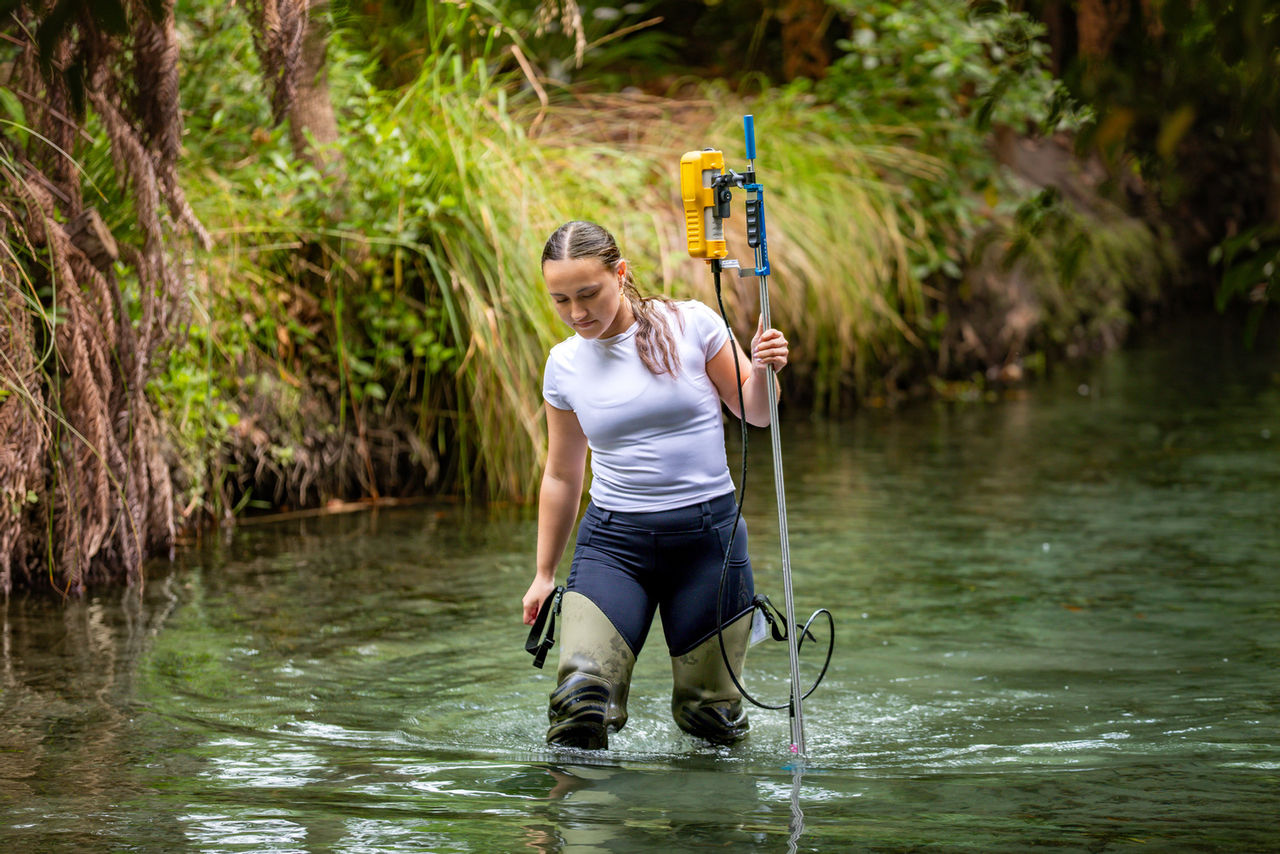
Water piped through buildings to cool the indoor air temperature is then discharged into waterways running through the campus: the Ōtākaro/Avon river and Waiutuutu/Okeover Stream. The air-coolant water is a few degrees warmer than natural spring water, but otherwise has high water quality, with no chemicals added to it. UC monitors the Waiutuutu/Okeover Stream, including water temperature and flow rate from air-cooling outflow pipes.
Water that goes into drains in carparks, roads, and building down-pipes flows straight into our campus waterways. Several student research projects from the Natural Resources Engineering programme have examined aspects of stormwater quality and volumes flowing into Okeover Stream as part of a waterways restoration project.
Wastewater
Strict environmental standards govern the discharge of wastewater from UC sites, managed in Christchurch and the wider Canterbury region by Environment Canterbury and the Christchurch City Council via resource consents.
UC’s wastewater is treated via the Christchurch City Council’s wastewater treatment systems. This is comprised of a network of 239 pump stations, all feeding to the treatment plant in Bromley. After proceeding through screens, grit removal and sedimentation tanks, the water is aerated in tanks and basins and then sent through clarifiers into six oxidation ponds which destroy harmful bacteria and viruses using natural processes. Finally, the water is discharged into Pegasus Bay three kilometres offshore via an ocean outfall pipe buried eight metres below the sea floor.
The Christchurch Wastewater Treatment Plant’s Environmental Statement ensures that the Christchurch community is provided with ‘a safe and healthy environment through the appropriate treatment and disposal of its wastewater’.
Water-conscious planting and management
UC has targets to increase canopy cover by planting more trees, particularly in areas of bare lawn. This canopy cover target will improve biodiversity and other ecosystem services, namely cooling, as well as reducing water loss and will assist with flood mitigation and water quality. UC is also using plant landscapes and management techniques to minimise water useage. Examples include:
- Mulching: UC's campus gardens are mulched to retain soil moisture and evaporation. Plants are selected by identifying dry and hot north facing borders, compared to cooler shady south facing borders. 70% of the mulch is produced on site from UC Campus green waste.
- Xeriscaping (eg. the use of drought-tolerant plants): Endemic locally sourced native planting have been selected which have evolved to survive in the area. This requires no annual or perennial plantings, with the exception of the wildflower meadow trials.
- Irrigation: Frequency of irrigation to lawns is reduced during summer by deep irrigation mythology to encourage deep root growth. Irrigation is automated to operate from 11.00pm to 7.00am to reduce evaporation, and soil moisture levels are monitored to ensure efficient use of UC's water resource.
- Grass cut height: Cut height is raised to develop an increase in grass root depth and reduce evaporation by shading the soil.
- Lawn clippings: Clippings are not collected to allow for reduced evaporation by holding moisture in the soil.
UC has a landscape master plan that includes a commitment to planting species for their ability to filter and cleanse water. Learn more about UC's canopy cover targets by reading UC's Biodiversity Plan here.
What can you do to support water conservation?
UC is using building water monitoring to identify opportunities to reduce water consumption. You can help reduce water use and keep our waterways clean by:
- Notifying Facilities Management (extn. 6400) if you notice a water leak on campus.
- Being mindful of water use in any lab activities.
- Ensuring that if you are working or playing outside, that you tip any contaminated water into a sewer drain (i.e. take it to an indoor sink, or to one of the few designated wash-down drains outside). Only rainwater should flow into the "stormwater" drains in roads, carparks, and building down-pipes.
Refill your water bottle
Bottle fillers are available on drinking fountains at the following locations:
- Central library (James Hight building), by the lifts on all levels
- Engineering Core (outside E6)
- Rutherford building (Chemistry/Physics), by the lifts on all levels except the ground floor
- Science Library, by the main entrance
- Kotuku building, in entrance foyer
- Education library (Henry Field building), outside the NZ Room and Level 2 outside the toilet block
- Recreation Centre
- Wheki building, in all main corridors
- Haere-roa
- Beatrice Tinsley Bike Park (outdoor)
Download the Sustainability Pocket Map to see the most up-to-date location of campus drinking fountains.
Restoring our waterways
The UC campus waterways project aims to restore the ecology and diversity of the three waterways flowing through University of Canterbury's Ilam campus – the Ōtākaro/Avon, Waiutuutu/Okeover and Kā Waimaero/Ilam streams - for all to enjoy. A range of collaborative restoration projects have involved University of Canterbury general and academic staff, students, Christchurch City Council, and Environment Canterbury.
Background
The Ōtākaro/Avon, Waiutuutu/Okeover and Kā Waimaero/Ilam streams all flow through the University of Canterbury. Together, they represent a sub-catchment within the Christchurch city and are distinctive landscape features of the university campus.
Why the need for rehabilitation?
Up until the 1990s, drainage by European settlers of what was predominantly wetland and the increasing development of Christchurch had degraded waterways in the city, including the three waterways flowing through the University. With increasing urban development and creation of impermeable surfaces such as roads and houses, many of the natural groundwater springs have dried up. Meanwhile stream flows have been supplemented by artificial inputs, for example, car park runoff and building discharges which have inherently poorer water quality. Grassy lawns and exotic deciduous trees had replaced native forest and wetland vegetation alongside the campus streams, while building developments and the traditional maintenance practices of mowing lawn to the edges of stream banks and clearing aquatic vegetation from the streambeds have resulted in extensive in-stream siltation. The combined effect of all the above factors has been a loss of aquatic and riparian habitat, a decline in plant and animal species diversity, and an overall loss of intrinsic natural character.
Restoration initiatives have taken place on both the Ōtākaro/Avon and Waiutuutu/Okeover streams. These projects have also had a spectrum of social goals, including raising awareness and appreciation within the University and the local community of the campus streams; enhancing people’s understanding of the streams’ physical processes, species, communities, and ecosystem functioning; and increasing participation in developing the vision for the waterways.
The UC Waterways project 1997-2001
In 1996, a student initiative led to collaborative waterways project involving academic and general staff of the university, students from the campus environment club, and the Christchurch City Council. The project aimed initially to revegetate the banks of the Ōtākaro/Avon streams to attract native birds and provide a 'green corridor' linking areas of native bush in the vicinity. However, as the project developed, its aims broadened to the current overall goal of restoring the ecology and diversity of all three waterways for all to enjoy. Since then, much of the restoration focus has been on the Waiutuutu/Okeover stream.
UC Waterways and Campus Master Plan (2015)
The UC Campus Master Plan (2015) presents a significant opportunity to re-visit the restoration of waterways on UC campus. The Sustainability Office has developed a Waterways - Issues and Options document which is intended to inform the campus master plan.
- It provides background information about the history of the three waterways flowing through the University of Canterbury campus.
- Examines some key issues and risks associated with these waterways within a wider contemporary context, including Ngāi Tahu/ Te Ngāi Tūāhuriri perspectives.
- Identifies significant potential opportunities for UC, which includes improving the ecological health of the waterways and how doing so could contribute positively to a wider Christchurch and Canterbury context.
- Outlines past interventions undertaken on the waterways and a series of proposed interventions yet to be considered or completed.
This work has informed the UC Watershed and Waterways Plan 2017-2023, a document designed to support the UC Campus Masterplan with respect to its goals related to UC Waterways.
UC Waterways stakeholders
A wide range of stakeholders have an interest in UC waterways. These include:
- Te Ngāi Tūāhuriri as mana whenua.
- UC Sustainability Office (Facilities Services)
- UC Grounds (Facilities Services).
- Staff and students from the Freshwater Ecology Research Group (School of Biological Sciences) and the Hydrological and Ecological Engineering Group (Civil Engineering). UC staff and students play a crucial role, including guiding the scientific basis of the restoration, monitoring the waterways to document physical and ecological changes following rehabilitation efforts, and integrating campus waterways issues into relevant courses and research.
- UC Waterways Action Group.
- Christchurch City Council.
- Environment Canterbury.
The UC Waterways Action Group
Membership of the UC Waterways Action Group (2021) consists of:
| Name | Department |
| Ed Challies | Waterways Centre for Freshwater Research |
| Dr. Frances Charters | Civil and Natural Resources Engineering |
| Darryl Cone | Grounds Supervisor |
| Grant Craig | Health and Safety |
| Prof. Angus McIntosh | School of Biological Sciences |
| Prof. Tom Cochrane | Civil and Natural Resources Engineering |
| Prof. Aisling O'Sullivan | Civil and Natural Resources Engineering |
The Waterways Centre for Freshwater Management is a teaching and research centre based at both University of Canterbury and Lincoln University. Learn more here.

